Somewhere in the deep Atlantic, a submarine captain gives an order that sounds almost too simple: dive. There is no drama in the control room, no lurching, no alarm. The boat gets heavier — not by taking on cargo, but by taking on the ocean itself. Seawater floods into tanks along the hull, the vessel slips below the surface, and minutes later it is gone. When the order comes to surface, the reverse happens: high-pressure air blows the water out, and the boat rises like a cork.
The tanks that make this possible are the ballast tanks, the submarine’s oldest and most important system. Everything else on board — the reactor or the batteries, the sonar, the torpedoes — exists to do a job once the boat is underwater. The ballast tanks are what get it there and bring it home. The numbers that describe its ballast tanks describe the submarine itself: how much water the tanks hold, how fast they can flood and blow, and how deep the boat can go. Here is what they mean.
How It Works
Step 1: Two hulls, and the space between them
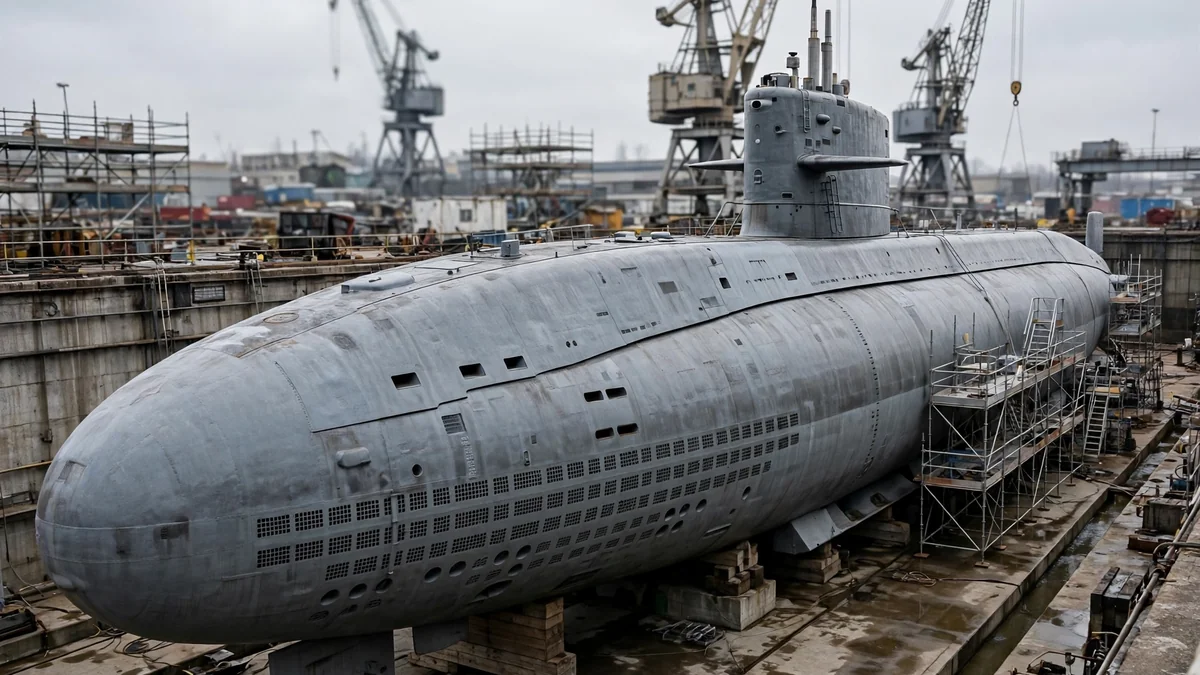
Most large submarines are built with two hulls: a strong inner pressure hull, a thick steel cylinder that holds the crew, and a lighter outer hull that gives the boat its streamlined shape. The ballast tanks live in the space between the two. The main ballast tanks are big compartments wrapped around the pressure hull, open to the sea at the bottom through flood ports and closed at the top by vent valves. When the vents open, the air escapes, seawater rushes in from below, and the boat gets heavy. That arrangement is part of how submarine ballast tanks work.
Step 2: Flooding to dive
To dive, the crew opens the vent valves on top of the main ballast tanks. The air inside escapes with a loud rush, seawater floods in through the ports at the bottom, and the submarine’s buoyancy falls. On the surface the boat is positively buoyant, with about ten to fifteen percent of its volume above the waterline, and flooding the main tanks takes that reserve away. The boat becomes just slightly heavier than the water, and the diving planes drive it down at a gentle angle. A crash dive can take a modern boat from the surface to periscope depth in well under a minute. The speed of the dive is set by how big the vents are and how fast the water can get in.
Step 3: Blowing to surface
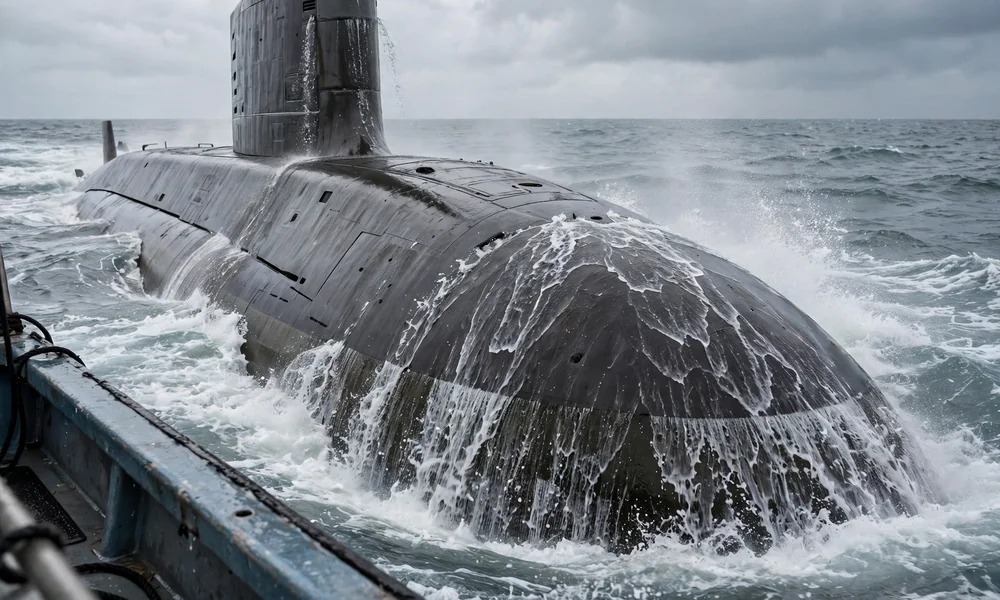
Surfacing is the reverse, and the more violent half of the cycle. High-pressure air, stored in steel flasks at around 200 to 300 bar, is blasted into the main ballast tanks, forcing the seawater out through the flood ports. The boat gets light again and rises — an emergency blow can send a submarine bursting out of the water like a whale, which is exactly the point in an emergency. Without high-pressure air there is no surfacing, so the compressors that refill the flasks run constantly. The steelwork around the tanks is covered in inside submarine ballast tanks production.
Step 4: Trim and the fine adjustment
The main ballast tanks are blunt instruments: full of air on the surface, full of water submerged. Fine control comes from the trim and compensation system, smaller tanks inside the pressure hull that can be pumped between to adjust the boat’s weight and balance by kilograms at a time. As a submarine dives deeper the seawater gets denser and the hull compresses slightly, changing buoyancy; firing a torpedo or taking on stores changes its weight too. The trim system compensates, pumping water fore and aft to keep the boat level and neutrally buoyant, neither rising nor sinking, so it can hover at a chosen depth with the engines barely turning.
Step 5: Depth control and the crush limit
Every metre of depth adds about a tenth of a bar of pressure, so at 300 metres the sea presses on the hull with about 30 bar — thirty times atmospheric pressure. The ballast tanks, open to the sea at the bottom, sit at the same pressure as the water outside, so the high-pressure air has to beat that pressure to blow them. That is why the air flasks are charged to 200 to 300 bar: they need a large margin over the pressure at the boat’s maximum depth. The test depth, the deepest a boat may go in normal operations, is set by the strength of the pressure hull, not the ballast system, but the ballast system has to work at that depth. The materials that make the pressure hull possible are discussed in submarine ballast tanks materials engineering.
Step 6: Safety, redundancy, and the emergency blow
Because the ballast system is the way home, it is built with layers of redundancy. Vent valves can be opened by hand if the hydraulics fail. The emergency blow system can dump air into all the main tanks at once from a single control. Some boats carry a separate emergency air supply that cannot be used for anything else. The crew drills the emergency blow again and again, because the one time it matters there is no time to think.

Submarine Ballast Tanks Specs
| Specification | Typical range |
|---|---|
| Main ballast capacity | About 10 to 15 percent of the submarine’s submerged displacement |
| High-pressure air | About 200 to 300 bar in storage flasks |
| Vent valve size | About 300 to 600 mm diameter on large boats |
| Dive time to periscope depth | Under a minute in a crash dive, a few minutes normally |
| Test depth | About 200 to 500 metres depending on class |
| Pressure at test depth | About 20 to 50 bar |
| Trim system | Small internal tanks, adjustable by kilograms |
| Tank structure | Free-flooding compartments between inner and outer hulls |
What Do Submarine Ballast Tanks Cost?
Ballast tanks are not sold as a separate product, so there is no catalogue price; their cost is buried inside the price of the submarine itself. A modern diesel-electric attack submarine is estimated to cost roughly $300 million to $600 million, while a large nuclear attack submarine is estimated to cost roughly $2 billion to $4 billion, and a ballistic missile submarine is estimated to cost $4 billion to $8 billion or more.
A Rare Fact
The first practical ballast tanks were not tanks at all. Early submarines in the 19th century dived by taking water into open compartments and surfaced by pumping it out with hand pumps, a slow and dangerous business that killed more than one crew. The breakthrough came with compressed air: the American inventor Simon Lake, building submarines in the 1890s, fitted high-pressure air flasks and used them to blow the tanks, the same principle used today. Lake also pioneered the double hull, giving the ballast tanks a home between the hulls.
Next time you see a submarine slip beneath the waves, remember that nothing about it has changed weight at all. It has simply traded air for seawater, kilogram for kilogram, and let the ocean do the rest. Without them there is no submarine — just a very expensive boat that floats.