Tap the screen, and the picture snaps into focus before you have finished blinking. The thing that does it is smaller than a grain of rice, lighter than a paperclip, and it moves a lens with the precision of a watchmaker — thousands of times a day, for years, without ever wearing out. It is the camera autofocus motor, and it is one of the smallest precision machines ever mass-produced.
Inside every phone camera, mirrorless camera, and drone camera sits a tiny motor that slides a lens back and forth by fractions of a millimetre. It has to be fast, quiet, and accurate enough to land the sharpest point of the image exactly on the sensor. Building millions of them, all identical, takes a factory that works at a scale where a speck of dust is a boulder. Here is how a camera autofocus motor is made.

How It’s Made
Step 1: Designing a motor the size of a grain of rice
The design starts with the lens it has to move. Engineers calculate how heavy the lens is, how far it must travel, and how fast it must get there, and then they choose the motor type: most phone cameras use a voice coil motor, a coil of wire that slides inside a magnetic field, while larger cameras often use ultrasonic motors that vibrate a ring to turn a gear. The whole motor must fit in a space a few millimetres across, so every part is designed to do two jobs at once — the frame is also the magnetic shield, the spring is also the guide. Prototypes are tested for speed, noise, and power use before production is approved.
Step 2: Winding the coils
The coil is the motor’s muscle. Copper wire thinner than a human hair is wound onto a tiny former by a machine that counts every turn, because one turn too many changes the force the motor can make. The winding is done in a clean room, and the wire is coated with a thin layer of insulation that must survive the heat of soldering. For ultrasonic motors, piezoelectric ceramic elements are cut and polished instead. Each coil is checked for resistance and short circuits, and any coil that fails is scrapped — at this size, there is no repairing a bad winding.
Step 3: Making the magnets and springs
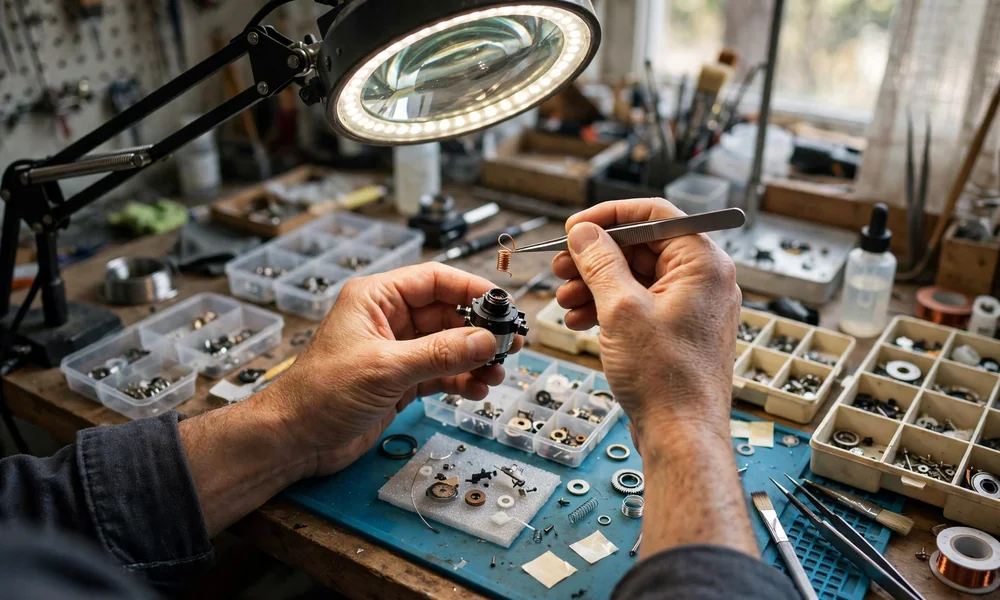
The magnets that push the coil are cut from neodymium, the strongest permanent magnet material available, and magnetised in a powerful field. They are tiny — a few millimetres across — and they are handled with tweezers and jigs, because they snap together with surprising force. The springs that hold the lens carrier are stamped from thin spring steel and shaped to flex smoothly in one direction and resist movement in every other. This is the same world of miniature precision that the camera’s sensor lives in, as cinema camera sensor materials engineering explains, and the parts are made to tolerances that would be invisible to the naked eye.
Step 4: Assembling the motor
Assembly happens under microscopes, on benches where workers use tweezers, vacuum pens, and tiny jigs. The coil is fitted into the frame, the magnets are glued in place, the lens carrier is mounted on its springs, and the whole assembly is closed up. Some factories use robots for this work, because a robot never gets tired and never drops a part; others still rely on skilled hands, because a human can feel when a tiny part is seated correctly. The assembled motor is about the size of a fingernail, and it is handled in trays of hundreds.
Step 5: Testing every motor
Every motor is tested, not just a sample. A test rig drives the motor through its full travel and measures how far it moves, how fast it gets there, and how much current it draws. Motors that are slow, noisy, or draw too much power are rejected. The best factories test each motor in a fraction of a second, and the test data is used to sort motors into grades — the fastest and quietest go into flagship cameras, the rest into cheaper models. The test rigs are calibrated daily.
Step 6: Fitting the motor to the lens
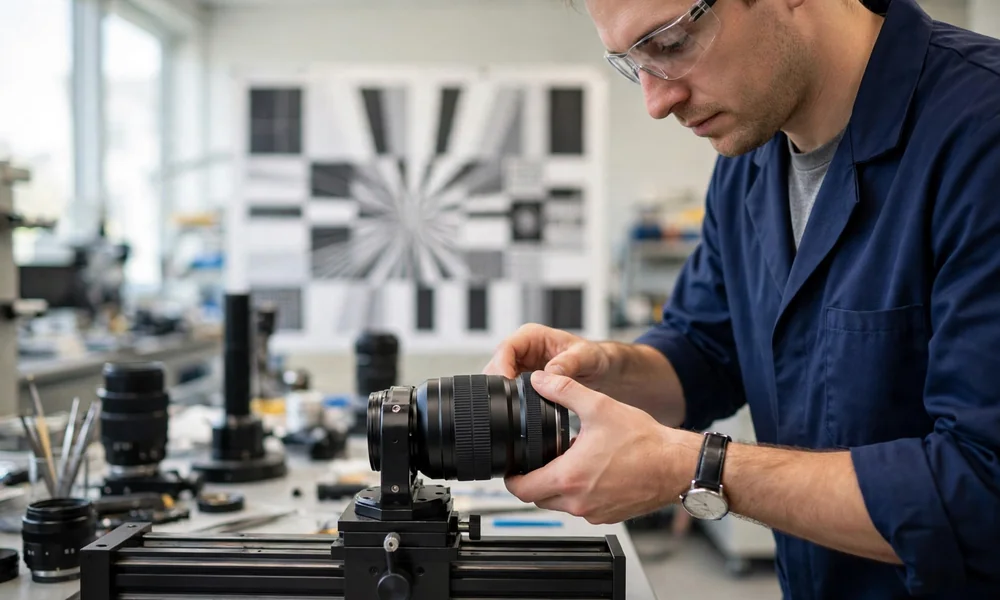
The finished motor is fitted into a lens module, where it is glued or screwed to the lens barrel and connected to the camera’s electronics with a flexible circuit. The whole module is then tested again as a unit: a camera is pointed at a test chart, and the autofocus is run through its paces to check that it locks on quickly and accurately. Passing modules are packed in trays and shipped to camera factories. The motor’s precision matters far beyond cameras, too — the same tiny-motor skills keep a drone’s camera steady in the air, as drone gimbal materials engineering shows. A motor that fails here is not repaired; at this size and price, it is replaced.
Specs
| Specification | Typical figure |
|---|---|
| Motor type | Voice coil motor in most phones |
| Size | About 8–10 millimetres across |
| Weight | Less than one gram |
| Lens travel | About 0.3–0.5 millimetres |
| Focus time | As little as 20–50 milliseconds |
| Coil wire | Copper wire thinner than a human hair |
| Testing | Every motor tested for speed and current |
| Production volume | Millions of units per factory per year |
Price
A camera autofocus motor is astonishingly cheap for what it does. A single voice coil motor for a phone camera is often estimated at well under one dollar — sometimes just a few cents in very high volumes — while a larger ultrasonic motor for a professional camera lens can cost tens of dollars as an estimate. Once the tooling is built, each motor is mostly a few milligrams of copper, a tiny magnet, and a stamped spring. These are estimates, and the real price is negotiated in secret between component makers and camera brands. Even so, the motor is one of the cheapest parts of a camera, and one of the hardest to live without.
A Rare Fact
The autofocus motor in your phone is a descendant of a technology first used in the 1980s, when the first autofocus compact cameras used bulky motors and gears that whirred loudly enough to hear across a room. The breakthrough was the voice coil motor, borrowed from the world of hard disk drives, where a similar coil moves a read head across a spinning disk. Camera engineers shrank that idea down to the size of a grain of rice, and the result is a motor with almost no moving parts to wear out — just a coil floating in a magnetic field, pushed back and forth by springs.
The autofocus motor is the smallest machine most of us will ever own, and it works every time we take a picture. It proves that the most impressive engineering is often the kind you never see — and the full story of that tiny motor is in how a camera autofocus motor is made. The next time your camera snaps into focus in an instant, remember the hair-thin coil, the tiny magnet, and the motor smaller than a grain of rice that did it all without a sound.