Stand at the end of a pit lane on a race weekend and watch a hypercar come in after a flying lap. The brake discs behind the wheels are glowing a dull orange, cooling from a temperature that would melt aluminium, and the mechanics do not even look worried. They know those discs were not cast or stamped like ordinary parts. Each one spent weeks inside furnaces hotter than a volcano, was soaked in molten silicon, and was ground to shape with diamond tools before it ever met a wheel.
A carbon-ceramic brake disc is one of the most demanding parts ever fitted to a road car, and the factory that makes one looks less like a car plant than a ceramics workshop crossed with a laboratory. This is the production line that turns carbon fibre and resin into a brake that can stop a two-tonne car from 200 miles per hour, lap after lap.

How It’s Made
Step 1: Designing the disc for one car
Production begins long before any fibre is cut, with the engineers who will fit the disc to a single model of car. They start from the car’s weight, its top speed, the size of its wheels, and the hardest braking the car will ever be asked to do, then calculate how much energy the disc must absorb in a single stop and how fast it must shed that heat before the next corner. The friction ring, the part the pads grip, is designed separately from the aluminium centre bell that bolts to the hub, because the two parts expand at different rates when they get hot, and the joint between them must let the ring grow without warping.
Step 2: Mixing and moulding the carbon fibre
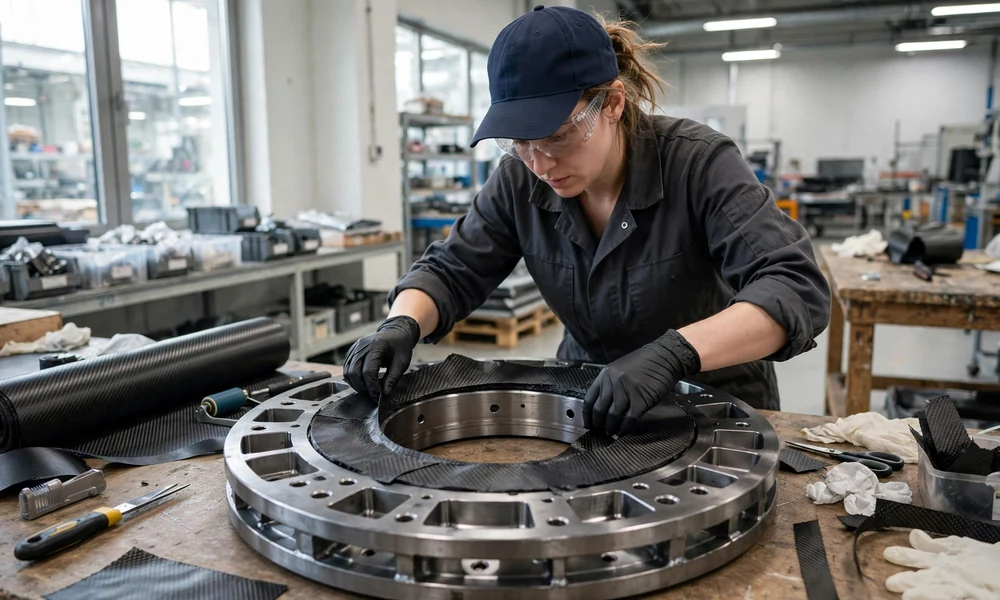
With the design fixed, the disc begins as chopped carbon fibres mixed with a phenolic resin, pressed into a ring-shaped mould under heat and pressure. Long carbon fibres are laid in layers around the ring as well, arranged so the disc is strong in every direction, because braking loads twist, bend, and squeeze it all at once. The mixture is pressed into a green body, a rough dark disc that is still soft enough to be machined, and workers check the fibre distribution by hand and by X-ray, since a thin patch or a clump of resin would become a weak spot when the disc is baked.
Step 3: Baking the disc in the furnace
The green body is placed in a furnace and heated slowly, over several days, to temperatures above 1,000 degrees Celsius in an atmosphere with no oxygen. As the heat rises, the resin turns to carbon in a process called carbonisation, and the disc shrinks and hardens as it does. This is the most delicate stage of the whole line: heating too fast cracks the disc, and any oxygen leaking into the furnace would burn the carbon away entirely. When the disc finally comes out, it is a carbon-carbon disc, strong and able to survive extreme heat, but still too soft and too porous to use as a brake.
Step 4: Soaking the disc in molten silicon
To turn the carbon disc into carbon ceramic, it is soaked in molten silicon at around 1,700 degrees Celsius inside a vacuum furnace. The liquid silicon seeps into the pores of the carbon and reacts with it to form silicon carbide, a ceramic almost as hard as diamond that can survive extreme heat without softening. The result is a disc far harder and more wear-resistant than carbon alone, one that keeps its friction steady even when it is glowing hot under braking. The full story of the material itself, from woven fibre to finished ceramic, is set out in how carbon-ceramic brakes are made, and the furnace stage is the reason the whole process takes weeks rather than hours.
Step 5: Machining, drilling, and fitting the bell
Once the disc has cooled, it is machined on a diamond-tipped lathe and grinder, because ordinary cutting tools cannot scratch silicon carbide. The friction faces are ground flat to within a few microns, and the ventilation holes and slots are drilled with diamond drills, giving the disc its familiar pattern of holes that clear gas and dust from between the pad and the disc. The centre bell, usually machined from a single billet of aluminium, is made separately and bolted to the ring with floating fasteners that let the ring expand when hot without warping the assembly.
Step 6: Balancing, testing, and packing
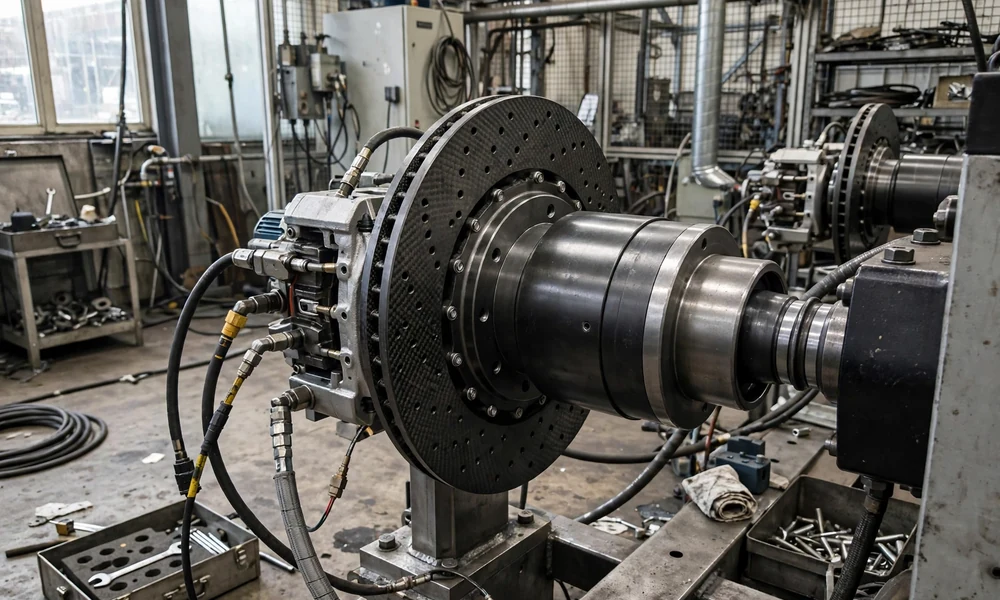
Every finished disc is balanced on a machine that spins it at high speed, and tiny amounts of material are removed until it runs true, because an unbalanced disc would shake the whole car under braking. It is then tested on a brake dynamometer, a rig that spins the disc and clamps it with pads over and over, measuring stopping power, temperature, and wear through hundreds of simulated stops. Engineers look for hot spots, cracks, and any sign of fading as the disc heats up, and only a disc that stops consistently from cold and from glowing hot is passed. There it will be fitted to a wheel that may never see a racetrack, yet must be ready for one.
Specs
| Specification | Typical figure |
|---|---|
| Disc material | Carbon fibre in silicon carbide ceramic |
| Front disc diameter | Roughly 380 to 420 millimetres |
| Disc thickness | Roughly 32 to 40 millimetres |
| Disc weight | About 6 to 8 kilograms each |
| Furnace temperature | Above 1,000 degrees, then about 1,700 degrees |
| Surface flatness | Ground to within a few microns |
| Peak braking temperature | Over 600 degrees Celsius under hard use |
| Build time per disc | Several weeks from mould to packing |
Price
A carbon-ceramic brake system fitted as an option on a performance car is estimated to cost roughly $8,000 to $15,000, depending on the car and the size of the discs, and a single replacement disc is estimated at roughly $4,000 to $10,000. A full set of four discs with pads is estimated at roughly $20,000 to $40,000 before labour, which is why most owners hope never to need a replacement set.
A Rare Fact
Carbon brakes were first used on Concorde, not on cars. The supersonic airliner needed brakes that could stop a 185-tonne aircraft landing at nearly 200 miles per hour, time after time, without fading, and steel brakes were too heavy and wore out too fast.
A brake disc that can glow orange and keep working is one of the quiet miracles of a fast car, and the numbers behind it are explained in the carbon-ceramic brakes specifications, while how carbon-ceramic brakes work sets out how the pads and calliper turn hydraulic pressure into stopping force. The next time a fast car sheds 150 miles per hour in a few seconds and pulls up straight and true, remember the weeks in the furnace, the molten silicon, and the diamond grinding that made the disc under the wheel.


