The cleanroom is so quiet you can hear the tape peel. A technician in a white suit, blue gloves and a face mask unrolls a sheet of black fabric that looks like woven silk and lays it gently over a curved mould the size of a car bonnet. She smooths it down with her hands, then with a small roller, chasing out every bubble of trapped air. Then she lays another sheet, angled differently, and another, and another — twenty, thirty, forty layers, each one placed by hand, each one recorded. This is composite layup, and it is still, at its heart, a craft.
Carbon fibre composites have transformed the machines we build: aircraft wings, racing car monocoques, bicycle frames, yacht masts and prosthetic limbs are all made by laying up sheets of fibre and resin, layer by layer, by hand. The machines that do it are impressive, but the laying itself is stubbornly human, because no robot yet matches a skilled technician’s hands for draping a stiff sheet of carbon over a compound curve without a wrinkle.

How Composite Layup Is Made
Step 1: Designing the stack
Long before anyone touches a roll of fibre, engineers design the layup schedule — the exact sequence of layers, their fibre directions and their thicknesses. A carbon fibre sheet is enormously strong along its fibres and weak across them, so each layer is rotated: one at zero degrees, one at 45, one at 90, one at minus 45, and so on, building up strength in every direction. The schedule is a document that can run to dozens of pages, specifying the material, the orientation and the order of every ply, and the technician follows it like a recipe.
Step 2: Cutting the plies
The carbon fibre arrives as rolls of prepreg — fabric already impregnated with resin, kept cold in a freezer so the resin stays soft and workable. Each layer is cut to shape, either by hand with a template and a sharp knife, or by a computer-controlled cutting table that slices the plies with a blade or a laser and labels each one with its position in the stack. The freezer, the clock and the cutting table are all part of the process.
Step 3: Preparing the mould
The mould itself is a work of engineering: machined from aluminium or carbon composite, polished to a mirror finish, and treated with a release agent so the finished part will come away cleanly. Even a fingerprint on the mould surface can show up on the finished part, so the mould is cleaned and inspected before every layup.
Step 4: Laying up the plies
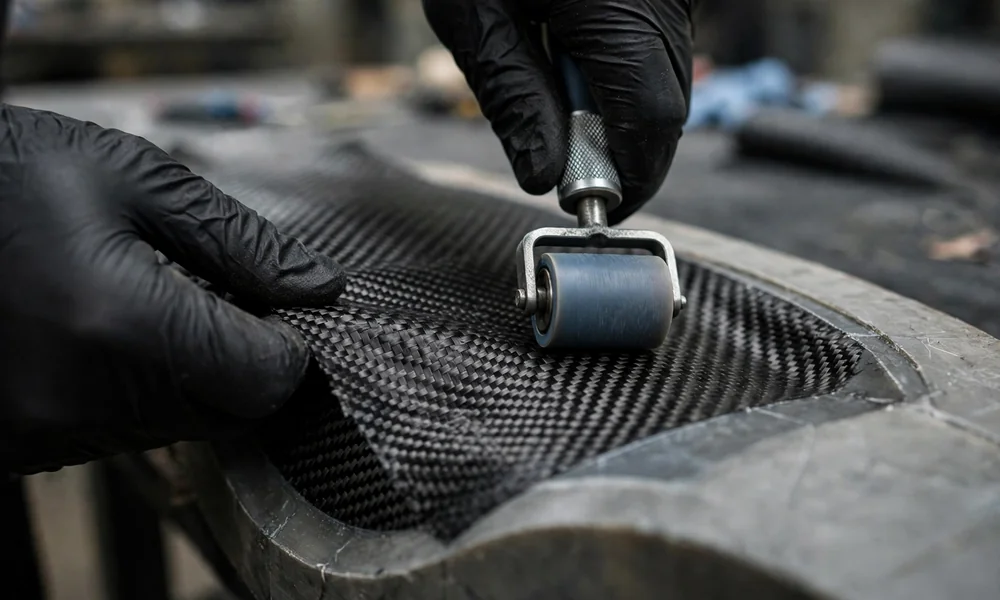
Now the slow, skilled work begins. The technician lays the first ply onto the mould, smoothing it into every curve with her hands and a roller, then peels off its backing film and lays the next, rotating the fibre direction exactly as the schedule demands. A large part can take a whole shift to lay up, and the technician works in a temperature-controlled room, because warm resin gets sticky and cold resin gets stiff. It is patient, physical, exacting work — and the same hand skill that builds a woven structure, as in carbon fibre weaving, is what makes the layup hold together.
Step 5: Bagging and debulking
Every few layers, the layup is paused for debulking: a vacuum bag is sealed over the mould and the air is sucked out, pressing the plies together and squeezing out trapped air and excess resin. This step is repeated several times during a large layup, because air trapped between layers becomes a void in the finished part, and a void is a weak spot. When the layup is complete, the whole assembly is bagged one final time, with breather cloths and vacuum lines arranged to pull evenly across the part.
Step 6: Curing in the autoclave
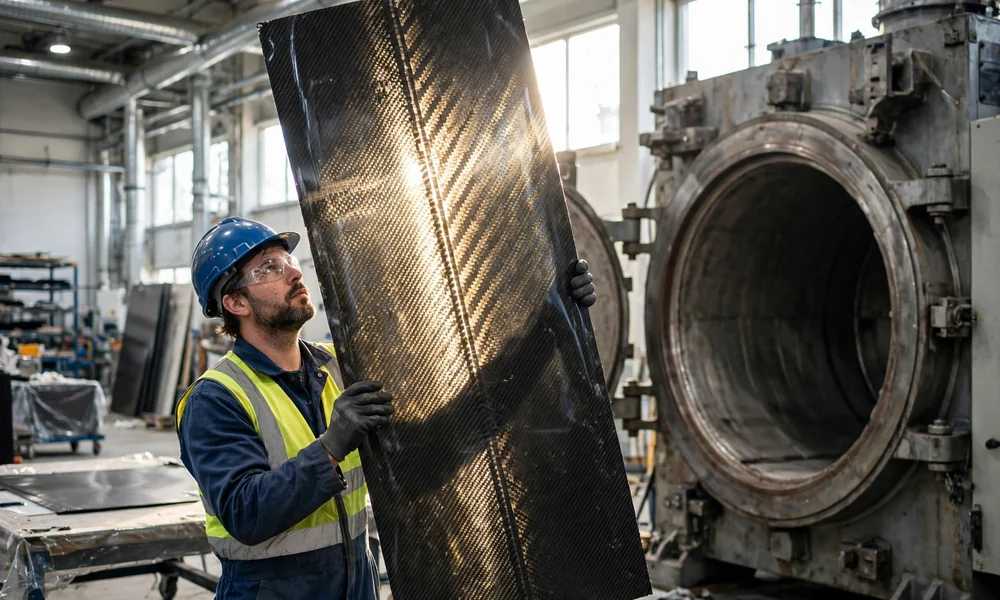
The bagged mould is wheeled into an autoclave, a giant pressurised oven that is the heart of the composites factory. Inside, the temperature rises to around 120 to 180 degrees Celsius and the pressure to several bar, and the resin flows, bonds the fibres together, and hardens into a rigid solid. The cure cycle lasts hours, following a precise recipe of ramps and holds, and it is monitored by sensors that record the temperature at a dozen points. The curing stage is where a soft layup becomes a structure, much as autoclave curing turns a stack of fabric into flight hardware.
Step 7: Trimming, inspecting and finishing
The cured part is lifted from the mould and trimmed to its final shape, usually with a diamond-coated cutting tool or a water jet, because carbon fibre blunts ordinary tools in minutes. Ultrasonic scanning finds flaws the eye cannot, and any part with a defect in a critical area is rejected. The finished part is then painted or clear-coated, and it leaves the factory as a single, seamless piece that is stronger than the metal it replaced. It is the same finish-first discipline that builds a tough aramid structure, as in Kevlar composite production — different fibre, same demand for perfection.
Composite Layup at a Glance
| Specification | Typical Value |
|---|---|
| Main fibres | Carbon, glass, aramid (Kevlar), basalt |
| Main resins | Epoxy, polyester, vinyl ester, phenolic |
| Typical ply thickness | About 0.125–0.25 mm per carbon ply |
| Typical layer count | 10–100+ plies, depending on the part |
| Cure temperature | About 120–180 °C for aerospace epoxy |
| Autoclave pressure | Typically 3–7 bar |
| Key advantage | Strength of steel at a fraction of the weight |
What Does It Cost?
Composite layup is labour-intensive, and the price shows it. Carbon fibre prepreg costs roughly $30–$100 per kilogram (estimates), and a skilled technician can lay up only a few square metres per day on a complex part, so labour is often the largest cost. A small carbon bicycle frame might cost $500–$1,500 to produce (estimates), a racing car monocoque tens of thousands of dollars (estimates), and a large aircraft wing section millions (estimates). An autoclave large enough for a wing can cost $5 million to $20 million (estimates). The cost is justified by weight: every kilogram saved on an aircraft saves fuel for its entire life, and on a racing car it is the difference between winning and losing.
A Rare Fact
The Boeing 787 Dreamliner is more than half composite by weight — the first airliner whose fuselage and wings are built largely from carbon fibre layup rather than aluminium — and its barrels are laid up by machines that crawl around a giant rotating mandrel, placing tape with millimetre precision. The world’s most advanced aircraft still depends on the oldest tool in manufacturing — the human hand. It is a fitting end to a process that is equal parts science and craft, and it shares its soul with every woven structure ever made, from carbon fibre weaves to the sails of a racing yacht — different fibres, same hands, same patience.


