The frame is the soul of an e-bike, and it starts life as a rack of plain silver tubes. Walk into the factory and the first thing you see is wall after wall of them: aluminium tubes in different diameters and wall thicknesses, some butted thin in the middle and thick at the ends, some already bent into the gentle curves of a top tube or a chainstay. The gap between a rack of tubes and a bike you would trust at forty kilometres an hour is a chain of cutting, welding, and checking that leaves no room for sloppiness.
Lightweight e-bike frames are a balancing act. Every gram saved makes the bike livelier and the battery last longer, but every gram removed from the wrong place makes the frame flex, crack, or fail. The factories that build them well have learned to put metal exactly where the loads are and nowhere else, and they prove it with jigs, gauges, and test rigs before a single frame is painted.

Inside the Production
Step 1: Choosing and preparing the tubes
Production starts with the tube set, and the choice of alloy sets the character of the whole bike. Most lightweight e-bike frames use 6061 or 7005 aluminium, chosen because it welds cleanly and can be heat-treated back to full strength afterwards. The tubes are butted, meaning their walls are thicker at the ends where the joints take the load and thinner in the middle where weight can be saved. Each tube is checked for straightness and wall thickness, then cut to length on saws that leave a clean, square end. The cut ends are deburred and cleaned, because any dirt or oxide left on the metal will show up as a flaw in the weld.
Step 2: Mitring, bending, and hydroforming
A frame is not a pile of straight tubes, so each one is shaped to fit its neighbours. Tube ends are mitred, cut to the exact curve of the tube they will join, so the two sit together with almost no gap for the weld to bridge. Some tubes are bent on mandrel benders that keep the tube round instead of kinking it, and others are hydroformed: placed in a mould and swollen into complex shapes by high-pressure water, forming the wide, flat profiles around the battery compartment that give modern e-bikes their clean look. The shaping work done here is the foundation of how the e-bike lightweight frame is made.
Step 3: Jigging and welding
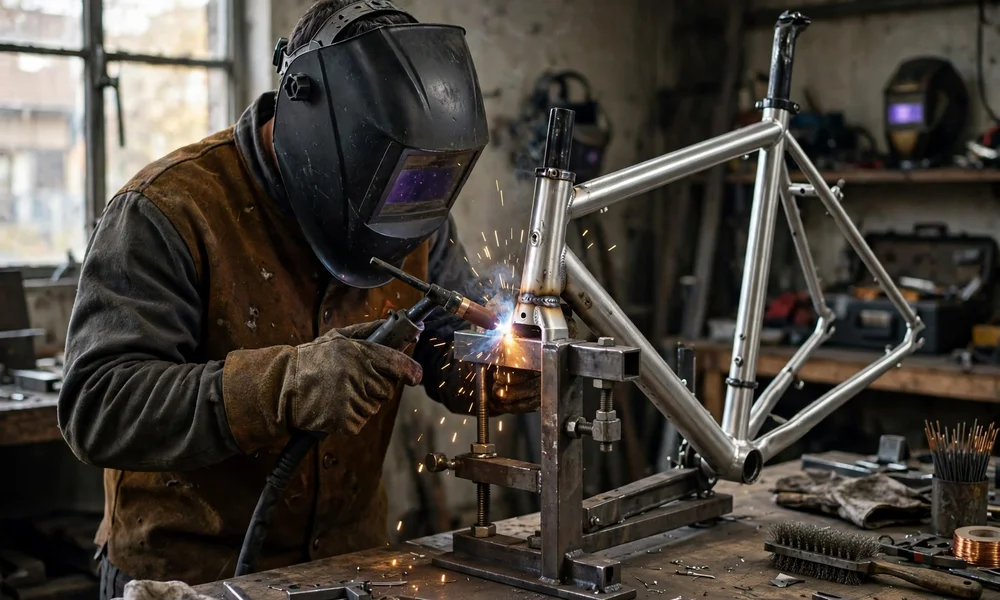
The shaped tubes are clamped into a steel jig, a rigid fixture that holds every tube in exactly the right position and angle while the frame is welded. The welder works in TIG, feeding a thin filler rod into an electric arc under a shield of argon gas, laying down neat, even beads around each joint. A good weld on a lightweight frame looks like a row of overlapping coins, smooth and consistent, with no undercut at the edges. The head tube, bottom bracket, and dropouts are the critical joints, and they are welded first while the jig holds everything true.
Step 4: Heat treatment and alignment
Welding softens aluminium around each joint, so a welded frame is weaker than the tubes it started from until it is heat-treated. The frames go into an oven at around 170 to 200 degrees Celsius for several hours, a process called artificial ageing that restores the alloy to its full strength. After the oven, each frame is checked on an alignment table: the head tube and bottom bracket must be parallel, the dropouts must be square, and the rear triangle must sit dead centre. A frame that is out by more than a millimetre is bent back into line by hand on a straightening table. Frames that cannot be brought true are scrapped, because a crooked frame will always ride crooked, however good the components bolted to it are.
Step 5: Facing, painting, and finishing
With the frame straight and strong, the bearing surfaces are faced and reamed: the head tube is cut square, the bottom bracket shell is threaded or pressed true, and the disc brake mounts are machined flat so the brakes sit perfectly. Then the frame is cleaned, masked at every thread and bearing seat, and painted. Most factories use powder coating, a dry paint that is sprayed on electrostatically and baked hard in an oven, giving a tough finish that resists chips far better than wet paint. Decals go on before a final clear coat, and the motor mount, battery rails, and cable guides are fitted and checked. The result is a frame that looks finished, and the paint is the first thing a buyer judges, even though the welding underneath matters far more. The weight and geometry targets the line works to are the ones riders compare in the e-bike lightweight frame specs.
Step 6: Final inspection and testing
No frame leaves the factory without a last round of checks. Inspectors measure the frame against its drawing with gauges, check every weld under bright light, and weigh the frame to make sure it hits its target. Sample frames from each batch are put on a fatigue test rig, where hydraulic arms flex the frame thousands of times to simulate years of riding, and the motor mount is load-tested to prove it can handle the torque of the drive unit. Frames that pass are fitted with a serial number, packed with protectors on every tube, and boxed for the assembly line. The care taken here is the same discipline that goes into the carbon side of the range, described in the e-bike carbon frame materials guide.
E-Bike Lightweight Frame at a Glance
| Specification | Typical Value |
|---|---|
| Main alloys | 6061 and 7005 aluminium |
| Frame weight | About 2–3 kg for the bare frame |
| Welding method | TIG welding under argon shielding |
| Heat treatment | Artificial ageing, 170–200°C for several hours |
| Battery integration | Hydroformed down tube housing the battery |
| Alignment tolerance | Within about 1 mm across the frame |
| Finish | Powder coating, baked hard |
What Does It Cost?
A lightweight aluminium e-bike frame is a mid-priced component in the world of bike manufacturing. A mass-produced frame from a large factory might cost $150–$400 to make (estimates), depending on the complexity of the hydroforming, the quality of the welding, and the finish. A small-batch or custom frame from a specialist builder can cost $800–$2,000 or more (estimates). The frame usually accounts for roughly a fifth to a quarter of the finished e-bike’s retail price, with the motor and battery taking the largest share. Hydroforming tools are the big upfront cost: a single mould set can run to tens of thousands of dollars (estimates), which is why the same frame shape is used across many models.

A Rare Fact
The lightest production e-bike frames weigh less than some road bike frames from twenty years ago, despite carrying a motor and a battery that together weigh more than the frame itself. The secret is not a miracle material but a century of bicycle engineering refined by computer modelling: tubes shaped by water pressure, welds laid by steady hands, and metal removed from everywhere it is not needed. The frame you ride is, in a very real sense, mostly empty space held together by good decisions.


