Lift it with one hand. A good e-bike frame weighs less than a bag of groceries, yet it has to carry a rider, a motor, a battery and every pothole a city can throw at it, day after day, for years. The frame is the bike. Everything else — motor, battery, wheels — bolts onto it, and if it fails, nothing else matters.
Most lightweight e-bike frames are aluminium, some are carbon fibre, and a few are steel or titanium. The aluminium frame is the workhorse of the industry, and its making is a story of tubes, jigs and heat. Here is how a lightweight e-bike frame is made, from raw tube to a finished frame ready for its motor and battery.
How an E-Bike Lightweight Frame Is Made
Step 1: Choosing the tubes
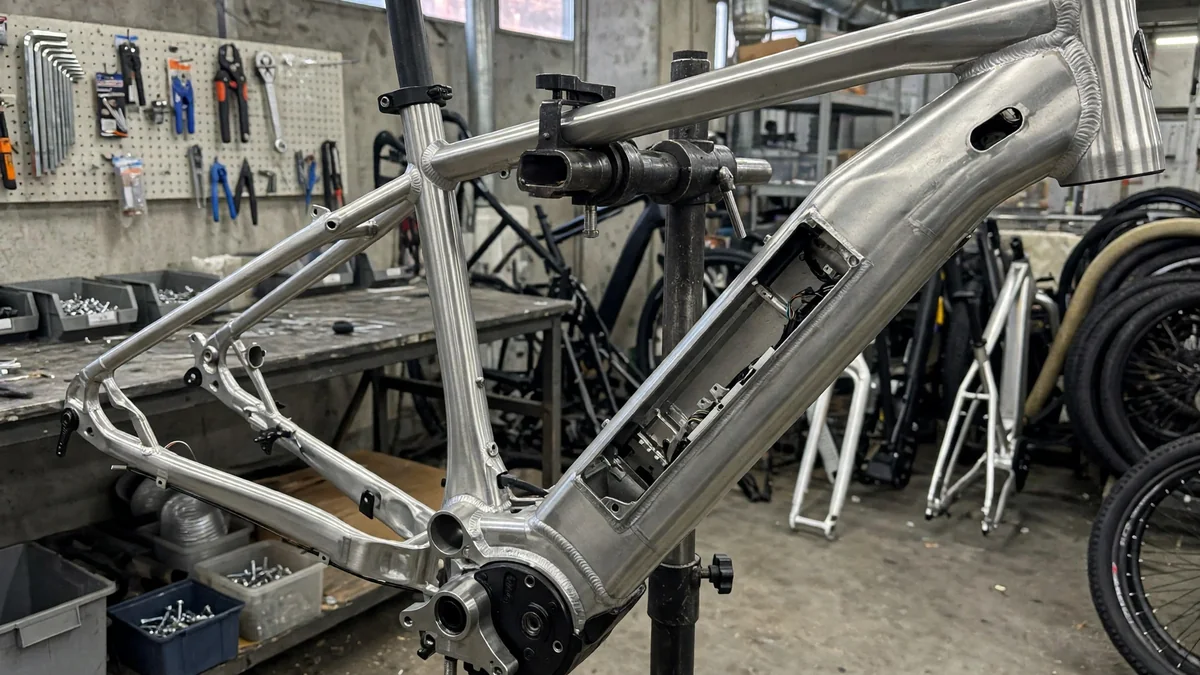
The frame starts as a set of aluminium tubes, usually 6061 or 7005 alloy, chosen for the balance of strength, weight and weldability. The tubes are not all the same: the down tube, which carries the battery on most e-bikes, is large and often hydroformed into an oval or rectangular section to house the battery pack inside it; the top tube is slimmer; the chain stays and seat stays are thin and butted — thicker at the ends where stress concentrates, thinner in the middle where it does not. The material science behind these choices is covered in e-bike lightweight frame materials engineering, where alloy, wall thickness and tube shape are designed as a system.
Step 2: Cutting, mitring and shaping
Each tube is cut to length and its ends are mitred — shaped to fit exactly against the tube it will join, so the weld has a tight, even gap all the way around. On modern production lines this is done by CNC tube cutters and laser notching machines that can hold tolerances of a fraction of a millimetre. The down tube may be hydroformed at this stage: placed in a die and expanded with high-pressure fluid into a complex shape with cable routing channels and a battery opening.

Step 3: Jigging and welding
The tubes are clamped into a steel jig — a heavy fixture that holds every tube in exactly the right position and angle, because a frame that is a millimetre out of alignment will never ride straight. Then a welder joins them, usually by TIG welding: an electric arc melts the joint while the welder feeds in filler rod by hand, building the characteristic stacked-dime bead that marks a quality aluminium frame. The craft of joining metal precisely is the same discipline found in other precision builds, from an e-bike gearbox to the motor that will eventually bolt into this frame.
Step 4: Heat treatment
Welding softens aluminium. The heat of the arc destroys the temper of the alloy around every joint, leaving the frame far weaker than the tubes it was made from — so every welded aluminium frame is heat-treated. The frame is heated in an oven to around 530 degrees Celsius to dissolve the alloying elements, quenched, and then artificially aged at a lower temperature for hours, a process that restores the alloy to its full strength. Carbon fibre frames take a different path, cured in moulds and ovens, as described in e-bike carbon frame materials engineering, but the principle is the same: the frame is only finished when its material has been brought back to full strength.
Step 5: Alignment checking and facing
After heat treatment, the frame is checked on an alignment table. The head tube and bottom bracket must be parallel and true, the dropouts must be in line, and the rear triangle must be centred. Then the bearing surfaces are faced and reamed: the head tube is machined flat, the bottom bracket threads are chased, and the disc brake mounts are faced so the calliper sits perfectly square.
Step 6: Painting and finishing
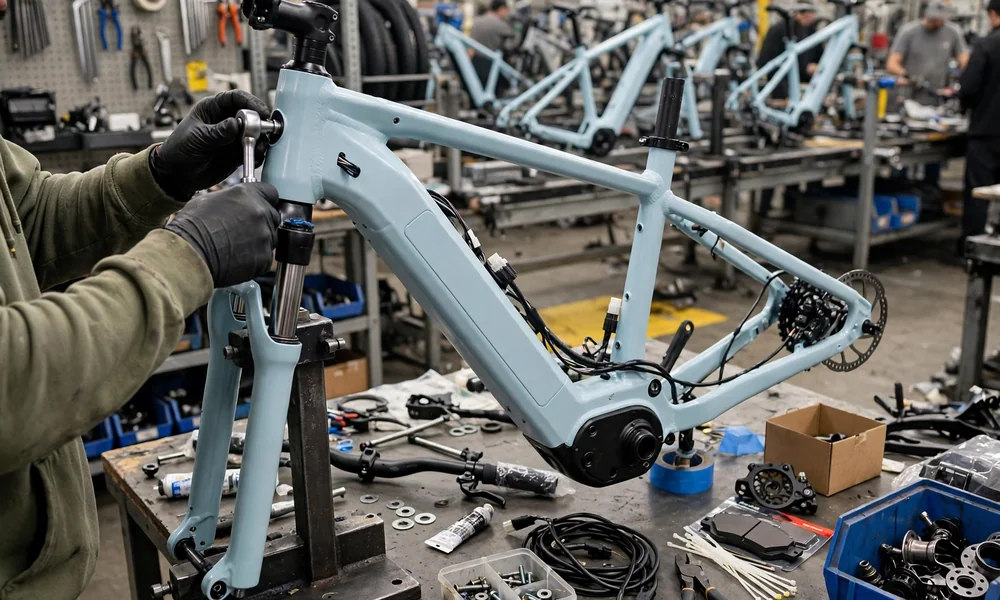
The bare frame is cleaned, primed and painted — usually powder-coated for durability, or wet-painted for the deepest colours and the finest finishes. E-bike frames get extra attention here: the battery compartment is masked and protected, cable ports are fitted, and the paint must survive the knocks of a battery sliding in and out hundreds of times.
Step 7: Testing before it becomes a bike
Finally, sample frames from every production batch are tested to destruction. Test rigs apply the loads a frame will see in service — pedalling forces, braking forces, impacts — repeated hundreds of thousands of times to simulate years of riding, and the frame must survive without cracking. Only after the test frames pass does the batch ship to the assembly line, where the motor, battery and components are fitted and the frame finally becomes a bicycle.
E-Bike Lightweight Frame at a Glance
| Specification | Detail |
|---|---|
| Common materials | Aluminium 6061 / 7005, carbon fibre, steel, titanium |
| Typical aluminium frame weight | About 2–3.5 kg for the frame alone |
| Typical complete e-bike weight | About 20–25 kg with motor and battery |
| Joining method | TIG welding for aluminium, bonding and curing for carbon |
| Heat treatment | Solution treatment near 530 °C, then artificial ageing |
| Down tube role | Often houses the battery inside a hydroformed section |
| Testing standard | ISO 4210, with higher loads for e-bikes |
| Key advantage | High strength-to-weight ratio with motor and battery integration |
What Does It Cost?
A frame is a large share of an e-bike’s cost, and its price depends on material, manufacturing location and finish. As rough estimates, a mass-produced aluminium e-bike frame typically costs the manufacturer on the order of one to three hundred dollars, while a complete e-bike built around it retails from around one thousand dollars for a basic city model to several thousand for a premium mountain or cargo e-bike. A hand-built titanium or custom carbon frame can cost far more on its own. Those figures are estimates, not quotes — the real number depends on the material, the production volume and the level of integration with the motor and battery system.
A Rare Fact
The diamond frame — two triangles sharing a top tube — has barely changed since the 1880s, and the e-bike frame is still built on it. Engineers have tried monocoque frames, step-through frames and wild new geometries, but the double triangle remains the lightest way to carry a rider’s weight, because triangles do not flex the way rectangles do. The e-bike’s real innovation is not the shape of the frame but what is hidden inside it: a battery where the water bottle used to go, and a motor where the pedals meet — a 140-year-old structure, quietly carrying a twenty-first-century machine.
A lightweight e-bike frame is easy to underestimate because it looks so simple — a few tubes, some welds, a coat of paint. But inside those tubes is a chain of decisions about alloy, shape, heat and testing, each one made so the frame can be lifted with one hand and trusted with a rider’s life. That is the whole job of a bicycle frame, and the e-bike has simply asked it to do more of it than ever before.


