It is the smallest part of an electric car that you touch every day, and the one you notice most when it goes wrong. The charging port is a socket about the size of your fist, hidden behind a little flap on the wing or nose, and every time you plug in, a hundred decisions made in a factory have to work perfectly: the pins must line up, the seal must keep out rain, the latch must hold a heavy cable, and hundreds of amps must flow without a hint of heat. Get any of it wrong and the car simply will not charge.
Building a charging port looks simple from the outside and is anything but. The part must survive ten thousand plug-in cycles, winters of road salt, summers of baking sun, and the occasional driver who yanks the cable sideways. It must also talk to the charger, negotiating voltage and current in milliseconds. The factory that makes it is a clean, quiet hall of precision presses, moulding machines and test rigs, where a component smaller than a shoebox is treated with the seriousness of a jet engine part.

How an EV Charging Port Is Made
Step 1: Designing the connector
Every charging port starts with a standard: CCS, NACS, CHAdeMO or the AC Type 2 connector, depending on the market. The standard fixes the shape of the pins, their spacing and the communication protocol, but the manufacturer still has to design the housing, the seals, the latch and the cooling around it. Engineers model the current path in software, and they design the port so a worn socket is replaceable without stripping the whole car. The plug should only fit one way, and a driver should be able to connect it in the dark and rain.
Step 2: Moulding the housing
The port housing is injection-moulded from high-performance engineering plastics, often glass-filled nylon or PBT, chosen for heat resistance, flame retardancy and toughness at low temperatures. Molten plastic is forced into a steel mould at high pressure, forming the complex shape — pin cavities, seal grooves, latch pockets and mounting points — in a single shot. The moulds themselves are precision tools, machined to tolerances of a few hundredths of a millimetre, because a housing that is slightly out of shape will let water in or leave a pin misaligned.
Step 3: Making the pins and contacts
The metal heart of the port is its pins: thick copper-alloy contacts, often silver-plated to keep resistance low and prevent corrosion. The pins are stamped or machined from copper rod, then plated in a chemical bath that lays down a microscopically thin layer of silver. Silver is not decoration — it keeps the contact resistance low across thousands of cycles, and low resistance means low heat. The plating thickness is measured and controlled. The pins are then pressed into the housing with an interference fit, locked in place so they can never work loose under the weight of a cable. The same care over electrical contacts that shapes EV battery pack assembly applies here.
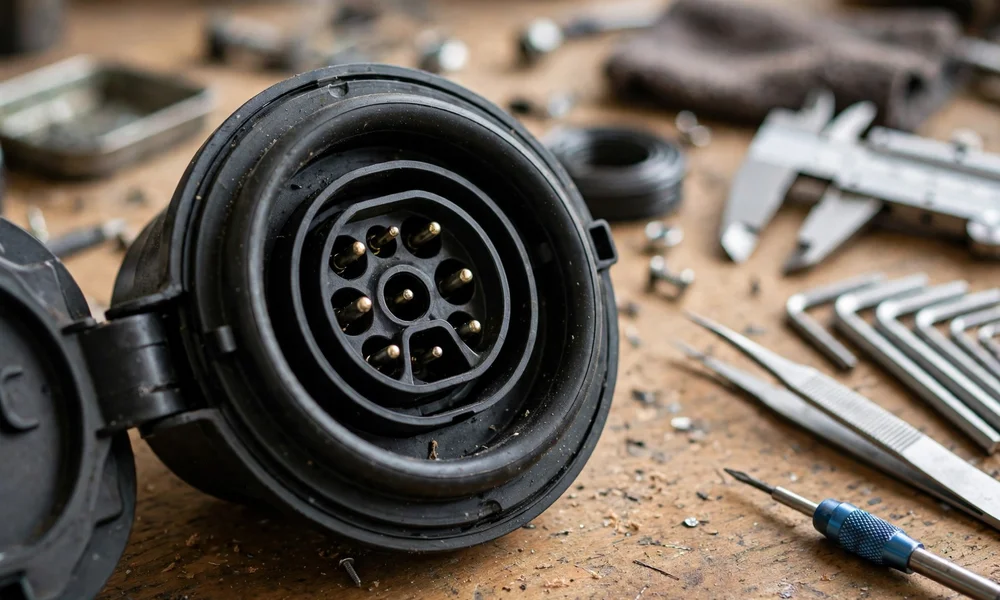
Step 4: Seals, latches and actuators
A charging port lives outside, so it must be weatherproof. Silicone and rubber seals are fitted around the flap, the socket and the cable entry, and the assembly is designed to meet an IP rating that keeps out driving rain and dust. The latch — the small mechanism that locks the plug in place during charging — is assembled from a motor or solenoid, a locking pin and a manual release, because a driver must always be able to free the cable even if the electronics fail. Every seal and latch is fitted and checked.
Step 5: Wiring and liquid cooling
Behind the socket, heavy cables carry the current to the battery, and on fast-charging cars those cables are liquid-cooled. Thin coolant channels run alongside the conductors, carrying heat away to a small radiator loop, and the port assembly includes the fittings, sensors and temperature probes that make the cooling work. Thermistors sit millimetres from the pins; if one gets too hot, the car tells the charger to slow down. Every joint is pressure-tested before the port moves on. The thermal discipline here mirrors the cooling systems inside EV inverters, where heat is the enemy of power.
Step 6: Testing every single unit
Unlike many car parts, which are sampled for quality, every charging port is tested. Each unit goes through a gauntlet: a plug-in cycle test with a reference connector, a high-voltage insulation test, a continuity and resistance check on every pin, a seal test with pressurised air, and a communication test that simulates a real charger handshake. The testing takes minutes per unit, but it is why a driver can plug in and simply trust that it works.
Step 7: Final assembly and traceability
Finished ports are packed with their mounting hardware, flap and trim, and each one carries a serial number or QR code that links it to its full production record: the batch of plastic, the plating bath, the test results, the operator who assembled it. If a fault ever appears in the field, the factory can trace it back to the exact shift and the exact batch of parts. A part this small, made this carefully, is a good example of how the whole car is built — something electric motor production shares, where every unit is tested before it ever meets a chassis.
EV Charging Port at a Glance
| Specification | Typical Value |
|---|---|
| Main standards | CCS, NACS, CHAdeMO, Type 2 AC |
| Peak DC power | Up to 350 kW on current fast-charging cars |
| Peak current | Up to about 500 A on liquid-cooled ports |
| Plug-in cycle life | 10,000 cycles or more, by design |
| Weather sealing | IP54 or better, dust and rain resistant |
| Housing material | Glass-filled nylon or PBT, flame retardant |
| Key advantage | Safe, fast, weatherproof connection, every unit tested |
What Does It Cost?
A charging port assembly is a modest part of a car’s cost, but it is not cheap for what it is. A complete port assembly — socket, housing, latch, flap, cables and cooling fittings — typically costs a manufacturer $150–$400 (estimates), and a replacement at a dealer can run $500–$1,500 including labour (estimates). The cost is driven by the silver-plated contacts, the precision moulding and the 100 percent testing, not by the size of the part. For the driver it is included in the car — but it cost more to make and test than many whole appliances.

A Rare Fact
The fastest charging ports in production today can add roughly 100 kilometres of range in about five minutes — but the port itself is not the bottleneck. The real limit is heat: push more current through the same pins and the metal gets hotter, so engineers cool the cables and the port with liquid, just like a racing engine. The humble socket on the side of the car is one of the hardest-working parts in the whole vehicle.