Before a hypercar has an engine, a body, or even wheels, it has a chassis — a skeleton that must be lighter than a steel frame, stiffer than a racing car’s, and strong enough to protect its driver at more than 200 miles per hour. In the best hypercars, that skeleton is a single piece of carbon fibre called a monocoque, shaped like a bathtub and built by hand, layer by layer, over weeks. It weighs less than a grown man, yet it can survive forces that would tear a normal car apart.
The chassis is the car’s soul. It decides how the car handles, how safe it is, and how fast it can go, because every other part — the engine, the suspension, the bodywork — bolts onto it. Building one is less like car manufacturing and more like building an aircraft: slow, precise, and done largely by hand. Here is how a hypercar chassis is made.

How It’s Made
Step 1: Designing the monocoque
Engineers start on computers, designing a tub that will hold the driver, the fuel tank, and the engine mounts, while leaving room for the suspension and the aerodynamics. Every millimetre matters: the tub must be stiff enough that the suspension can do its work instead of the body flexing, and it must include crumple zones that absorb energy in a crash. The design is tested in simulation thousands of times before anything is built, because a mistake in the chassis cannot be fixed later — the whole car is built around it.
Step 2: Laying up the carbon fibre
The chassis begins as sheets of carbon-fibre fabric, pre-impregnated with resin and stored in freezers until they are needed. Skilled laminators cut the fabric into patterns and lay them, layer by layer, into a mould — sometimes more than a hundred layers in the most stressed areas, each one oriented in a different direction to spread the load. The work is done by hand, in a clean, temperature-controlled room, because a wrinkle or an air bubble in a layer can become a weak spot. A single tub can take a team of laminators several days to lay up.
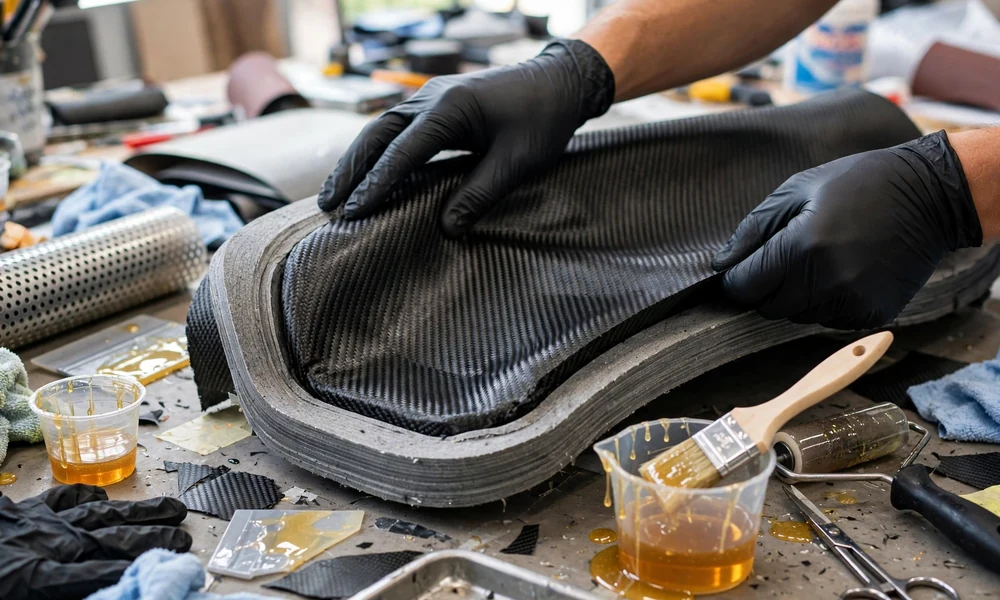
Step 3: Curing in the autoclave
Once the layers are in the mould, the whole assembly is sealed in a vacuum bag and placed in an autoclave — a giant oven that heats it to around 180°C while squeezing it with several atmospheres of pressure. The heat cures the resin, turning the soft fabric into a rigid, feather-light structure, while the pressure squeezes out any trapped air. The tub spends hours in the autoclave, and when it comes out, it is already stronger, weight for weight, than steel. It is then trimmed by hand and by machine, and its edges are finished to a precise tolerance.
Step 4: Bonding the metal inserts
A carbon tub on its own cannot hold an engine or a suspension, so metal inserts are bonded into it at every mounting point. These inserts — usually aluminium or titanium — are glued in with structural adhesive and sometimes bolted as well, and their positions are measured to a fraction of a millimetre. A suspension mount that is even a millimetre out would make the car handle badly, so the tub is checked on a measuring rig that scans it with lasers. The same obsession with geometry drives the Formula 1 monocoque, where the chassis is also the car’s survival cell.
Step 5: Adding the subframes
Front and rear subframes — usually aluminium or carbon — are bolted to the tub, carrying the engine, the gearbox, and the crash structures. The engine is mounted directly to the chassis in many hypercars, so the tub must cope with its vibration and heat as well as its weight. The fuel tank, a flexible bladder that sits behind the driver, is fitted inside the tub, and the wiring, brake lines, and cooling pipes are routed through it. At this stage, the chassis finally starts to look like a car, even though it still has no bodywork.
Step 6: Testing the finished chassis
Before a single body panel is fitted, the chassis is tested. It is twisted on a rig to measure its stiffness, shaken to check for rattles, and — on a sacrificial test tub — crashed into a barrier to prove it protects its occupants. Hypercar makers also test the tub’s strength by loading it with weights far beyond anything it will meet on the road. Only when the chassis passes every test is it cleared for the body shop, where the car’s skin is fitted around the skeleton that will define it for the rest of its life.

Specs
| Specification | Typical figure |
|---|---|
| Chassis type | Carbon-fibre monocoque tub |
| Tub weight | Roughly 70–100 kg |
| Carbon layers | Up to 100 or more in stressed areas |
| Cure temperature | About 180°C in the autoclave |
| Torsional stiffness | 40,000–65,000 Nm per degree |
| Build time | Several weeks per tub, mostly by hand |
| Crash protection | Meets road and racing safety standards |
| Material strength | Stronger than steel, weight for weight |
Price
A hypercar chassis is not sold on its own, but as an estimate, the carbon monocoque alone costs roughly $100,000 to $300,000 to build, depending on the car and the complexity of the tub. The finished hypercar typically costs $2 million to $4 million, and the chassis accounts for a large share of that — the materials are expensive, the labour is skilled and slow, and the testing destroys at least one tub per model. These are estimates, and the real figure is a closely guarded secret for every maker.
A Rare Fact
The first carbon-fibre monocoque in a road car came from Formula 1, where it was introduced in the early 1980s — and it was so strong that when a driver crashed at 140 miles per hour, he walked away from a car that had disintegrated around him, with the tub intact. That crash convinced the whole racing world, and then the hypercar world, that carbon fibre was the future. Today, every serious hypercar is built around a tub that traces its ancestry directly to that single race car.
The chassis is where a hypercar’s character is born, long before the engine ever starts. The suspension that bolts onto it has to be just as clever — see how hypercar suspension works — and the engine that sits behind the driver is a masterpiece in its own right. The V12 that powers some of the greatest hypercars is built with the same patience, as how a hypercar V12 engine is made shows. The next time a hypercar corners flat at impossible speed, remember the hand-laid layers of black fabric, the hours in the oven, and the tub lighter than a man that holds it all together.


