An electric car has no roaring radiator grille, no exhaust, and no glowing engine block — so it is easy to assume it does not need cooling at all. That assumption dies the first time you fast-charge one on a hot day. Plug in, and within minutes pumps whir, fans spin, and coolant circulates through the battery, the motor, and the cabin. The car is not just a battery on wheels. It is a thermal machine, and the system that manages its temperature is one of the most complicated things in it.
EV thermal management is the network of pumps, valves, radiators, chillers, and heat pumps that keeps the battery in its comfort zone, the motor from overheating, and the passengers warm in winter without draining the battery dry. It is built on a production line that looks more like a plumbing factory crossed with an electronics plant, where kilometres of hose and hundreds of connectors come together into a system that must never leak or fail. Here is how it is made.
How It’s Made
Step 1: Designing the thermal circuits
Production starts with a map of the car’s heat: every source — the battery cells, the drive motor, the inverter, the charger — and every place heat is needed, mainly the cabin in winter. Then they design the circuits: loops of coolant that valves can join or split, so waste heat from the motor can warm the battery on a cold morning, or the battery’s heat can be dumped through a radiator. Every extra valve, pump, and metre of hose adds weight, cost, and a place to leak. Modern cars solve it with a single integrated module packing the heat pump, valves, and pumps into one unit.
Step 2: Making the heat exchangers and the heat pump
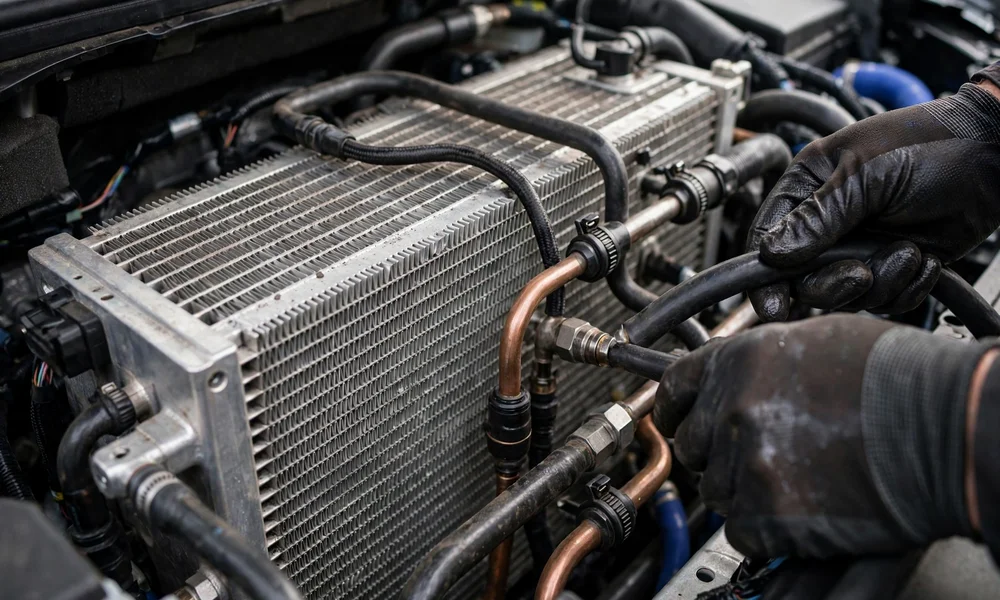
The heart of the system is the heat pump, built like a small air conditioner. A compressor squeezes refrigerant gas until it is hot, and the gas flows through heat exchangers — stacks of thin aluminium fins and tubes, brazed together in a furnace — that pass the heat into coolant or cabin air. The exchangers are pressure-tested with helium, because a leak too small to see can empty the system over a year. The compressor is balanced and tested on its own line before it meets the rest of the system, since a noisy compressor is one the driver will hear on every journey.
Step 3: Building the cooling plates and manifolds
The battery is the part that needs cooling most, and it gets its own hardware. Cooling plates — flat aluminium panels with channels milled into them — sit between the battery modules, carrying coolant right up against the cells. The channels are formed with great care, because uneven cooling creates hot spots that age cells unevenly. Manifolds, the junctions that split coolant flow between plates, are fitted with seals that must survive years of heating, cooling, and vibration without weeping a drop. Each plate is leak-tested before it is allowed near a battery, since a single drop of coolant inside a battery pack is a failure the car cannot recover from on the road.
Step 4: Assembling the thermal module
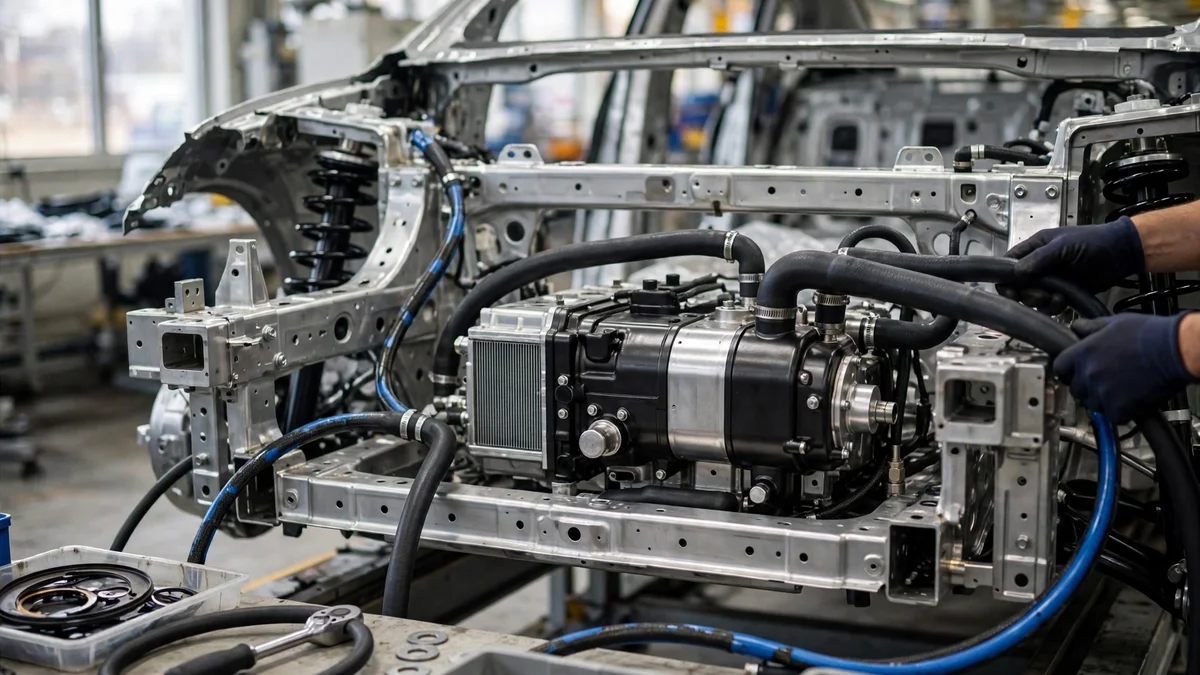
Workers — or, increasingly, robots — mount the heat pump, pumps, valves, and reservoirs onto a single frame, then connect them with pre-formed hoses and quick-connect fittings. Every connection is checked, because a hose that looks seated and is not will blow off when the system pressurises. Sensors are fitted throughout: temperature probes, pressure sensors, and flow meters that tell the car’s computer how much heat is moving where. The module is then filled with coolant and refrigerant, bled of air, and run on a test rig that cycles it through hot and cold before it leaves the line.
Step 5: Installing the module in the car
The thermal module is lifted into the car’s front compartment — the space where an engine used to live — and bolted to its mounts, while the battery cooling lines are connected to the pack under the floor and the cabin heating lines are routed to the heater inside. Each connection is torque-checked and leak-checked, because a joint made in haste is a warranty claim in a year’s time. The front radiator and the chiller, which lets the air conditioning cool the battery coolant directly, are fitted at the same stage, and the car’s front end is built around the thermal system’s need for air.
Step 6: Filling, testing, and calibrating
The car is filled with coolant under vacuum, and the refrigerant charge is weighed in to the gram. Then the car is run through a thermal test: the battery is charged and discharged, the motor is loaded on rollers, and the cabin is heated and cooled. Engineers check that the battery stays in its narrow comfort zone, that the cabin reaches its target without draining the range, and that the system switches smoothly between its modes. Only when the numbers match the design is the car signed off.

Specs
| Specification | Typical figure |
|---|---|
| System purpose | Cooling the battery, motor, and inverter; heating the cabin |
| Key component | Heat pump with compressor and heat exchangers |
| Battery comfort zone | Roughly 20–40°C for best life and performance |
| Coolant loops | Separate loops, joined or split by valves |
| Battery cooling | Cooling plates between the battery modules |
| Refrigerant | Weighed in to the gram during filling |
| Testing | Helium leak tests, hot and cold cycling |
| Winter benefit | Heat pump uses far less energy than a resistive heater |
| Build approach | Integrated module, installed as one unit |
Price
An EV thermal management system is sold as part of the car, so any price is an estimate. As an estimate, the thermal system costs roughly $1,500 to $4,000 per car, depending on how integrated the design is and whether a heat pump is fitted. It is a small share of the car’s price, but a good thermal system can add tens of miles of winter range and years to the battery’s life. The expensive part is not the hardware but the engineering — the thousands of hours spent making one system do the jobs that used to take three.
A Rare Fact
The cleverest trick in EV thermal management is that the car steals heat from itself. On a cold morning, the heat pump harvests the waste heat the motor and inverter make while driving, and even the heat the battery gives off while discharging, and moves it into the cabin. Some cars warm the battery with motor heat before a fast charge, because a warm battery accepts charge far faster than a cold one. The car is a small heat-recycling plant on wheels, and the better it moves warmth around, the further it goes on the same charge.
The battery cooling that works alongside this system is explained in how EV battery cooling works, and the pack it protects is covered in how an EV battery pack is made. The cost of all that clever plumbing is explored in why EV thermal management is so expensive. The next time your electric car charges quickly on a freezing morning, remember the heat pump, the cooling plates, and the quiet recycling of warmth that made it possible.


