At more than 300 kilometres per hour, a Formula 1 car is a missile with a driver strapped inside it, and the only thing between that driver and a concrete wall is a shell of carbon fibre barely thicker than a paperback book. That shell is the monocoque, and it is the most important part of the car.
A monocoque is not bolted together from panels. It is a single structure, laid up by hand, layer upon layer, in a clean room, then baked in a giant oven until the layers fuse into one rigid tub. A finished monocoque weighs about 60 kilograms, yet it can survive an impact that would destroy a family car. Only a handful of factories in the world can build one. This is how a Formula 1 monocoque is produced.

Inside the Factory
Step 1: Cutting the carbon fibre
Production begins with rolls of carbon fibre prepreg, cloth in which the carbon threads are already soaked in resin, kept in a freezer at around minus 18 degrees Celsius so the resin does not start to harden. Each roll is booked out and warmed up slowly. The cloth is then cut into hundreds of pieces, each shaped for a precise position in the monocoque and labelled with its ply number and fibre direction. A monocoque can contain more than 1,000 individual plies, and every piece is checked against the list before it leaves the cutting table.
Step 2: Laying up the tub by hand
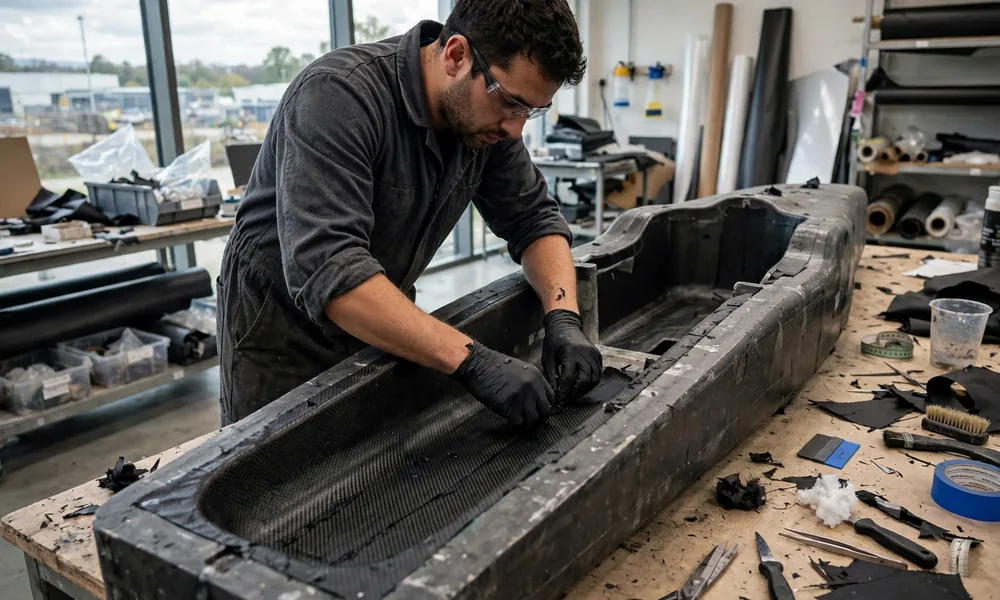
The cut plies are laid into a mould, one at a time, by laminators working in a clean room where the temperature and humidity are tightly controlled. The mould is machined from a solid block and polished smooth. The laminators press each ply into place by hand, smoothing out air bubbles with small rollers, and they build the tub up in layers, turning the fibre direction at each layer so the finished structure is strong in every direction rather than just one. The cockpit surround and the fuel cell area get extra plies, and inserts for the suspension, engine, and seat belts are placed into the layup as it grows. A single tub can take a team of laminators several days to lay up.
Step 3: Bagging and curing in the autoclave
Once the layup is complete, the mould is sealed inside a vacuum bag and the air is drawn out, pressing the plies tightly together so no air remains between them. The whole assembly is then loaded into an autoclave, a huge pressurised oven, where it is heated to around 120 to 180 degrees Celsius while the pressure rises to several times normal air pressure, squeezing the layers together as the resin melts, flows, and hardens. The cure cycle lasts for hours, with the temperature raised and lowered on a strict schedule. Sensors inside the bag record the temperature, and if any reading drifts outside its limits, the cure is stopped and the tub is scrapped. The full story of how the tub is built from cloth to finished shell is told in how a Formula 1 monocoque is made, and the autoclave cure is the moment when hundreds of separate plies become one structure.
Step 4: Machining and bonding the inserts
When the tub comes out of the autoclave, it is a rough black shell, and it goes to the machine shop, where computer-controlled mills trim the edges, cut the openings for the cockpit and the fuel cell, and drill the holes for the suspension and the roll hoop. The machining is done in sealed cabinets with extraction. The metal inserts are then checked for position with a measuring machine, and any that moved during the cure are corrected by re-machining. Brackets for the steering, pedals, and seat are bonded into place with structural adhesive and left to cure before testing.
Step 5: Crash testing and inspection
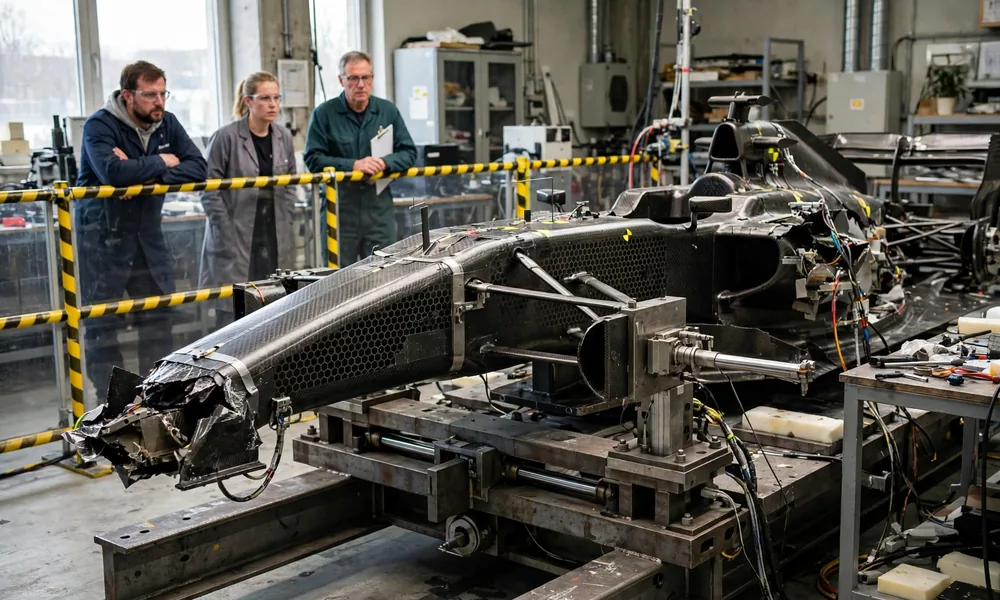
Before any monocoque is allowed to race, a sample from the same production batch must pass the crash tests set by the sport’s governing body, and every tub is inspected as if it were that sample. The tests include frontal, side, and rear impacts, plus a heavy weight dropped onto the roll hoop, and in each case the survival cell must stay intact while the structure around it absorbs the energy. Inspectors also scan every tub with ultrasound, which can find delamination inside the carbon that the eye cannot see. The cockpit opening is checked against a template of the driver’s seating position, and the seat belts, headrest, and fire extinguisher are fitted and checked. A monocoque that passes every test is stamped and logged.
Step 6: Finishing, painting, and fitting out
The last stage is finishing, and it begins with the tub being sanded, filled, and primed, so the surface is smooth enough to paint. The team’s livery is applied in thin layers, because paint adds weight and every gram is counted. The fuel cell, the wiring loom, the fire extinguisher system, and the driver’s seat are then fitted inside the tub, followed by the steering column and the pedals, and each system is tested in place before the tub is handed to the race team. The finished monocoque is weighed, measured one final time, and packed into a padded case for the journey to the track.
Specs
| Specification | Typical figure |
|---|---|
| Material | Carbon fibre prepreg, 1,000+ plies |
| Finished weight | Roughly 60 kilograms |
| Cure temperature | Around 120 to 180 degrees Celsius |
| Cure pressure | Several times normal air pressure |
| Machining tolerance | About 0.1 millimetres on inserts |
| Layup time | Several days for one tub |
| Inspection | Ultrasound scan of every tub |
| Crash tests | Frontal, side, rear, and roll hoop tests |
Price
A Formula 1 monocoque is never sold on its own, so its cost is estimated from the price of a complete car, which is estimated at roughly $15 million to $20 million. The monocoque itself, including the carbon fibre, the moulds, the autoclave time, and the hundreds of hours of hand layup and inspection, is estimated at roughly $1 million to $2 million per tub, and a team builds several tubs each season.
A Rare Fact
The monocoque must be strong enough to protect the driver in a crash, yet the rules also require a driver of a set size to climb out of the cockpit, steering wheel removed, in less than five seconds, while wearing full racing gear. The tub is therefore built around two opposite demands at once: it must be a fortress in a crash, and an open doorway in an emergency.
A monocoque is the part of a Formula 1 car the driver trusts with their life, and the numbers behind it are set out in the Formula 1 monocoque specifications, while the Formula 1 monocoque materials explain why the carbon fibre must be laid in so many directions at once. The next time a car hits the wall and the driver walks away, remember the freezer, the clean room, the autoclave, and the ultrasound scan that made the black tub around them.


