The car hits the barrier at nearly 200 miles per hour. It cartwheels through the gravel, sheds both front wheels, and comes to rest upside down against the tyre wall. For a few seconds the grandstand holds its breath. Then the driver unclips his belts, climbs out of the wreck, and waves. The car is destroyed. The small carbon-fibre tub around the driver is not. That tub is the monocoque, and it is the reason a Formula 1 crash that looks unsurvivable usually ends with a bruised driver and a shrug.
This guide explains the Formula 1 monocoque in plain English — its weight, its strength, the crash tests it must pass, and how it compares with the road cars and race cars around it.

The Monocoque Specs, Explained
Every number below comes from the FIA regulations and the figures teams and suppliers publish. Where the exact figure varies by team, the range is given instead of a single number.
| Spec | Typical figure | What it means | How it compares |
|---|---|---|---|
| Bare survival cell weight | About 35–50 kg | The empty carbon shell, before seat, pedals and fuel cell go in | Lighter than a single F1 wheel and tyre; a road-car body shell weighs 250–350 kg |
| Material | Carbon-fibre composite, dozens of layers | Layers of carbon cloth set in resin, cured in an autoclave | Road cars use steel; only hypercars use a full carbon tub |
| Minimum car weight | 800 kg including driver (2025 rules) | The whole car, driver and tyres, cannot be lighter than this | About half the weight of a small hatchback |
| Frontal crash test | Impact at 15 m/s (54 km/h) | The nose and cell must absorb the hit with the driver surviving | Road-car tests run at 64 km/h but with far heavier, softer structures |
| Peak deceleration survived | Up to about 75 g in real crashes | The driver has walked away from impacts measured near 75 g | A road-car crash rarely exceeds 30–40 g before the cabin deforms |
| Static load tests | Up to 250 kN on the cell | The FIA squeezes the cockpit sides, floor and roll structure with huge forces | 250 kN is roughly the weight of 25 tonnes pressing on one spot |
| Cockpit opening | About 850 mm long, 550 mm wide | The hole the driver climbs through, shaped by an FIA template | Far tighter than any road car; drivers practise getting out in under five seconds |
| Estimated cost | About $500,000–$1,000,000 per monocoque (estimate) | Materials, labour, testing and the tooling behind a single cell | More than most supercars cost to buy outright |
How a Monocoque Works
Step 1: Layers, not lumps
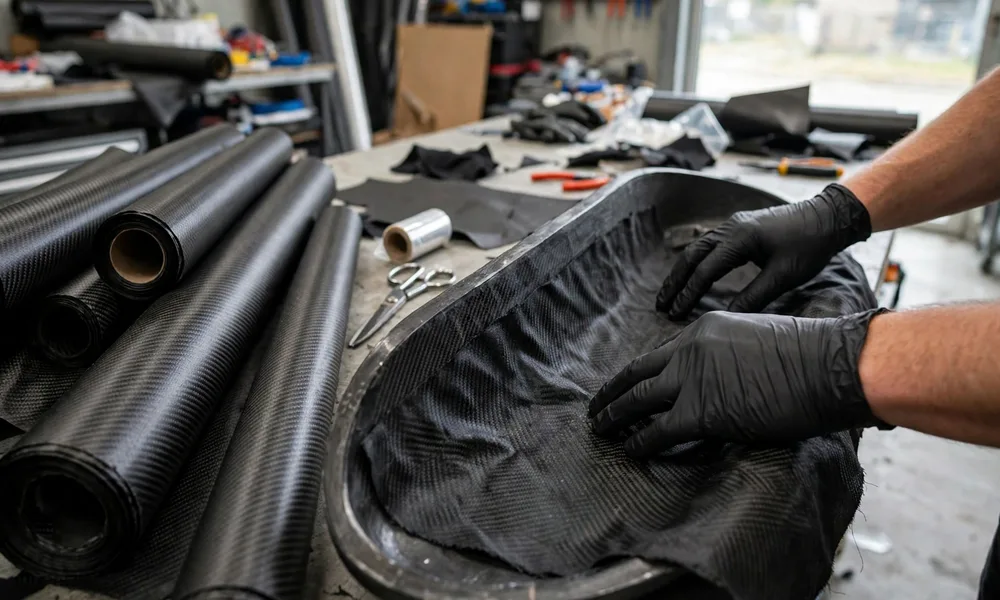
A monocoque is not cast or machined from a block. Technicians lay sheets of carbon-fibre cloth — prepreg, cloth already soaked in resin — into a mould, one layer at a time. The direction of the fibres in each layer is planned: some run lengthways for bending strength, some diagonally for twisting loads, some around the cockpit opening where the shell is weakest. A single cell can contain dozens of layers, and the thickest areas, around the driver and the fuel tank, are built up the most. The honeycomb core that stiffens many composite panels is explained in our guide to honeycomb core materials.
Step 2: The autoclave cure
Once the layers are in the mould, the whole thing goes into an autoclave — a giant oven that heats the part to around 120–180 degrees Celsius while squeezing it at several atmospheres of pressure. The heat cures the resin into a hard plastic matrix, and the pressure squeezes out air bubbles that would become weak spots. When the mould opens, the monocoque is a single rigid piece with no joints or welds.
Step 3: The crash structures
The monocoque itself is only part of the safety system. Ahead of it sits a nose cone and impact structure designed to crush progressively, absorbing energy before the load reaches the driver. Behind the driver sits the fuel cell, wrapped in a rubber bladder and a kevlar cover, inside a section of the monocoque built to contain it. The structure works as a chain, and the monocoque is the link that must never break.
Step 4: The FIA tests
Before a team may race a design, the FIA puts a monocoque through a battery of tests. The survival cell is crashed nose-first into a barrier at 15 metres per second, struck from the side by a heavy impactor, and squeezed by hydraulic rams that apply up to 250 kilonewtons to the cockpit sides, the floor and the roll structure. The cell must not crack open, the dummy inside must not be exposed, and the seat mountings must stay attached. A cell that fails any test goes back to the drawing board.
Step 5: Life on the car
In service, the monocoque carries everything. The front suspension bolts to it, the engine hangs off its rear bulkhead, and the driver sits in a seat moulded to their body and bolted into the cell. After a heavy crash, a monocoque is retired even if it looks undamaged — carbon fibre can hide internal cracks, and no team gambles a driver’s life on a cell with an unknown history. Undamaged cells, meanwhile, can run for several races before being replaced by a newer specification.

How the Monocoque Is Made
The process starts months before a season, with a design frozen in software and a mould machined from aluminium or carbon. The layup takes days of skilled hand work, the autoclave cure hardens the resin, and the shell is then trimmed, fitted with metal inserts, and scanned for flaws. The cost follows the labour — an estimated $500,000 to $1,000,000 per cell — which is why teams guard their layup schedules like state secrets. The brakes that help stop the car from 200 miles per hour are covered in our guide to how carbon ceramic brakes are made.
What a Monocoque Costs to Run
A Formula 1 team does not buy one monocoque and race it all year. A top team builds around six to ten cells per season: two race cars, spares for crashes, and test pieces. At an estimated $500,000 to $1,000,000 each, the monocoque programme alone runs to several million dollars a season, before the engine, gearbox and aerodynamics are counted. Smaller teams stretch fewer cells further, repairing minor damage where the rules allow and keeping a crashed cell as a spare for practice sessions. The cost cap now limits total spending, so the monocoque budget is a real trade-off against wind-tunnel time and upgrades.
The turbocharger that feeds the engine bolted to the back of the cell is explained in our guide to how a hypercar turbocharger works.
A Rare Fact
In the 2007 Canadian Grand Prix, Robert Kubica’s BMW Sauber hit a concrete wall at around 300 kilometres per hour, went airborne, rolled, and was measured at a peak deceleration of about 75 g — a force that should, by any ordinary measure, have been fatal. Kubica walked away with a sprained ankle and a concussion. The monocoque was intact. It remains the most famous demonstration of what the numbers in the table above actually buy: a carbon shell, lighter than a sack of cement, that can turn an unsurvivable-looking crash into a hospital check and a race seat the next weekend.


