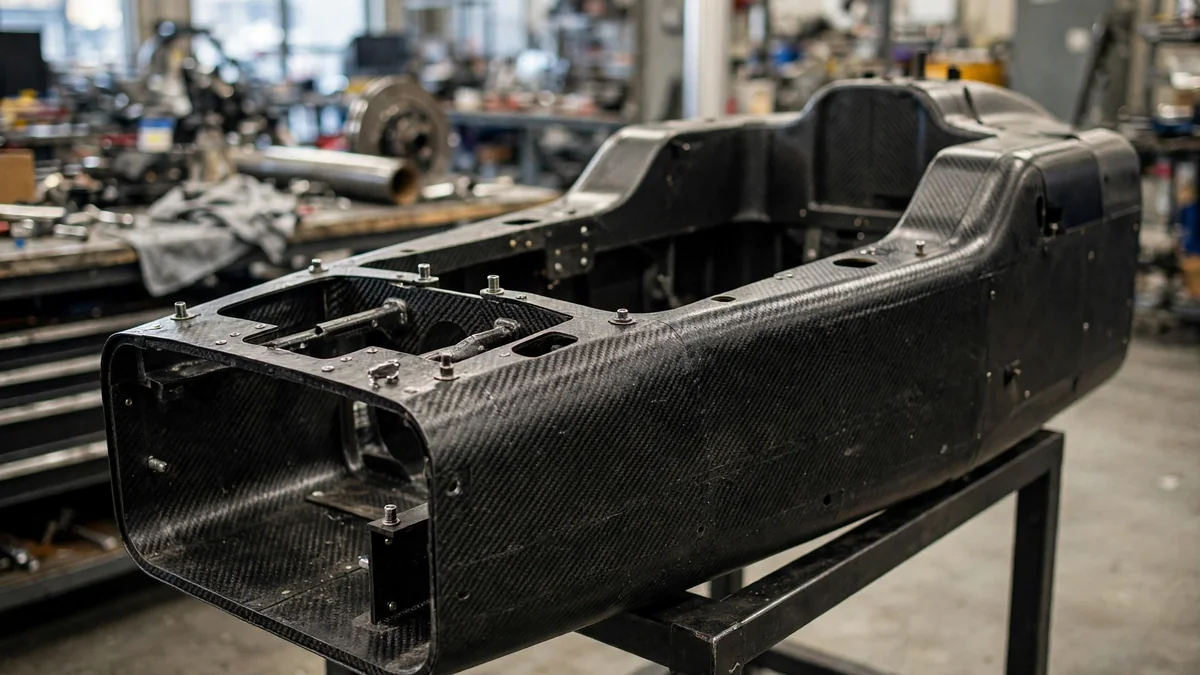
Picture a Formula 1 car hitting a barrier at close to 300 kilometres per hour. The nose crumples, the wheels tear away, and for a terrible half-second the car looks destroyed. Then the driver climbs out, unhurt, and walks away. What saved him was not luck. It was a survival cell the size of a bathtub, built from woven black fabric and glue.
That survival cell is the monocoque, the single-piece chassis at the heart of every Formula 1 car. It holds the driver, the fuel tank, the pedals and the front suspension, and it must be stiff, light, and strong enough to protect a human being in a crash that would destroy almost anything else. It weighs around 70 kilograms, yet it can carry loads of many tonnes without bending.
The monocoque is also, quietly, the most expensive single part of the car. A team builds only a handful each season, each one taking weeks of hand work, and each is a precise recipe of fibres, resins and metals, laid up by hand and baked under pressure.
The Materials Behind It
1. Carbon fibre prepreg, the fabric that carries everything
The monocoque is built from carbon fibre prepreg, sheets of carbon cloth already impregnated with partly cured epoxy resin. The fibres most used are intermediate and high-modulus grades, roughly equivalent to Toray T800 and T1000, with tensile strengths above 5,000 megapascals. Plies are laid in different directions, 0, 45 and 90 degrees, so the laminate is strong in every direction a crash can load it. The same kind of woven cloth is used across the car’s bodywork, as explained in the guide to carbon fibre weave and how its pattern changes strength. Prepreg must be kept frozen until use, because the resin starts curing the moment it warms up.
2. Epoxy resin, the glue that makes the fibres a solid
Carbon fibre on its own is just cloth. The epoxy resin is what turns hundreds of separate plies into one rigid shell. The resin is a toughened aerospace epoxy, chosen to stay strong at race temperatures and to resist cracking under repeated flexing. It softens at high temperature, so the fuel sits inside a rubber bladder behind a crushable structure. The resin is cured in an autoclave, where heat and pressure drive out air and bond the plies into a solid with almost no voids.
3. Aluminium honeycomb core, the sandwich that adds stiffness
Between the carbon skins, the monocoque hides a core of aluminium honeycomb, thin foil formed into hexagonal cells. The sandwich works like a steel I-beam: two stiff skins held apart by a light core are far stiffer than either skin alone, for very little extra weight. Honeycomb density varies across the tub, thicker and denser around the cockpit opening and the front bulkhead, where crash loads are highest. The core also absorbs energy in an impact, the cells crushing progressively instead of failing all at once.
4. Titanium inserts and fasteners, the hard points
Carbon fibre is poor at taking point loads, so anywhere something bolts to the monocoque, engineers bond in titanium inserts. Suspension wishbones, engine mounts, seatbelt anchorages and headrest fixings all land on titanium, usually Ti-6Al-4V, because it is strong, light and bonds well to carbon. Titanium is also used for the fasteners themselves, where steel would be too heavy and aluminium too weak. The inserts are proof-tested to loads far above anything the car will see on track.
5. Zylon and aramid panels, the anti-intrusion armour
Since the early 2000s, the sides of the monocoque have carried panels of Zylon, a polymer fibre stronger than aramid and far tougher than carbon, bonded to the cockpit sides. Carbon fibre is stiff but brittle: it shatters on sharp impact. Zylon does not shatter, it stretches and catches, so a wheel or a piece of debris striking the cockpit side is stopped instead of punching through. The panels are tested by firing a wheel assembly at them. It is the one part of the monocoque whose job is not stiffness, but survival.
How a Monocoque Is Made
- Design and ply book. Engineers model the tub and produce a ply book, a layer-by-layer map of hundreds of carbon plies, each cut to a pattern on a computer-controlled cutter.
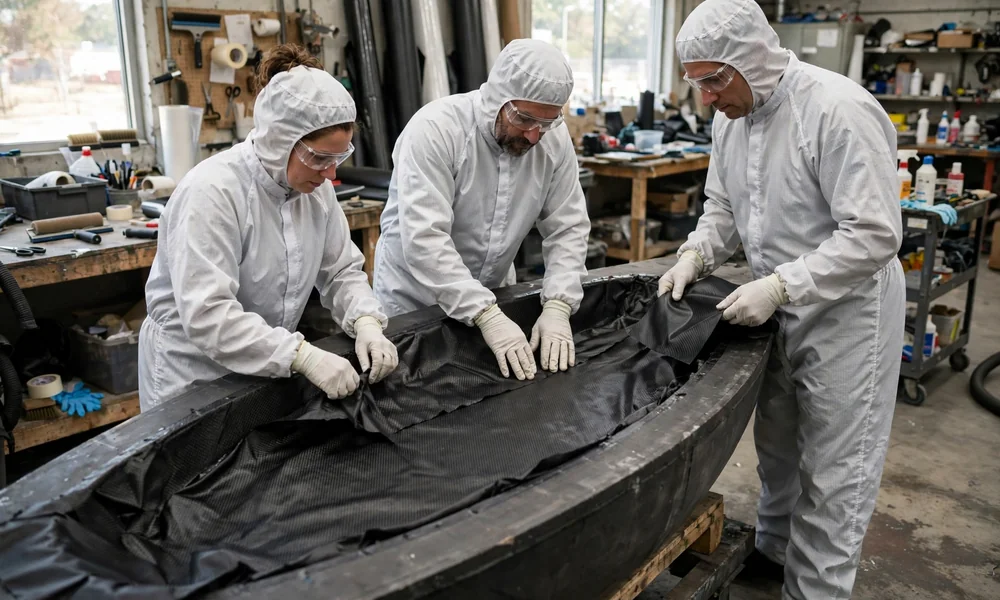
- Lay-up. Technicians lay the plies by hand into a female mould, in the exact order and orientation of the ply book, adding honeycomb core and titanium inserts as the laminate builds up.
- Vacuum bagging. The mould is sealed in a vacuum bag, which squeezes the laminate tight, pulls out trapped air and holds everything in place for the cure.
- Autoclave cure. The mould goes into an autoclave, a giant oven and pressure vessel, heated to around 120 to 180 degrees Celsius under several bars of pressure for hours, curing the resin into a solid.
- Trimming and bonding. The cured tub is trimmed, machined for its inserts, and bonded to the front impact structure, the roll hoop and the engine mounting points.
- Testing. Before it may race, the design must pass the FIA’s static load tests and crash tests, including frontal, side and rollover tests, with the tub surviving intact while the crash structures around it absorb the energy.
Formula 1 Monocoque Materials
| Material | Where it is used | Why it is chosen |
|---|---|---|
| Carbon fibre prepreg | The whole tub shell | Extremely strong and stiff for its weight |
| Toughened epoxy resin | Matrix bonding the plies | Turns cloth into a rigid solid, resists fatigue |
| Aluminium honeycomb | Core between carbon skins | Huge stiffness gain for very little weight |
| Titanium Ti-6Al-4V | Inserts and fasteners | Strong hard points that bond well to carbon |
| Zylon panels | Cockpit sides and opening | Stops debris punching through the carbon |

What Does a Formula 1 Monocoque Cost?
A single monocoque is estimated at roughly $500,000 to $1,000,000, depending on the team and the season’s design, and a team typically builds four to six tubs a year, plus spares. Most of the bill is labour: hundreds of hours of hand lay-up, autoclave time, machining and testing. A crashed tub is usually written off, even if it looks intact, because the laminate may hide damage. For comparison, the stopping power at the other end of the car is just as exotic, and the guide to carbon ceramic brakes shows what it takes to slow a car from 300 kilometres per hour again and again.
A Rare Fact
In 2020, Romain Grosjean’s car hit a barrier at an estimated 192 kilometres per hour and split in two, the rear tearing away while the front, with the monocoque, speared through the barrier and caught fire. Grosjean climbed out of the burning survival cell with burns to his hands and nothing worse. The monocoque had done exactly what it was designed to do.
A Formula 1 monocoque is not really a chassis in the old sense. It is a piece of aerospace engineering that happens to have wheels attached, and a lifeboat that happens to go 350 kilometres per hour. The carbon carries the load, the honeycomb adds the stiffness, the titanium takes the bolts, and the Zylon stands between the driver and the debris. It is why the modern driver can walk away from crashes that once killed. The same obsession with carbon structure shapes the fastest road cars too, as the Aston Martin Valkyrie proves, a road car built like a race car from the tub outwards.


