In Sant’Agata Bolognese, a small town in northern Italy, there is a factory where the loudest thing is not the machinery. It is the engine. The Lamborghini Revuelto carries a brand-new 6.5-litre V12, the latest in a line of twelve-cylinder engines that stretches back to the company’s first car in 1963, and it is built in a plant that was rebuilt around it, with new lines, new tooling, and new testing cells.
The Revuelto’s V12 is naturally aspirated, which means no turbochargers, no supercharger, just twelve pistons pulling air through their own lungs and revving to 9,500 rpm. It makes 825 horsepower on its own, before three electric motors add their share, and it weighs less than the V12 it replaces. Building it is a job for a small team of specialists, not a moving line of hundreds, and each engine is assembled largely by hand, in a sequence that takes hours and ends on a test bench that runs it harder than any owner ever will.
This is how that V12 comes together, from raw castings to the first roar on the bench.
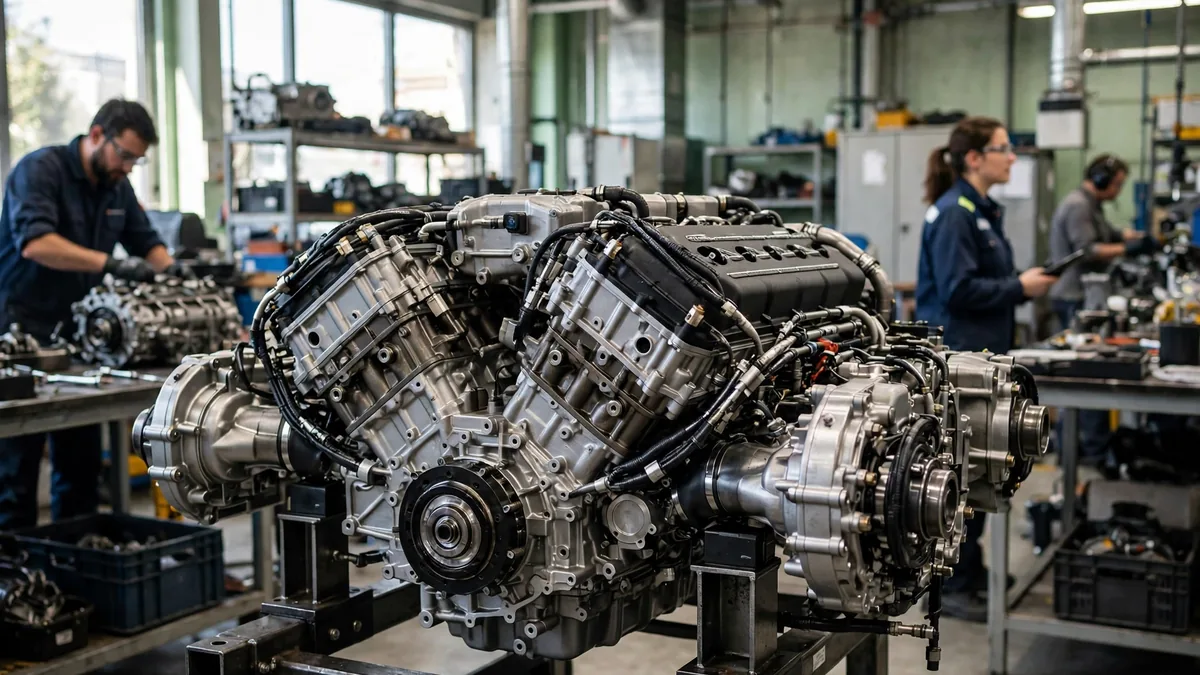
How the Lamborghini Revuelto V12 Is Made
Step 1: Casting the block and heads
The engine begins as aluminium alloy, melted and cast into the crankcase and the two cylinder heads. The Revuelto’s block is a fresh design, lighter than the Aventador’s, with thinner walls made possible by better simulation and tighter casting control. Moulds are filled under pressure, cooled in a controlled cycle, and the raw castings are then aged in ovens to stabilise the metal before any cutting begins. Every casting is X-rayed and checked for hidden voids, because a flaw inside a block that will spin to 9,500 rpm is not a flaw you can live with. Castings that fail are melted down and tried again.
Step 2: Machining to racing tolerances
Machining is done on computer-controlled centres that bore the twelve cylinders, mill the deck faces flat, and cut the seats for forty-eight valves. Tolerances are measured in hundredths of a millimetre, and the bores are honed to a finish that lets the piston rings seal at high revs without excess friction. The crankshaft, forged from steel and then ground and polished, is balanced so precisely that it can spin at nearly ten thousand revolutions a minute without shaking itself apart.
Step 3: Building the rotating assembly
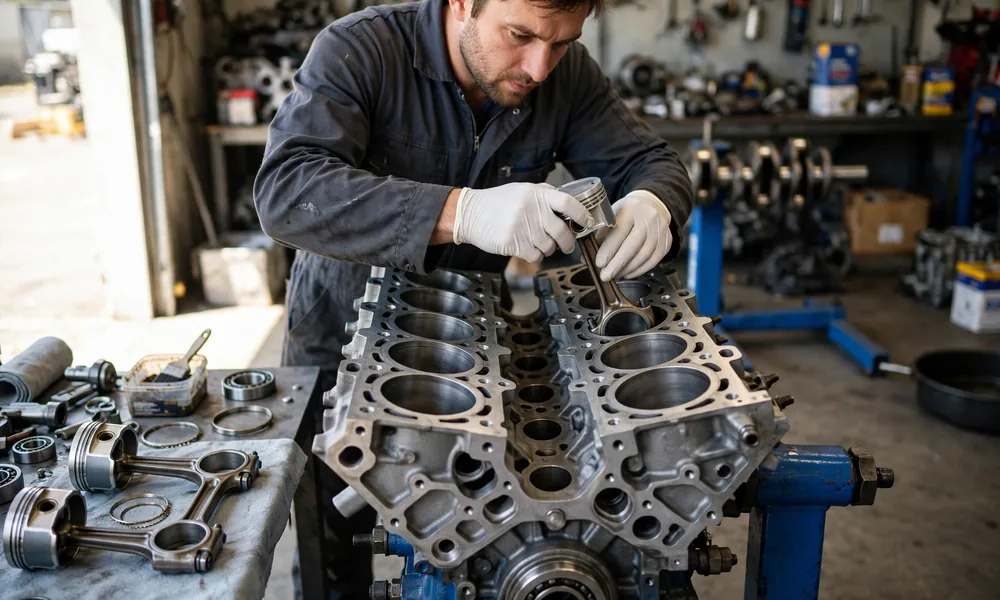
The crankshaft is lowered into the block, its main bearings torqued down in sequence, and the twelve pistons and connecting rods are fitted one bank at a time. Pistons are matched to their bores by weight and size, so each cylinder behaves like the others, and the rings are gapped individually. The valvetrain follows, with four valves per cylinder, double overhead camshafts, and finger followers that let the engine breathe at speeds where ordinary valvetrains would float and fail. Timing is set with dial gauges and locking tools, because a camshaft one tooth out on an engine like this is not a small mistake.
Step 4: Fitting the intake and exhaust
The intake system, with its long trumpets tuned to the engine’s natural resonances, is bolted on top, and the exhaust manifolds are fitted to the heads. The Revuelto’s exhaust is part of its character, and its routing is designed as much for sound as for flow, with the tailpipes exiting high at the rear of the car. Sensors, wiring looms, and the direct-injection fuel rails are added, each connector clicked home and each clip checked. The engine at this point is nearly complete, a dense package of metal and plumbing that looks more like a sculpture than a machine.
Step 5: Marrying the hybrid system
Unlike every V12 Lamborghini before it, the Revuelto is a plug-in hybrid, and the engine is built to work with three electric motors: two at the front axle and one inside the eight-speed dual-clutch gearbox at the rear. The gearbox itself is a new design, mounted behind the engine, and the motor inside it fills in torque while the gears change. Fitting the hybrid hardware means high-voltage cables, orange-jacketed and routed with strict separation from everything else, plus cooling circuits for the battery and the power electronics.
Step 6: The test bench
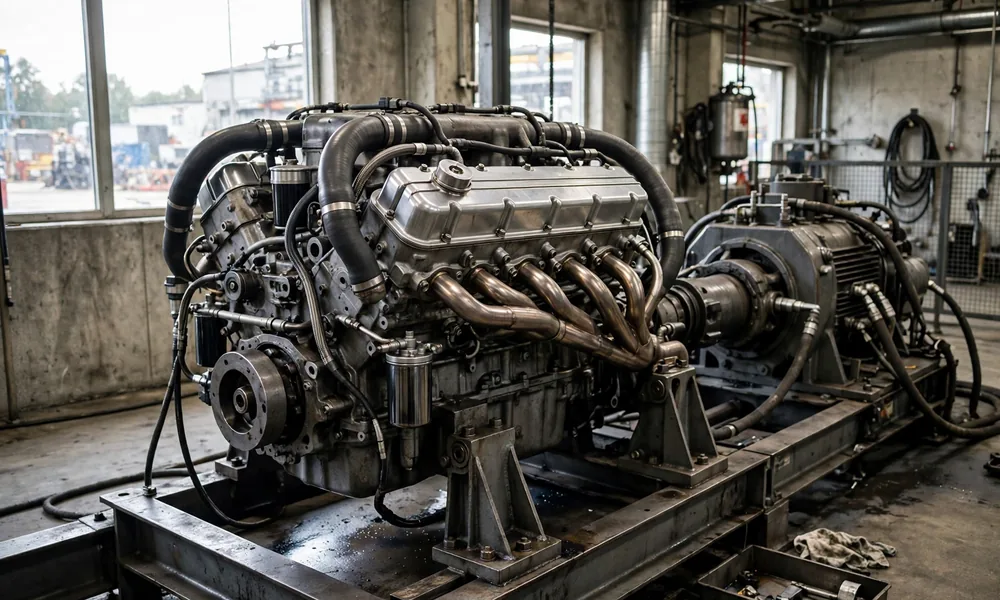
Every Revuelto V12 is run on a test bench before it meets a car. The engine is fuelled, cooled, and wired to a dynamometer, then run through a programme that takes it through its rev range, checks power and torque against the specification, and listens for knocks, leaks, and vibrations. Oil pressure, coolant temperature, and exhaust readings are logged, and any engine that misses its targets is pulled apart to find why. Only an engine that passes the bench is released, cleaned, and sent to the car assembly line, where it is lowered into a chassis that has been waiting for it.
Specifications
| Specification | Typical value |
|---|---|
| Engine | 6.5-litre naturally aspirated V12 |
| Power (engine alone) | 825 hp at 9,250 rpm |
| Redline | 9,500 rpm |
| Hybrid system | Three electric motors, plug-in hybrid |
| Gearbox | Eight-speed dual-clutch |
| Block material | Cast aluminium alloy |
| Valves | 48, four per cylinder |
| Weight | Lighter than the Aventador V12 it replaces |
| Testing | Full-load dynamometer run on every engine |
| Built in | Sant’Agata Bolognese, Italy |
What It Costs
The Revuelto is a car that starts at roughly $600,000 before options, and the V12 is the reason much of that price exists. Lamborghini does not sell the engine on its own, so any figure for the engine alone is an estimate, but industry estimates put a hand-built, low-volume V12 of this kind in the tens of thousands of dollars to produce, before the hybrid system and gearbox are counted. The cost is driven by low volume, hand assembly, and the test-bench time every unit gets. All prices here are estimates, and the car’s list price varies by market, taxes, and the options list, which on a Lamborghini can run long.
A Rare Fact
The Revuelto’s V12 is the lightest V12 Lamborghini has ever built, yet it is also the most powerful engine the company has ever fitted to a production car. That combination comes from a block that was redesigned from scratch rather than evolved from the Aventador’s, with thinner walls, a new casting process, and a dry-sump lubrication system that lets the engine sit lower in the chassis. And despite the hybrid system, the V12 itself has no turbochargers at all, which makes the Revuelto one of the very few new supercars whose flagship engine still breathes entirely on its own. It is a deliberate choice, and it is why the car sounds the way it does.
The V12 is the end of a line and the start of another: the last naturally aspirated twelve-cylinder Lamborghini will ever build, and the first to share its work with electric motors. Its factory story sits alongside the company’s other great engines, from the hand-built Bugatti W16, whose own specifications read like a dare, to the carbon-ceramic brakes that have to stop whatever the engine starts. In Sant’Agata, they still build engines one at a time, and they still test every one before it leaves.


