When Lamborghini replaced the Huracán, it did not just build a faster car. It built a new engine from scratch, a four-litre twin-turbo V8 that revs to ten thousand revolutions per minute, makes around eight hundred horsepower on its own, and works with electric motors to push the Temerario to about nine hundred and twenty horsepower in total. It is the most technically ambitious engine the company has ever put in a production car.
The Temerario’s V8 is a clean-sheet design, not a borrowed engine with a Lamborghini badge on it. It has a flat-plane crankshaft like a racing engine, its two turbochargers sit in the V of the engine where they can spool quickly, and it was designed from the start to work with a hybrid system rather than having one bolted on afterwards. Every part of it, from the block to the turbos, exists to serve two masters at once: the instant response of an electric motor and the scream of a high-revving petrol engine.
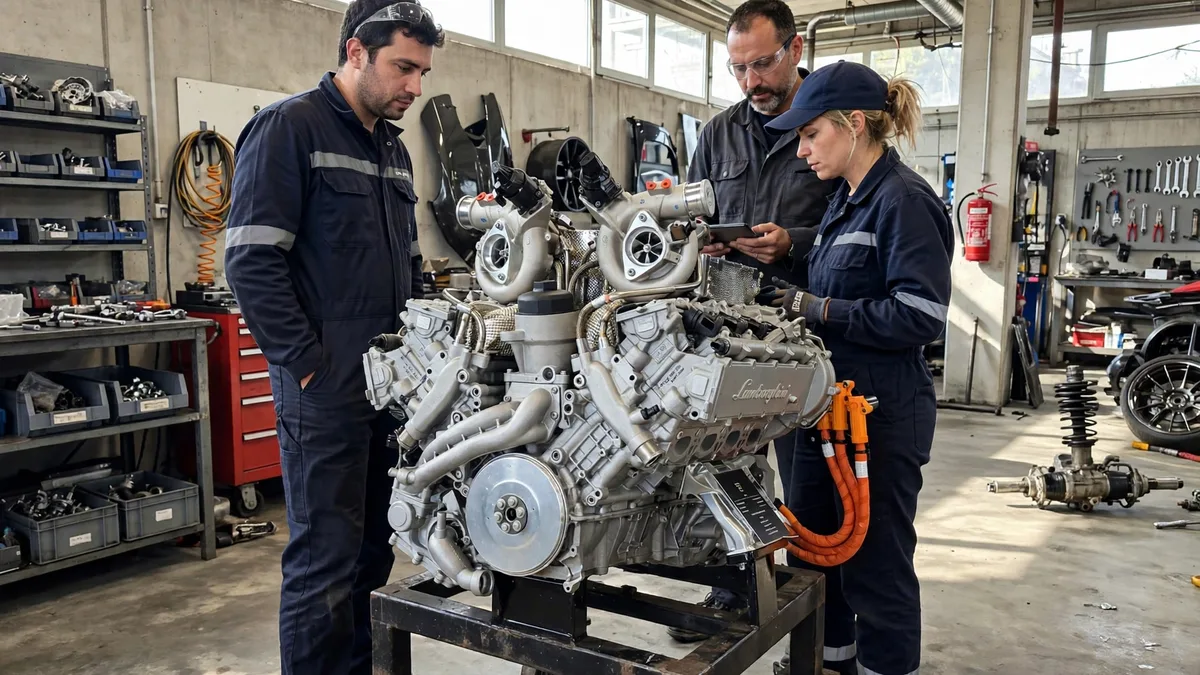
Building that engine is a job for a small team in Sant’Agata Bolognese, Italy, where Lamborghini has built its cars for decades. There is no high-speed production line here, no engine rolling past on a conveyor every minute. Instead, each V8 moves through a series of stations where technicians assemble, measure, and test it by hand. Here is how it is made.
How the Lamborghini Temerario V8 Is Made
Step 1: Casting the aluminium block
The engine begins as molten aluminium alloy, poured into moulds to form the crankcase that holds the eight cylinders in their V layout. The block is the foundation of everything that follows, so the casting has to be perfect: any hidden void or weak spot would only show up later, under boost, at ten thousand revs. Once cool, the casting is cleaned, inspected with X-rays for flaws buried inside the metal, and heat-treated to stabilise it. Blocks that fail inspection are scrapped, because there is no repairing a casting that will hold eight pistons and two turbochargers at full load. Only a perfect block moves on to machining, and the standard is the same one Lamborghini applies to its V12s.
Step 2: Machining the block and heads
The raw casting is clamped into a computer-controlled machining centre, where cutters bore the eight cylinder liners, mill the mating faces flat, and drill the oil and coolant passages to their final sizes. Tolerances are measured in hundredths of a millimetre, and each bore is honed to a mirror finish so the piston rings can seal against it under high turbo boost. The two cylinder heads are machined the same way, with seats cut for thirty-two valves, four per cylinder, and passages shaped for the hot-V turbo layout.
Step 3: Fitting the flat-plane crankshaft and pistons
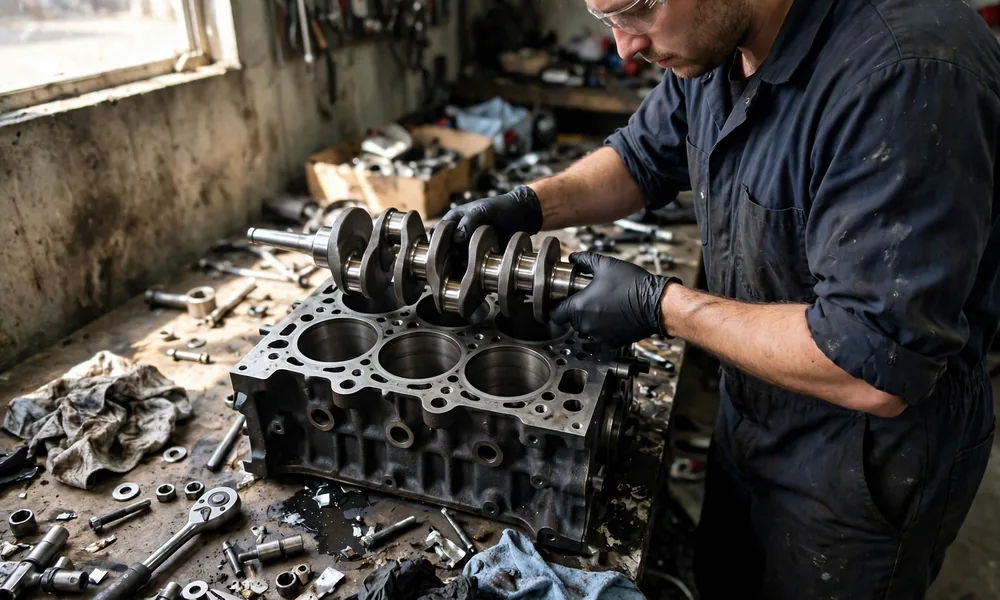
Next comes the rotating heart of the engine. The Temerario uses a flat-plane crankshaft, the kind found in racing engines, where the crank pins sit at one hundred and eighty degrees to each other instead of ninety. It is lighter and revs more freely than the cross-plane crank in most road-car V8s, and it gives the engine its sharp, high-pitched sound. The crankshaft is forged from steel, ground to its final shape, and balanced to spin true at ten thousand revs. Forged pistons and connecting rods are fitted to it, each set weighed and matched so the rotating assembly is balanced, and the whole crank is lowered into the block and bolted down with main bearing caps torqued to an exact figure.
Step 4: Mounting the hot-V turbochargers
The two turbochargers sit inside the V of the engine, between the cylinder banks, rather than hanging off the sides. This hot-V layout shortens the path the exhaust gases travel to reach the turbines, so the turbos spool faster and the engine answers the throttle with less delay. Each turbo is a precision assembly in its own right, its turbine wheel spinning at well over a hundred thousand revolutions per minute, balanced to a fraction of a gram. Technicians fit the turbos, their oil and coolant lines, and the intercoolers that chill the compressed air before it enters the cylinders. The plumbing is tight and crowded, and every hose and clamp is checked twice, because a boost leak at full throttle would cost power and could damage the engine.
Step 5: Adding the hybrid system
The Temerario is a hybrid, and the V8 was designed around that fact. Electric motors work with the engine, filling in torque at low revs while the turbos spool, and adding power at the top end. The motors and their power electronics are fitted alongside the engine, with high-voltage cables routed through shielded channels and cooling lines to keep the electronics at their working temperature. Technicians check every connection and run diagnostics before the engine moves on, because a fault in the hybrid system would show up as a hesitation the driver would feel at once.
Step 6: Assembling the engine by hand
With the major parts in place, the engine is assembled by hand at a series of stations, one technician or a small team working on each engine at a time. Ancillaries go on one by one: the oil pumps, the water pump, the fuel rails and injectors, the ignition coils, the exhaust manifolds, and the wiring harness that ties the whole engine to the car’s computers. Every bolt is tightened to a figure on a checklist, and every torque value is recorded. Nothing is rushed, because the assembly is also an inspection: the technician fitting a part is the last person who will see that joint before the engine is sealed up and run. By the end of this stage, the V8 is complete, a compact, densely packed unit that looks as much like a piece of sculpture as a machine.
Step 7: Testing on the bench, then in the car
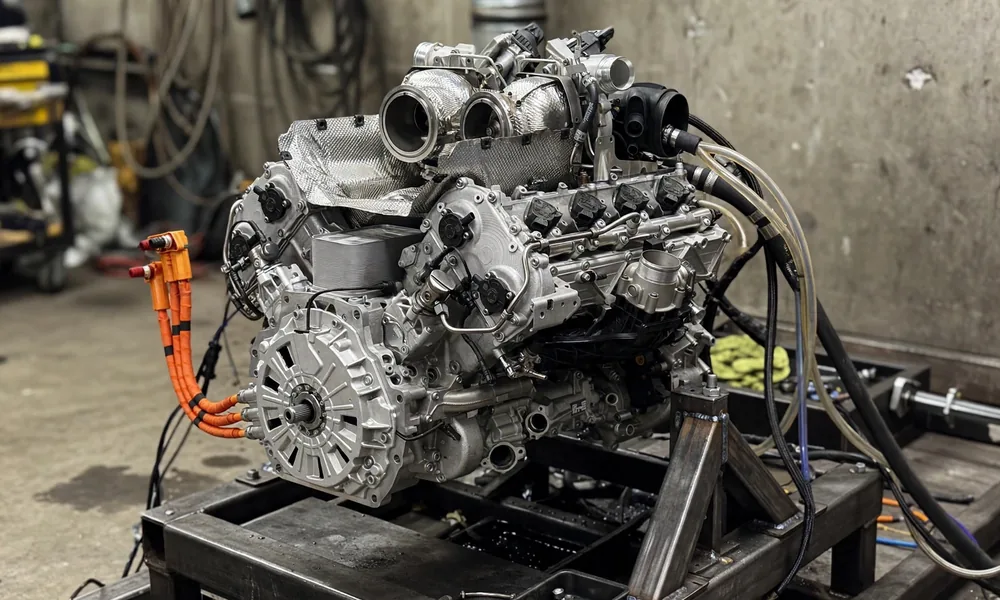
No Temerario engine leaves the factory untested. Each finished V8 is mounted on a test bench, connected to fuel, cooling, and exhaust, and run through a programme that takes it from idle to full revs and full boost, while engineers watch power, temperatures, oil pressure, and vibration. The bench run checks that the engine makes its rated power and that nothing leaks, rattles, or overheats. Only after it passes is the engine released to the production line, where it is lowered into the Temerario’s chassis, mated to its gearbox, and connected to the hybrid system. The car then goes through its own tests, including a road test, before it is signed off. The bench test is the last gate, and it is also the proof that the hours of hand assembly were worth it.
The Temerario V8 is a bet on a particular idea: that a hybrid supercar can still feel like a Lamborghini, with a screaming, high-revving engine at its heart, rather than a quiet appliance with a badge. The Revuelto’s V12 shows the same philosophy at the top of the range, the Revuelto production line shows how the factory handles it, and the dual-clutch gearbox is what turns all that power into speed. The V8 is smaller and newer than the V12, but it is built to the same standard, by the same hands, in the same factory, and that is the point.