It weighs more than a house, spins faster than a car engine, and spends its entire life underwater, invisible to everyone it serves. A ship propeller is the largest single piece of machinery most people will never see, and it is also one of the most precisely made objects on Earth. A propeller for a container ship can be ten metres across and weigh a hundred tonnes, yet its blades are shaped to tolerances of millimetres, balanced to grams, and polished to a mirror finish — because a blade that is slightly wrong does not just waste fuel, it shakes the whole ship.
Building a propeller is foundry work on a heroic scale. The metal arrives as ingots, is melted in furnaces that hold tens of tonnes, and is poured into a mould the size of a room. Then the real work begins: weeks of machining, grinding and polishing by craftsmen who can read a blade’s shape with their hands. It is one of the oldest heavy industries in the world, and one of the least changed.
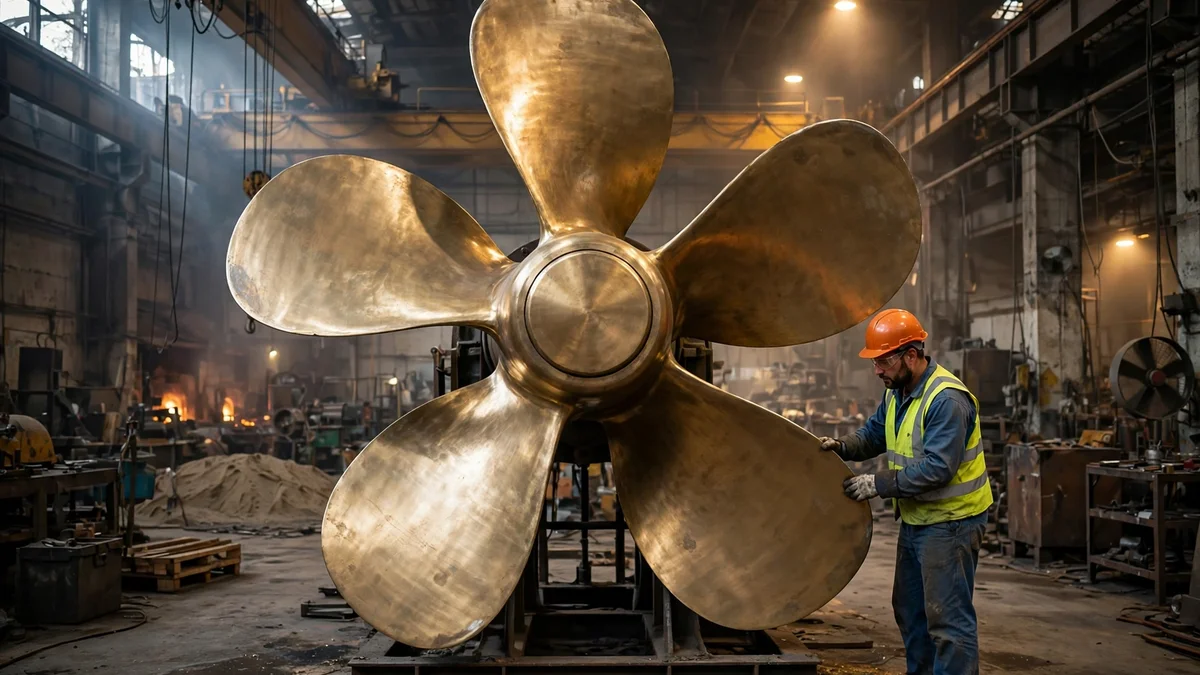
How a Ship Propeller Is Made
Step 1: Designing the blades
Every propeller starts with the ship it will serve. Naval architects calculate the hull’s resistance, the engine’s power and the speed the ship must reach, then design a propeller to match — the number of blades, their diameter, their pitch and their shape. A slow bulk carrier gets a large, slow-turning propeller; a fast ferry gets a smaller, faster one. The design is tested in software and in model tanks, where a scale propeller is run in a towing tank to measure thrust and efficiency. A well-designed propeller is about 70 percent efficient; a poor one wastes fuel on every voyage. The design stage also decides the alloy, almost always a nickel-aluminium bronze that resists corrosion and cavitation.
Step 2: Making the mould
The mould for a large propeller is a work of engineering in itself. Foundry workers build it from sand, shaped around a pattern of the blades, with channels for the molten metal to flow in and for air to escape. The mould must be strong enough to hold tens of tonnes of liquid bronze without cracking, and it must be built to exact dimensions — the casting that comes out of it will be close to the final shape, but there is no room for a mould that is wrong. Building the mould takes days, and it is destroyed in the pour, so every propeller needs a new one.
Step 3: The pour
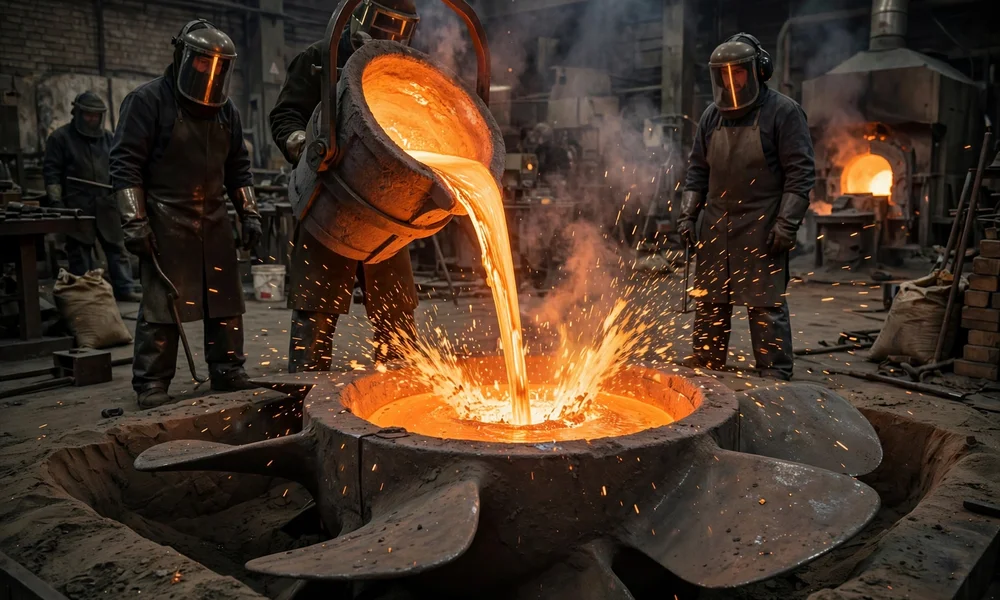
The pour is the most dramatic moment in the factory. Bronze is melted in a furnace at over 1,000 degrees Celsius, and when the metal is ready, the crucible is lifted and tipped, and a river of glowing orange metal flows into the mould. The pour must be continuous and steady — stop, and the metal cools and forms a weak seam; pour too fast, and air is trapped. Then the mould is left alone for days while the casting cools slowly — cooling a hundred-tonne casting too fast would crack it.
Step 4: Rough machining
Once the casting has cooled, the mould is broken away and the rough propeller is revealed — dull, heavy, and close to its final shape but not there yet. It is lifted onto a huge vertical lathe or a five-axis milling machine, some of the largest machine tools in the world, and the blades are machined to their designed profile. The machine works for days, removing metal in careful passes. The hub is bored to fit the propeller shaft, and the keyway is cut. The machining discipline is the same one that shapes submarine propellers, where silence matters as much as thrust.
Step 5: Grinding and polishing by hand
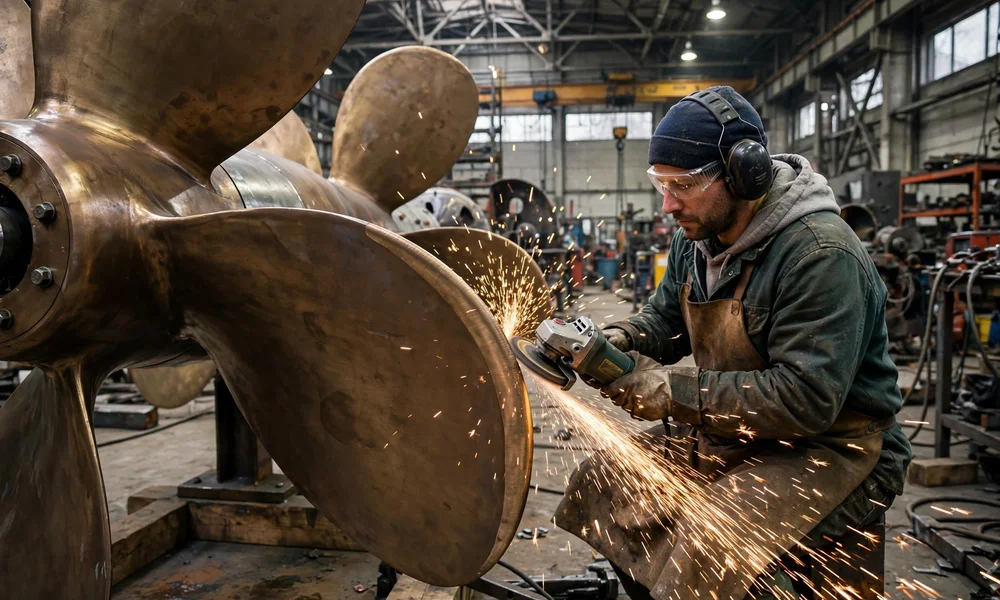
The final surface of a propeller is finished by hand. Craftsmen grind each blade with portable tools, checking the shape with templates and gauges, and then polish the bronze until it shines. The polish is not cosmetic: a smooth blade resists cavitation and reduces drag. A propeller blade is checked in dozens of places, and the craftsmen work by eye and by feel as much as by measurement — a skill that takes years to learn and cannot be automated. The same hand-finishing tradition shapes superyacht steel hulls.
Step 6: Balancing
A propeller that is not balanced will shake the ship. The finished propeller is mounted on a balancing machine, spun slowly, and checked for any heavy spot. If one blade is heavier than the others, metal is ground away until the propeller is balanced to within grams — an extraordinary tolerance for an object that weighs as much as a house. A balanced propeller runs smoothly for decades; an unbalanced one wears out bearings and costs fuel on every voyage.
Step 7: Inspection, coating and delivery
Before delivery, the propeller is inspected one last time: its dimensions are measured, its surface is checked for defects with dye penetrant, and its material is verified. Then it is coated with a protective layer for transport, crated or loaded onto a heavy trailer, and shipped to the shipyard. Fitting it to the ship is a major operation in itself — the propeller is lifted by crane, slid onto the shaft in dry dock, and bolted in place. When the ship sails, the propeller disappears under the water until the next dry docking, years later. The same long, quiet service life is expected of the structures around it, including the modular ship construction that carries the shaft and the stern.
Ship Propeller at a Glance
| Specification | Typical Value |
|---|---|
| Main material | Nickel-aluminium bronze (NiAl bronze) |
| Diameter | Up to about 10 m on the largest container ships |
| Weight | Up to about 100 tonnes for the largest propellers |
| Blade count | Usually 4–6 blades, depending on the ship |
| Melting temperature | Over 1,000°C for the bronze pour |
| Efficiency | About 60–70% at design speed |
| Key advantage | Huge thrust from a single, precisely shaped casting |
What Does It Cost?
A large ship propeller is one of the most expensive single components on a vessel. A propeller for a large container ship typically costs $500,000–$2 million (estimates), depending on size and alloy, and the foundry work, machining and hand-finishing account for most of that. Smaller propellers for ferries and workboats run from tens of thousands of dollars (estimates). Spread over a working life of twenty years or more, it is one of the cheapest parts of a ship per voyage — but only if it is made right. A cheap, poorly finished propeller costs its owner fuel and repairs for its entire life.
A Rare Fact
The largest propellers ever made are so big that their blades are cast separately and bolted to the hub, because no foundry could pour a single casting that large. The most secretive propellers belong to submarines, where the blade shape is a classified secret — a noisy propeller is what gets a submarine found. The shape that pushes a ship silently through the sea is, quite literally, a matter of national security.