On a quiet night in the North Atlantic, a submarine slips beneath the waves and vanishes. There is no wake, no smoke, no sound a listening ship can follow. That silence is not an accident. It is engineered, millimetre by millimetre, into the one part of the boat that does all the pushing: the propeller.
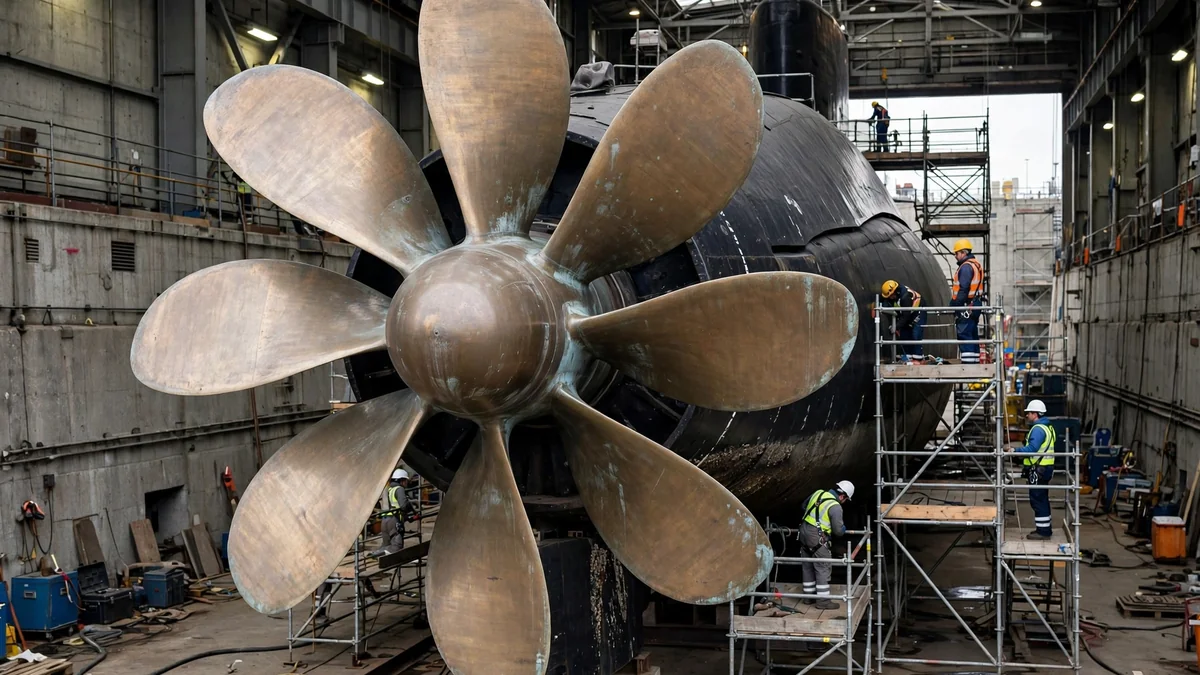
A submarine propeller looks simple from a distance, a bronze flower of curved blades turning at the stern. Up close it is one of the most demanding machines ever put to sea. It must turn the power of a nuclear reactor, or a bank of batteries, into forward motion without shaking the boat, without making bubbles, and without giving the submarine away. A surface ship can afford a noisy propeller. A submarine cannot. This is how the silent propeller works.
How It Works
Step 1: Turning power into thrust
The propeller’s job begins deep inside the boat, where the engine turns a shaft that runs the length of the submarine to the stern. On a nuclear boat the reactor makes steam to drive a turbine; on a conventional boat, batteries drive an electric motor. Either way, the shaft spins, and the propeller bolted to its end spins with it. Each blade is set at an angle, like the wing of an aeroplane, so that as it turns it pushes water backwards, and the water pushes the submarine forwards.
Step 2: Shaping the blades to bite the water
A propeller blade is not flat. It is a twisted, curved surface, shaped so that every part of it meets the water at the right angle. Near the hub, where the blade moves slowly, the twist is steep; near the tip, where it moves fastest, the twist is shallow. This is called the pitch. Submarine blades are also broad and swept back, so the load is spread across a large area of water. The broader the blade, the more gently it can push, and the quieter the boat stays. Shaping a blade this precisely demands the same care as titanium machining, where a tiny error can ruin an expensive part.

Step 3: Choosing the bronze
Submarine propellers are cast from a special nickel-aluminium bronze, chosen because it is strong, resists corrosion in salt water, and can be repaired by welding. A single propeller can weigh several tonnes, cast in one piece in a foundry mould the size of a small room. The molten bronze is poured and left to cool slowly, then weeks of machining, grinding and polishing bring the blades to their final shape. A rough surface is a noisy surface, and noise is the enemy.
Step 4: Keeping the blades in balance
A propeller spinning at a hundred revolutions a minute, with blades weighing hundreds of kilograms each, must be balanced to within grams. If one blade is even slightly heavier than the others, the shaft vibrates, and vibration travels through the hull into the water, where an enemy sonar can hear it. So each blade is weighed, and metal is ground away in tiny amounts until all the blades match. The same exact fit matters across the boat, where whole sections are built separately and joined, as in modular ship construction.
Step 5: Fighting cavitation, the propeller’s worst enemy
The greatest threat to a silent propeller is cavitation. When a blade moves fast enough, the pressure on its back drops so low that the water itself boils, forming tiny bubbles. Those bubbles collapse a fraction of a second later, and each collapse is a tiny explosion that pits the bronze and makes a loud crackling noise. A cavitating propeller can be heard for miles. Submarine designers fight it in three ways: they use many blades, often seven, so each blade carries less load; they turn the propeller slowly, using a large diameter to get the thrust instead of speed; and they keep the blades smooth and perfectly shaped so the water flows over them without sudden pressure drops. Some modern boats use a pump-jet instead, a propeller hidden inside a duct, which is even quieter.
Step 6: Sealing the shaft and fitting the propeller
The shaft has to pass through the pressure hull, which holds back the ocean at depth, so the seal where it leaves the boat is one of the most carefully built parts of the submarine. A series of seals and bearings keeps the sea out while letting the shaft spin freely, and a slow drip of lubricating oil keeps the seal cool. At the stern, the propeller is fitted onto the tapered end of the shaft and pulled tight with a huge hydraulic nut, then locked in place. The fit is checked with feeler gauges, because a propeller that sits even slightly off-centre will vibrate.

Step 7: Proving the silence at sea
On sea trials, the submarine runs at every speed while listening ships and hydrophones record its noise. If a particular speed makes the propeller cavitate, that speed is marked as one to avoid. The propeller is inspected after every patrol, because even a small dent from a rope or a fishing net can change the flow over a blade and make the boat louder. When damage is found, the blade is ground smooth or welded and reshaped, and the balance is checked again. A submarine’s stealth is not a single invention but a habit: the propeller is checked, polished and protected for the whole life of the boat. The pressure vessel it pushes faces the same standard, as the crew of Alvin’s titanium pressure sphere know.
Specs
| Specification | Typical figure |
|---|---|
| Material | Nickel-aluminium bronze, cast in one piece |
| Number of blades | Five to seven on most modern boats |
| Diameter | Typically 4 to 7 metres on a large submarine |
| Weight | Several tonnes for a single propeller |
| Turning speed | Usually under 200 revolutions per minute at full speed |
| Top speed pushed | About 20 to 35 knots, depending on the boat |
| Blade finish | Polished smooth, balanced to within grams |
| Service life | Decades, with regular inspection and repair |
Price
A submarine propeller is never sold on its own, and navies do not publish a price for one. As an estimate, a single large submarine propeller, cast, machined and balanced, is generally understood to cost in the region of several hundred thousand to a few million dollars, depending on its size and complexity — this is an estimate, and the true figure is classified. For scale, a complete modern submarine costs roughly $500 million to $4 billion, depending on type — also estimates. The propeller is a small fraction of that cost, but it is the fraction that decides whether the boat can be heard.
A Rare Fact
During the Second World War, the shape of a submarine propeller was one of the most closely guarded military secrets in the world: photographs of a boat in dry dock were routinely censored to hide the propeller, because a rival navy could read its speed, its noise and its design from the curve of a single blade. Some navies still cover their propellers with tarpaulins in dry dock today, more than eighty years later.
From molten bronze to a silent spin in the dark, the submarine propeller is a piece of engineering that has to be powerful and invisible at the same time. It is the loudest thing a submarine owns, and its whole job is to make no sound at all. That is what makes it extraordinary.


