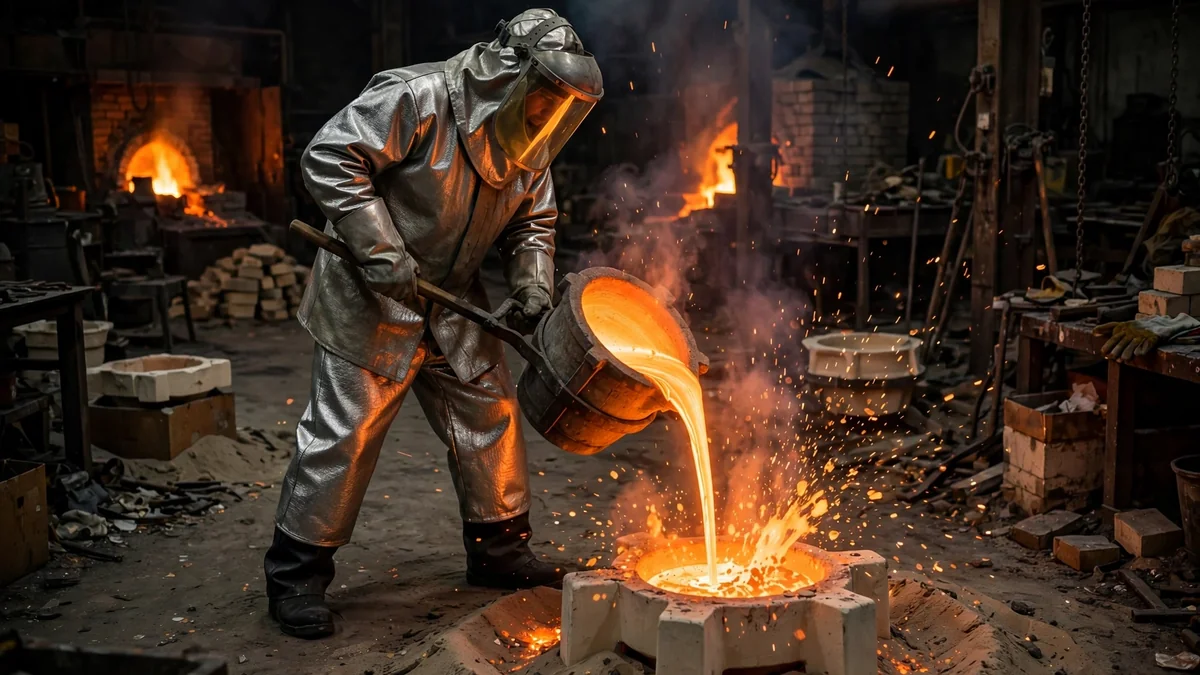
The hottest room in the factory is also the quietest. There is no hammering, no cutting, no roar of machinery — only the glow of a furnace, the slow swing of a crucible, and a worker in a silver heat suit tipping a stream of liquid metal into a mould. The metal is not steel. It is a nickel superalloy, an alloy so resistant to heat that it stays strong at temperatures where ordinary steel would sag like candle wax. Inside a jet engine, turbine blades made from this metal spin in gas hotter than their own melting point, cooled only by air forced through tiny channels inside them. Every one of those blades begins here, in a mould, in the glow.
Superalloy casting is the art of freezing liquid metal into a shape that can survive hell. A turbine blade is one of the most demanding parts ever made: it must hold its shape at more than 1,000 degrees Celsius, spin at thousands of revolutions per minute, and survive for thousands of hours without cracking.
How Superalloy Casting Is Made
Step 1: Making the wax pattern
Every blade begins as a wax replica, injected into a steel die in the exact shape of the finished part, including the hollow cooling channels that will run inside it. Those channels are formed around ceramic cores — fragile, precisely shaped inserts that sit inside the wax and will later be dissolved away, leaving hollow passages behind. Several patterns are then joined onto a central wax sprue, like branches on a tree, so that a dozen blades can be cast in a single pour.
Step 2: Building the ceramic shell
The wax tree is dipped, again and again, into a ceramic slurry and then coated with fine sand, building up a shell layer by layer until it is several millimetres thick. Each coat is dried carefully before the next, and the whole process takes days. The result is a hard ceramic mould that can survive molten metal at 1,500 degrees Celsius without cracking.
Step 3: Melting out the wax and firing the shell
The coated tree is placed in an autoclave, where steam melts the wax out through a hole at the base, leaving a hollow ceramic mould with the ceramic cores still inside. The empty shell is then fired in a furnace at over 1,000 degrees Celsius, burning out the last traces of wax and hardening the ceramic into a mould strong enough to hold molten metal. The fired shells are inspected for cracks, because a cracked shell will leak superalloy across the furnace floor.
Step 4: Melting the superalloy
Meanwhile, the superalloy itself is being prepared. Nickel superalloys are complex recipes — nickel mixed with chromium, cobalt, aluminium, titanium, tungsten and a dozen other elements in exact proportions, some of which are added in quantities of less than one percent. The alloy is melted in a vacuum induction furnace, because at these temperatures the metal would react with air and be ruined. The molten metal is held at around 1,500 degrees Celsius, stirred by the induction field, and tested before pouring. The same obsession with exact composition that makes a rare alloy expensive — as with Inconel — is what makes a turbine blade possible at all.
Step 5: Pouring and directional solidification
The pour is the moment everything depends on. The glowing shell is placed in a vacuum chamber, the crucible tips, and the molten superalloy flows into the moulds. For the most advanced blades, the mould is then withdrawn slowly from the furnace, so the metal solidifies from the bottom up in a single crystal — one continuous grain with no boundaries at all. Grain boundaries are where cracks start at high temperature, so a single-crystal blade has no place for a crack to begin. It is the slowest, most patient step in the whole factory.
Step 6: Breaking out the casting
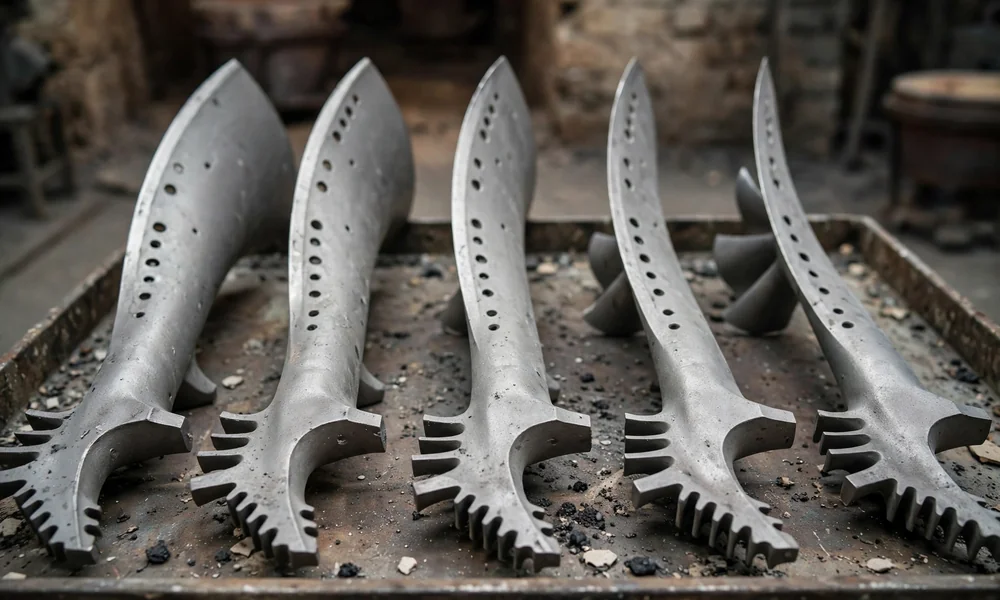
Once cool, the ceramic shell is broken away with hammers and vibration, and the metal tree emerges, grey and rough, with the blades still attached to the sprue. The ceramic cores inside the blades are dissolved out with a caustic solution, leaving the hollow cooling channels open. The blades are cut from the tree, and their surfaces are cleaned by blasting and chemical washing. What remains is a blade that looks almost finished — but it is still far from flight-ready, because casting leaves the metal in a state that must be tuned.
Step 7: Heat treatment and inspection
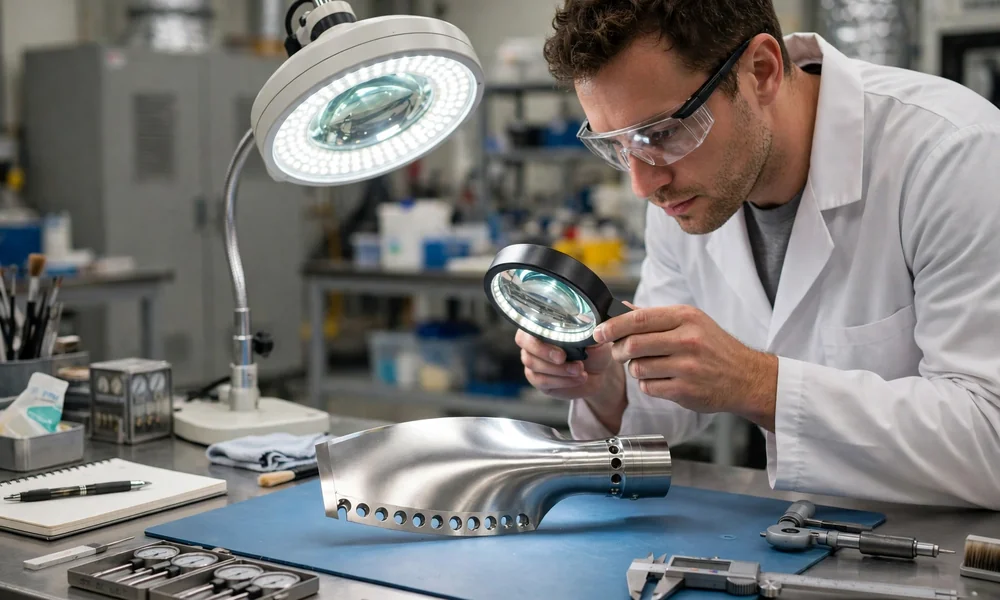
The blades go through a carefully controlled heat treatment, a cycle of heating and cooling that sets the alloy’s internal structure and gives it its final strength. Then comes coating: a ceramic thermal barrier coating, sprayed on in layers, that insulates the metal from the hottest gas in the engine. Finally, every blade is inspected — X-rayed for hidden voids, measured to within microns, and tested for the alignment of its single crystal. The same uncompromising standard that governs a twelve-cylinder hypercar engine, as in hypercar V12 production, governs every blade that leaves this foundry.
Superalloy Casting at a Glance
| Specification | Typical Value |
|---|---|
| Main alloys | Nickel-based: Inconel 718, CMSX-4, René N5 |
| Melting temperature | About 1,300–1,500 °C |
| Service temperature | Over 1,000 °C in a turbine |
| Casting method | Lost-wax investment casting, vacuum poured |
| Blade types | Equiaxed, directionally solidified, single crystal |
| Cooling channels | Hollow, formed by leached ceramic cores |
| Key advantage | Strength at temperatures where steel fails |
What Does It Cost?
Superalloy casting is one of the most expensive ways to make a part, and the price reflects it. A single large turbine blade can cost $1,000 to $10,000 (estimates), and a full set for one engine can run into hundreds of thousands of dollars (estimates). The cost comes from everywhere: the alloy itself, with its rare elements, can cost $50–$150 per kilogram (estimates); the ceramic moulds take days to build and are destroyed in a single use; and the scrap rate for single-crystal blades can reach 20 percent or more (estimates). A vacuum induction furnace costs several million dollars (estimates). Yet there is no alternative — no other material and no other process can make a blade that survives inside a jet engine, so the price is paid.
A Rare Fact
A single-crystal turbine blade has no grain boundaries at all — it is one continuous crystal, grown like a gemstone, and it is the reason modern jet engines can run hotter than ever. The first single-crystal blades were developed in the 1970s, and they raised the temperature a turbine could survive by more than a hundred degrees, which in turn made engines more powerful and more efficient. It is a quiet triumph of patience over heat, and it shares its spirit with the most extreme engineering anywhere, from Bugatti’s W16 engine to the blades themselves — different machines, same rule: when failure is not an option, you build the part that cannot fail.


