Put on a virtual reality headset and the world disappears. Mountains rise in front of you, a workshop appears around you, and the screen that makes it all possible is only a few centimetres from your eyes. What stands between your eyes and that screen is a pair of lenses no bigger than coins, and they are among the most precisely made optical parts in any consumer product.
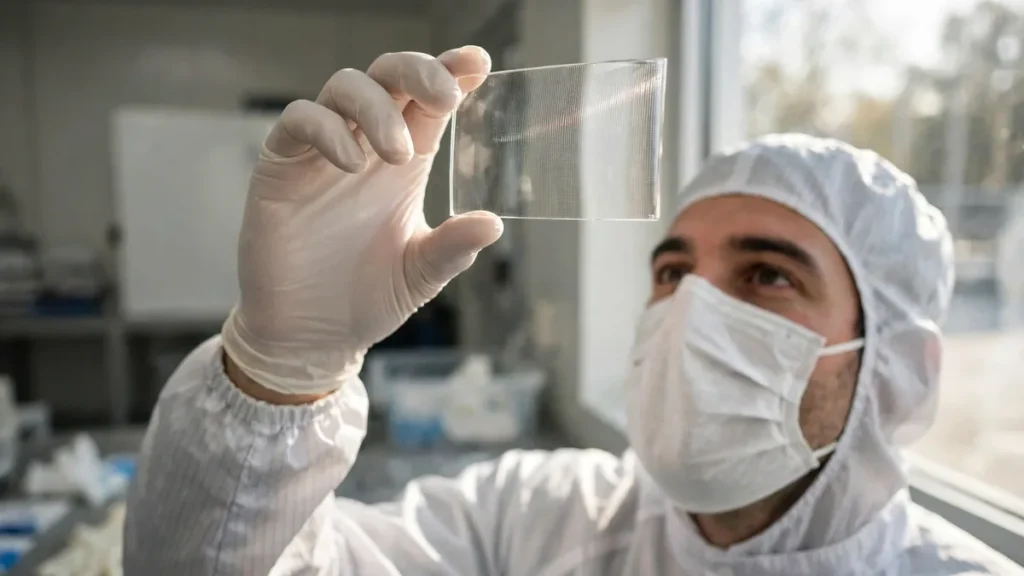
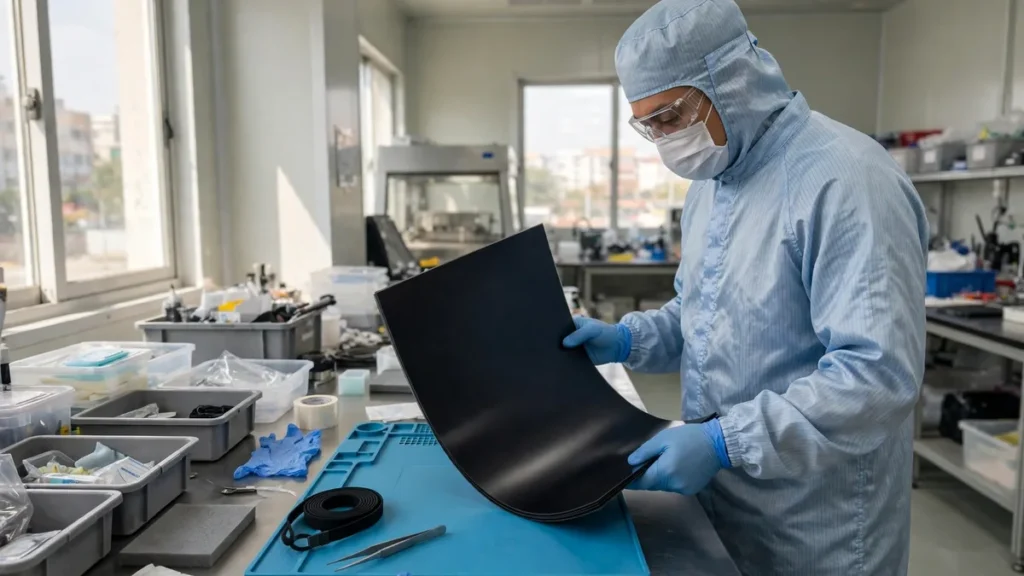
Those lenses are made in a cleanroom, a factory floor cleaner than a hospital operating theatre, where the air is filtered, the workers wear full suits and gloves, and a single speck of dust can scrap a lens. This is the production line that turns raw optical material into the lenses inside a VR headset.

How It’s Made
Step 1: Designing the lens for two eyes
Production begins with the optical design, and a VR lens is not a simple magnifying glass. It must take a flat screen a few centimetres away and present it to the eye as if it were metres distant, across a wide field of view, without distorting the image at the edges. Engineers model the lens in software, choosing its curves, its thickness, and its material so that the left and right lenses work as a matched pair, giving the brain the two slightly different views it needs for depth.
Step 2: Moulding the lens blanks
Most VR headset lenses are moulded from optical plastic, rather than cut from glass, because plastic is lighter and can be shaped into the complex aspheric curves a VR lens needs. Pellets of optical-grade polymer are dried, melted, and injected into a precision steel mould under high pressure, filling every curve of the cavity in a fraction of a second. The mould is held at a carefully controlled temperature, and the lens is cooled slowly so it does not warp or develop internal stresses that would bend the light passing through it. Each mould can produce thousands of lenses, but it is machined to tolerances of a few microns, and it is polished by hand to a mirror finish, because any mark on the mould is copied onto every lens it makes.

Step 3: Grinding and polishing the surfaces
The blanks are ground and polished to their final shape on machines that remove material in layers thinner than a human hair. A diamond tool first cuts the lens to its rough curve, then a series of ever-finer polishing pads, fed with a slurry of microscopic abrasive, smooth the surface until it is optically clear. The polishing is done in a cleanroom, because a single grain of dust caught under a polishing pad would scratch the lens beyond repair. A lens that is out of shape by even a few hundred nanometres is sent back for more polishing or rejected outright.
Step 4: Coating the lens
A bare lens reflects a surprising amount of the light that hits it, which would wash out the virtual image with glare and ghost reflections. To stop that, the lens is coated in a vacuum chamber with layers of transparent material, each only a few atoms thick, that cancel out reflections across the visible spectrum. The lenses are loaded into racks, the chamber is pumped down to a near vacuum, and the coating materials are heated until they evaporate and settle onto the lens surfaces in perfectly even layers. The full story of how the lens is built from blank to finished optic is told in how VR headset lenses are made, and the coating stage is the one that gives the finished lens its faint blue or green tint when it catches the light.
Step 5: Cutting, edging, and centring
Once coated, each lens is cut to its final shape and edged, the process of trimming the rim so it fits exactly into the headset’s lens housing. The centre of the lens must line up precisely with the centre of the wearer’s eye, so the lens is marked with its optical centre and checked against the design before it is cut. The edged lens is then cleaned in an ultrasonic bath, where high-frequency sound waves shake loose any dust or polishing residue, and it is dried with filtered air.
Step 6: Testing, pairing, and fitting
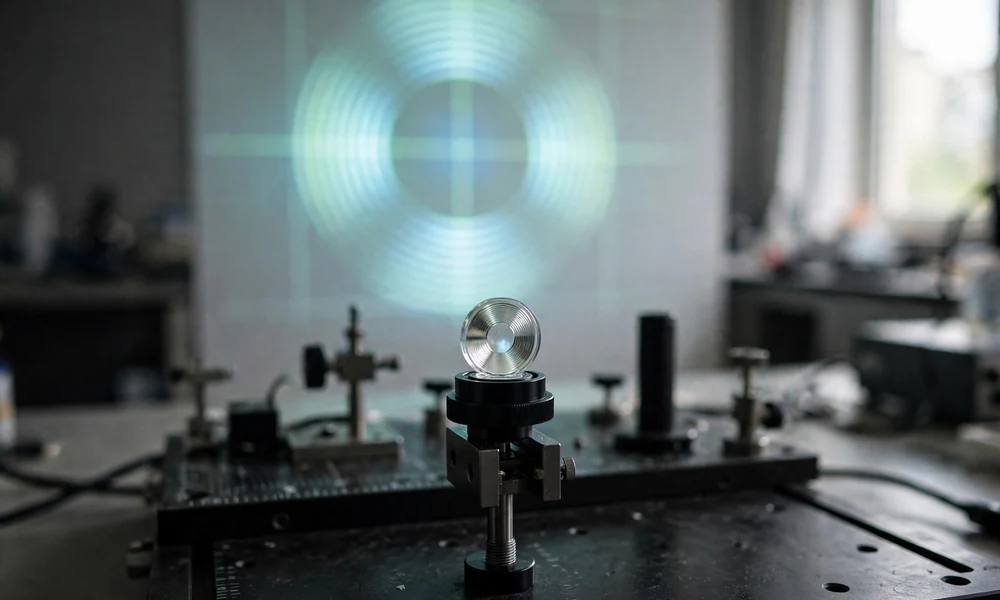
Every finished lens is tested on an optical bench that projects a test pattern through it and measures sharpness, distortion, and colour fringing across the whole field of view. Lenses that pass are paired, left with right, and matched so the two lenses in a headset have the same focal length and the same coatings, because a mismatch between the eyes would break the sense of depth. The pair is then fitted into the headset’s lens module, sealed against dust, and the whole module is tested again as a unit, checking that the display, the lenses, and the eye-tracking sensors all work together. Only a module that passes every test is packed for the assembly line, where it will meet the display, the electronics, and the head strap that turn it into a finished headset.
Specs
| Specification | Typical figure |
|---|---|
| Lens material | Optical-grade polymer, sometimes glass |
| Lens diameter | Roughly 40 to 50 millimetres |
| Lens weight | A few grams per lens |
| Surface accuracy | Within a few hundred nanometres |
| Coating layers | Several layers, each atoms thick |
| Field of view | Roughly 90 to 110 degrees per eye |
| Cleanroom standard | Filtered air, full suits and gloves |
| Testing | Every lens checked on an optical bench |
Price
A pair of VR headset lenses is estimated to cost roughly $20 to $60 to manufacture, including moulding, polishing, coating, and testing, though the figure rises sharply for the larger pancake lenses used in newer headsets. The lenses are a small share of the headset’s retail price, which is estimated at roughly $300 to $1,000 depending on the model, yet they are one of the most expensive parts to make per gram, because of the cleanroom, the precision moulds, and the rate at which lenses are rejected.
A Rare Fact
The lenses in early VR headsets were adapted from a surprising source: the cheap plastic magnifiers sold in hobby shops. The first modern VR prototypes used off-the-shelf lenses because no one yet made lenses for virtual reality, and the whole field grew out of makers experimenting with those simple optics. Today’s lenses are designed from scratch for VR, with aspheric curves and coatings that those early magnifiers never had, yet the basic idea is the same: a small lens, close to the eye, turning a tiny screen into a whole world.
A VR lens is the part of the headset you never notice when it works, and the numbers behind it are set out in the VR headset lenses specifications, while how VR headset lenses work explains how the two lenses turn a flat screen into depth. The next time a virtual world snaps into focus in front of you, remember the cleanroom, the diamond polishing, and the coatings a few atoms thick that made the lens in front of your eye.