Hold a virtual reality headset in your hands and you are holding a small optical miracle. Two lenses, each barely wider than a coin, sit between your eyes and a screen only a few centimetres away. Somehow they turn that flat, close-up display into a beach, a cockpit, or a workshop that feels like it stretches to the horizon. The illusion is so complete that your brain forgets the screen is there at all. But before any of that magic happens, each lens has to be made — and making one is far harder than it looks.
A VR lens is not a piece of glass cut to shape and polished until it shines. It is a precision optical component, moulded or ground to curves measured in microns, coated with layers thinner than a soap bubble, and inspected so ruthlessly that a single speck of dust can send it to the scrap bin.
The stakes are high because the lens is magnifying everything. It stretches a small display until it fills more than a hundred degrees of your view, and magnification is unforgiving. Every ripple in the surface, every tiny bubble, every fingerprint becomes part of the world you see. That is why the making of a VR headset lens is a story of patience, dust-free air, and measurements most people would need a microscope to believe.

How It Is Made
Step 1: Choosing the optical material
It starts with a choice: glass or optical plastic. Most VR lenses today are moulded from optical-grade plastic, because plastic can be shaped into the complex curves and fine Fresnel rings a headset needs, and it is light enough to wear on your face for hours. The raw material arrives as clear pellets or pre-cut blanks, each batch tested for clarity and consistency before anything else happens. A batch that bends light even slightly differently from the last one is rejected, because two lenses in one headset must match each other perfectly.
Step 2: Moulding the lens shape
The heart of the process is precision injection moulding. The plastic is heated until it flows, then injected into a steel mould whose surfaces have been polished to a mirror finish. The mould carries the lens design in negative: the aspheric curves that keep the picture sharp, and, for Fresnel lenses, the fine concentric rings that do the work of a much thicker lens in a fraction of the space. The same obsession with tiny tolerances shapes other miniature mechanisms, such as the hinge in how a foldable phone hinge is made, where parts must fold thousands of times without wearing out.
Step 3: Grinding and polishing the surfaces
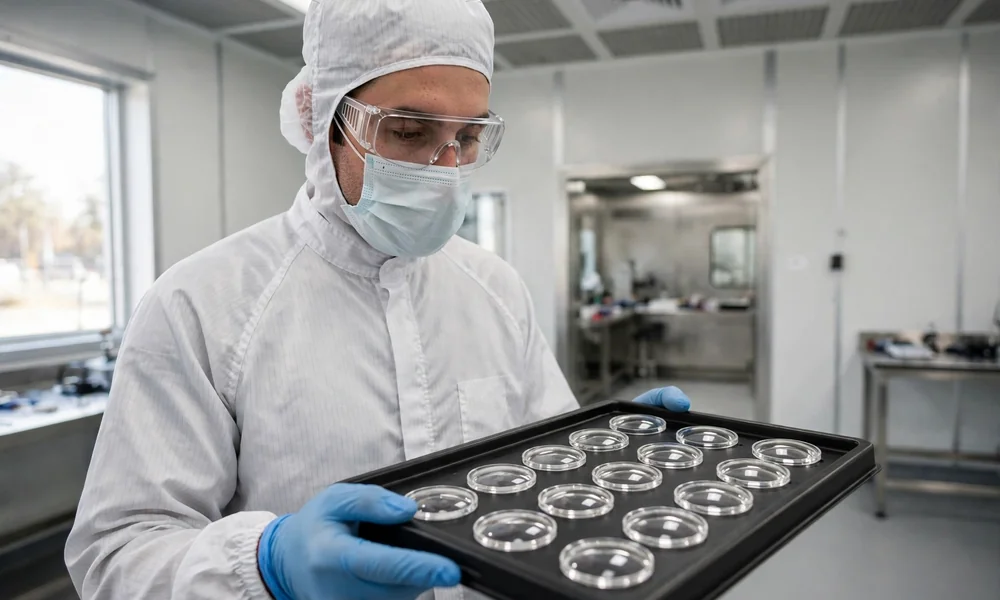
Glass lenses, and any plastic lens that needs a final touch, go through grinding and polishing. Abrasive tools shape the curve in stages, each one finer than the last, until the surface is smooth to within a fraction of a wavelength of light. Then polishing takes over, using soft pads and fine compounds to remove the last microscopic scratches. At this stage the lens is handled with gloves and kept in filtered air, because a single grain of dust dragged across the surface can undo hours of work. The surface is checked with interferometers, instruments that read the shape of the lens from the pattern of light waves bouncing off it.
Step 4: Cutting the Fresnel rings
For Fresnel lenses, the defining feature is cut into the surface: dozens of fine concentric rings, each one a tiny prism bending light by a slightly different amount. In moulded lenses the rings come straight from the mould, but the mould itself is cut on a diamond-turning lathe, a machine that shapes metal with a single-crystal diamond tool to accuracies measured in nanometres. The rings are what let a VR lens stay thin and light while doing the optical work of a thick piece of glass, and they are also what makes the lens so hard to copy.
Step 5: Coating the lens
An uncoated lens loses light at every surface, throwing away brightness and painting faint ghost images across the picture. So the lens goes into a vacuum chamber, where it is coated with layers of metal oxides, each only a few dozen atoms thick. These anti-reflective coatings let more light through and cut the reflections that cause glare, while a hard coat on the outside resists scratches from everyday handling. The coatings are applied in darkness and silence, because vibration or a stray particle during coating can ruin a lens that was perfect a minute earlier. Display makers face the same battle against wasted light, as seen in how a quantum dot display is made, where every layer of the panel exists to get more light to your eyes.
Step 6: Inspection, pairing, and assembly
The final step is the strictest of all. Each lens is inspected under bright light and magnification for bubbles, scratches, and coating flaws, and its optical power is measured to confirm it bends light exactly as designed. Lenses that pass are paired — left and right lenses matched so closely that your brain cannot tell them apart — then mounted into the headset’s lens barrels, aligned to the display with sub-millimetre precision. A lens that fails any test is scrapped, however close it came. In a headset, there is no such thing as good enough.
Specs
| Specification | Typical value |
|---|---|
| Lenses per headset | 2 (one per eye) |
| Common lens types | Fresnel, aspheric, pancake |
| Typical lens diameter | About 35–50 mm |
| Lens material | Optical plastic or glass |
| Surface accuracy | Within a fraction of a wavelength of light |
| Coatings | Anti-reflective layers, hard coat |
| Field of view enabled | 90–120 degrees |
| Manufacturing environment | Clean room, filtered air, gloved handling |
What Does It Cost?
You cannot buy VR headset lenses on their own, so their cost hides inside the price of the headset. A standalone headset typically sells for around $500, while a flagship mixed-reality headset can cost around $3,500, and those are approximate retail prices. The lenses are a meaningful share of that cost: the diamond-turned moulds, the vacuum coating chambers, and the high scrap rate all add up, and a single failed inspection can throw away a lens that took hours to make. Prescription inserts for glasses wearers are sold separately, typically for an estimated $50–$100 a pair, an estimate that varies by supplier. As display technology improves, the bar keeps rising — the panel behind the lens matters just as much, which is why the numbers in OLED display panel specs explained are worth knowing alongside the optics.

A Rare Fact
Here is the detail most people miss: the Fresnel lens in a VR headset uses the same optical trick as a lighthouse. In the 1820s, Augustin-Jean Fresnel designed a lens of concentric rings so a lighthouse lamp could throw its light for miles without a lens weighing tons. Two centuries later, the same rings — shrunk to the size of a coin and moulded in plastic — let a headset stay light enough to wear while throwing an entire world into your eyes. The lighthouse keeper’s problem and the VR engineer’s problem turned out to be the same: how to bend a lot of light with as little glass as possible.


