Hold a sheet of Kevlar composite and the first surprise is how ordinary it feels. It is light, a little stiff, golden-yellow in colour, and it bends in your hands like a piece of thick card. Then you learn what it is for: stopping bullets, shielding aeroplane engines, and wrapping the fuel tanks of Formula One cars.
Kevlar is a brand name for a fibre called aramid, and a Kevlar composite is that fibre set in resin, usually epoxy, to make a rigid sheet or part. The fibre gives the strength, the resin holds the fibres in place. The specification sheet is where the two halves of that partnership are measured.
Each number answers a question about strength: how much it can take, in which direction, and for how long.

Kevlar Composite Specs Explained
1. Tensile strength: megapascals
Tensile strength is the pulling force a material can take before it breaks, and it is measured in megapascals. A Kevlar fibre has a tensile strength of about 3,000 megapascals, roughly five times stronger than steel of the same weight. A finished composite still reaches 500 to 800 megapascals in tension, weaker than the fibre alone because the resin adds weight without much strength. The number that matters in practice is the strength-to-weight ratio: Kevlar composite is about five times stronger than steel for its weight, which is why it is used where every gram counts.
2. Fibre type: Kevlar 29, 49, and 129
Not all Kevlar is the same. Kevlar 29 is the original fibre, used in ropes, cables, and ballistic protection. Kevlar 49 is stiffer, with a higher modulus, and it is the fibre used in composites for aircraft, boats, and sporting goods, where the part must hold its shape under load. Kevlar 129 is a later development with higher strength and better resistance to damage, used in the most demanding armour. The fibre type decides what the composite is good for: 29 for stopping things, 49 for building things, and 129 for the hardest jobs of all.
3. Modulus: stiffness in gigapascals
Modulus, also called Young’s modulus, measures how stiff a material is, or how much it stretches under load. It is measured in gigapascals, and Kevlar 49 fibre has a modulus of about 112 gigapascals, against about 200 for steel. A Kevlar composite typically reaches 30 to 70 gigapascals, depending on how much fibre it contains and how the fibres are arranged. Stiffness decides whether a part holds its shape: a panel that bends too much under load is useless, however strong it is. Kevlar is less stiff than carbon fibre, so the two are often combined: carbon for stiffness, Kevlar for toughness.
4. Areal weight and fabric weight: grams per square metre
Areal weight is the weight of the fabric per square metre, measured in grams per square metre, and it is the number that decides how a composite part is built up. A typical Kevlar fabric weighs 170 to 450 grams per square metre, and a finished part is made by stacking layers, or plies, of that fabric until the part is thick enough. A ballistic vest might use twenty or more layers of light fabric; an aircraft panel might use a few of heavy fabric. More layers mean more strength and more weight, so the areal weight lets the designer calculate the finished weight in advance. The carbon nanotube composite specifications describe the same relationship: the fibre’s numbers only become a part’s numbers once the layers are laid up and cured.

5. Weave style: plain, twill, and unidirectional
Weave style describes how the fibres are arranged in the fabric. In a plain weave, the fibres cross over and under each other in a simple, stable pattern, slightly weaker because the fibres bend around each other. In a twill weave, the fibres pass over two and under one, which lets the fabric drape around curves more easily. In a unidirectional fabric, all the fibres run in one direction, which gives the highest strength along that direction but almost none across it. Plain weave suits flat panels, twill suits curved shapes, unidirectional suits parts loaded in one direction only. The carbon-fibre weave specifications show the same three patterns shaping carbon parts.
6. Impact resistance and damage tolerance
Impact resistance is Kevlar’s greatest strength, and it is the reason the material exists. When something strikes a Kevlar composite, the fibres stretch and absorb the energy rather than snapping. In the standard test, a weight is dropped onto a panel, and Kevlar composites absorb far more energy than carbon fibre or glass fibre of the same weight. That is why Kevlar lines racing car fuel tanks and aircraft leading edges: it catches debris that would destroy a stiffer, more brittle material.
7. Temperature, moisture, and UV limits
Kevlar has limits. The fibre starts to lose strength above about 160 degrees Celsius, and it degrades faster above 300 degrees, so it is not used where carbon fibre or metal would survive. It also absorbs moisture, up to about 6 percent of its weight, which can weaken the bond with the resin if the part is not sealed. Ultraviolet light breaks the fibre down as well, which is why Kevlar parts are painted or covered when they are used outdoors. These limits are why Kevlar is almost always used as part of a system, protected by a coating, rather than left exposed.
Kevlar Composite Specs
| Specification | Typical range |
|---|---|
| Fibre tensile strength | About 3,000 megapascals |
| Composite tensile strength | About 500 to 800 megapascals |
| Fibre types | Kevlar 29, 49, and 129 |
| Modulus, Kevlar 49 fibre | About 112 gigapascals |
| Composite modulus | About 30 to 70 gigapascals |
| Fabric areal weight | About 170 to 450 grams per square metre |
| Weave styles | Plain, twill, unidirectional |
| Temperature limit | Strength loss above about 160 degrees Celsius |
| Moisture uptake | Up to about 6 percent by weight |
What Does Kevlar Composite Cost?
Kevlar fabric is estimated to cost roughly $20 to $60 per square metre (estimate), depending on the fibre type and the weave, and a finished composite part is estimated at roughly $100 to $500 per kilogram (estimate), depending on the complexity of the shape and the curing process. A ballistic vest panel is estimated at roughly $200 to $600 (estimate), while a large aircraft or racing part can cost thousands. The price is driven by the fibre, expensive to make, and by the hand labour of laying up the fabric layer by layer. The curing step is described in the autoclave curing specifications, the same process used for the most demanding carbon parts.
A Rare Fact
Kevlar was invented by accident. In 1965, chemist Stephanie Kwolek was working on a new fibre for tyres when a cloudy, low-viscosity solution she was about to throw away produced fibres that were far stronger than anything she had made before. She had discovered the liquid crystal polymer that became Kevlar.
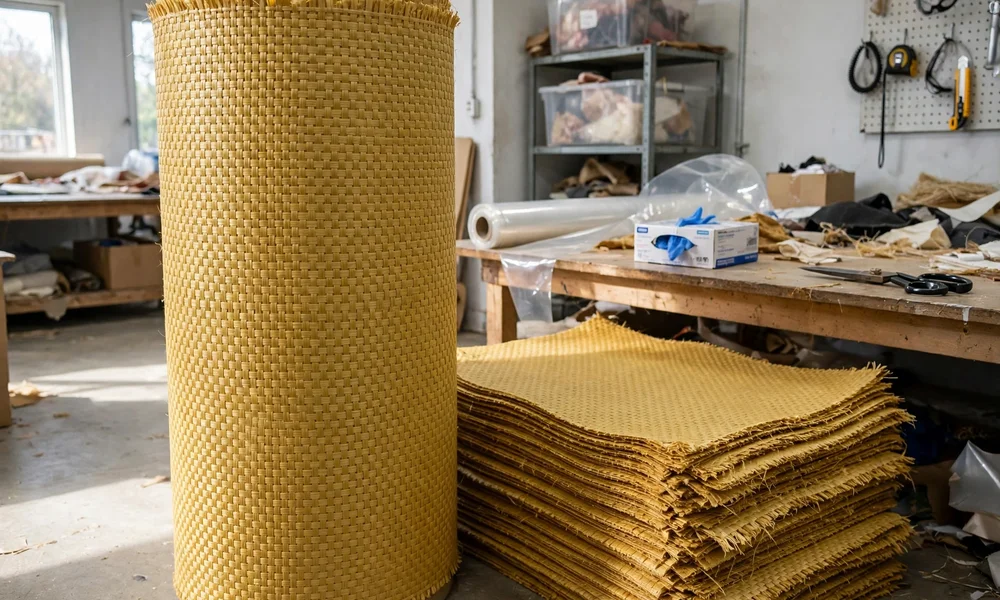
A Kevlar composite earns its specification sheet every time something hits it. Read the tensile strength, the fibre type, the modulus, and the impact resistance together, and the golden-yellow cloth stops looking ordinary: it is one of the toughest materials ever made, built one layer at a time.


