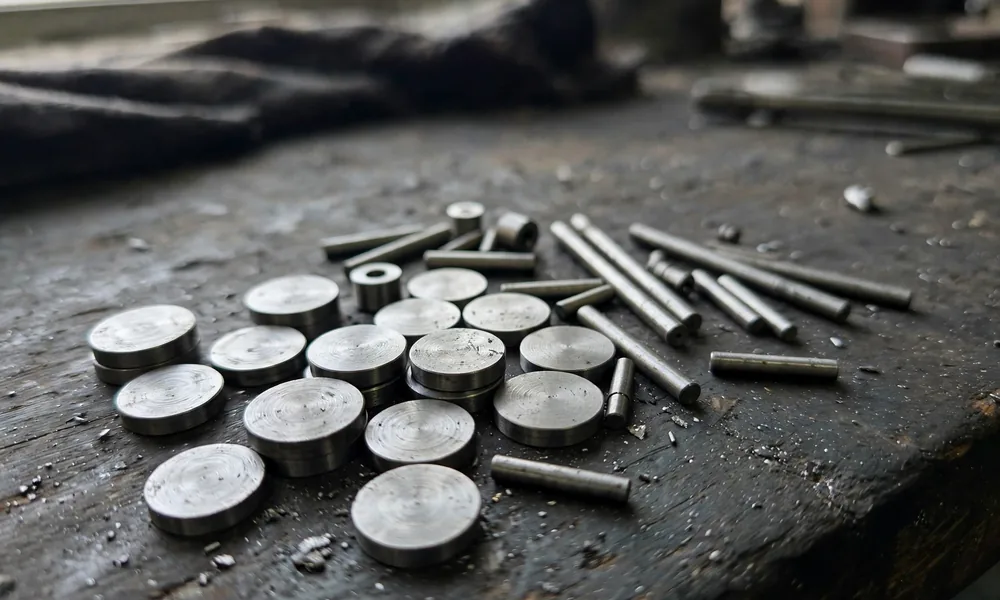
The block on the bench is barely bigger than a sugar cube, but when the engineer picks it up, it feels wrong. It is far too heavy for its size, as if it were made of lead and then somehow squeezed smaller, and it does not bend, scratch or dent when it is dropped on the steel bench. It just sits there, dense and unyielding, a small grey cube that weighs as much as a steel block three times its size.
That cube is a tungsten heavy alloy, and it is one of the densest engineering materials in ordinary use. Tungsten itself is the metal with the highest melting point of any element, and when it is mixed with nickel and iron or copper, it becomes an alloy that is almost as dense as gold, far stronger than steel, and able to survive temperatures that would melt most other metals.
The alloy’s numbers decide where it can be used. This guide explains them one by one — density, melting point, tensile strength, hardness, composition and the grades that separate one tungsten alloy from another.

How Tungsten Alloy Works
Step 1: Density is the headline number
Density is the first number anyone quotes for a tungsten alloy, and it is extraordinary. A typical tungsten heavy alloy is about 17 to 18.5 grams per cubic centimetre, compared with 7.8 for steel and 11.3 for lead. That means a tungsten part of the same size as a steel part weighs more than twice as much, which is exactly why it is used for counterweights: a small tungsten weight can balance a large mechanism without taking up space. The density comes from the tungsten itself, which makes up 90 to 97 percent of the alloy by weight.
Step 2: Melting point sets the ceiling
Pure tungsten melts at 3,422 degrees Celsius, the highest melting point of any metal and the reason it was used for the filaments of old light bulbs. The alloys melt lower, because the nickel and iron binder melts first, but they still keep their strength at temperatures where steel has gone soft: a tungsten heavy alloy is still strong above 1,000 degrees Celsius. This heat resistance is why tungsten alloys are used in rocket nozzles, furnace parts and the heat shields of re-entering spacecraft.
Step 3: Strength and hardness
Tungsten heavy alloys are strong and hard, but not in the way steel is. Their tensile strength is typically about 750 to 1,000 megapascals, roughly double that of ordinary structural steel, and their hardness is about 25 to 32 on the Rockwell C scale. What they are not is ductile: a tungsten alloy will not stretch and bend like steel before it breaks, and it is notch-sensitive, meaning a scratch or sharp corner can start a crack. Where toughness matters more than density, a different alloy wins, as our guide to Inconel alloy specs explains for a superalloy built to survive heat and corrosion.

Step 4: Composition and grades
A tungsten heavy alloy is named by its tungsten content and its binder. The common grades are 90, 93 and 95 percent tungsten, with the rest a mix of nickel and iron, or nickel and copper for parts that must not be magnetic. The 90 percent grade is the most ductile and easiest to machine, the 95 percent grade is the densest and hardest, and the 97 percent grade is used where maximum density matters and little else does. The nickel-iron binder gives better strength, while the nickel-copper binder is non-magnetic and better for medical and electronic uses. The grade is usually written as a code, such as W-Ni-Fe 93, which tells a buyer the tungsten percentage and the binder metals at a glance.
Step 5: Machining a metal that fights back
Machining tungsten alloy is slow, expensive work. The alloy is abrasive and eats cutting tools, so machinists use carbide tooling, low cutting speeds and plenty of coolant, and a part that would take an hour in steel can take three hours in tungsten. The cost of machining is one reason tungsten parts are kept small: a counterweight the size of a brick can cost thousands of dollars. Other advanced materials face the same machining challenge, as described in our guide to graphene composite specs.
Step 6: Shielding and the uses nothing else can fill
The most important use of tungsten alloy is radiation shielding. Its density stops X-rays and gamma rays better than lead, in a smaller and thinner package, and unlike lead it is not toxic, so it is used in medical imaging, cancer treatment machines and nuclear instruments. The same density makes it the material for vibration dampers, crankshaft counterweights and the ballast in racing yachts and Formula 1 cars, where every gram of weight must sit exactly in the right place. It is also used in armour-piercing penetrators, where its density and hardness let a small rod punch through steel plate. The lightest strong materials solve the opposite problem, as our guide to Kevlar composite specs shows.
Tungsten Alloy Specs
| Specification | Typical range |
|---|---|
| Density | About 17 to 18.5 g per cubic centimetre |
| Tungsten content | About 90 to 97 percent by weight |
| Melting point, pure tungsten | About 3,422 degrees Celsius |
| Tensile strength | About 750 to 1,000 megapascals |
| Hardness | About 25 to 32 Rockwell C |
| Binder metals | Nickel and iron, or nickel and copper |
| Common grades | 90, 93, 95 and 97 percent tungsten |
| Manufacturing method | Powder metallurgy and sintering |
What Does Tungsten Alloy Cost?
Raw tungsten heavy alloy is estimated to cost roughly $80 to $200 per kilo depending on grade and form, while a finished machined part is estimated at $300 to $1,000 per kilo or more because of the slow machining. A small radiation shielding block is estimated at $500 to $5,000, and a Formula 1 ballast weight is estimated at several thousand dollars. Prices are estimates only and vary by grade, size and market conditions.
A Rare Fact
Tungsten’s name comes from the Swedish words tung sten, meaning heavy stone, and it was first identified in 1781 by the Swedish chemist Carl Wilhelm Scheele. But the strangest tungsten fact is about its density: tungsten is so dense that a small tungsten cube is a classic scam in the gold trade, because a gold-plated tungsten bar weighs almost exactly the same as a solid gold bar — tungsten’s density is 19.25 grams per cubic centimetre, and gold’s is 19.32. The same density that makes tungsten invaluable for shielding also makes it the perfect gold impostor.
Tungsten alloy is a material of extremes: the densest practical engineering metal, the highest melting point of any metal, and a strength that holds up where steel gives up. Its numbers — density, tungsten content and grade — are the difference between a part that shields, balances or penetrates exactly as designed and one that fails at the worst moment. It rewards careful design and punishes shortcuts, which is why engineers specify it only where its extremes are genuinely needed. For the jobs nothing else can do, there is still no substitute.


