Stand on a busy street and watch a self-driving test car glide past, and you will see a small dark dome spinning on its roof. Inside it, a laser is firing tens of thousands of pulses every second, painting the world in invisible light and timing each reflection to measure distance to the centimetre. That is LiDAR, and it is the sensor that lets a machine see in three dimensions — through darkness, fog and glare, where cameras go blind. What makes it possible is not software alone. It is a handful of exotic materials, each chosen to handle light the human eye cannot even see.
A LiDAR sensor is a tiny optical instrument, closer to a telescope than to a camera. Its laser must fire in the infrared, where the light is invisible and safe for eyes. Its detector must catch a handful of returning photons out of a flood of sunlight. Its lens must focus that light without distortion, and its housing must keep dust, rain and vibration out while the whole thing spins or steers a beam thousands of times a second.

The Materials Behind the LiDAR Sensor
At the heart of the sensor is its laser, usually built from indium gallium arsenide or a vertical-cavity surface-emitting laser, known as a VCSEL, which fires pulses of infrared light. The returning light is caught by a detector — an avalanche photodiode or a single-photon avalanche diode — made from silicon or indium gallium arsenide. Between them sit glass optics, a spinning mirror or a MEMS chip that steers the beam, and an aluminium housing that keeps it all cool and dry. Every material is chosen for one wavelength of light and one job.
Step 1: The laser that fires in the dark
The laser is the sensor’s voice, and its material decides what it can say. Early automotive LiDAR used lasers at 905 nanometres, built from gallium arsenide, because the components were cheap and well understood. Newer sensors use 1550 nanometres, built from indium gallium arsenide, because the human eye absorbs that wavelength before it reaches the retina — which means the laser can fire far more powerfully without risking anyone’s sight. The trade-off is cost, because indium gallium arsenide is harder to make and to handle.
Step 2: The detector that counts photons
A returning laser pulse can be astonishingly faint — sometimes just a few photons bouncing off a dark tyre a hundred metres away. Catching it takes a detector made from silicon or indium gallium arsenide, built as an avalanche photodiode: a semiconductor that multiplies each arriving photon into a cascade of electrons, amplifying the signal millions of times. The newest sensors use arrays of single-photon avalanche diodes, or SPADs, which can register individual photons.
Step 3: Optics that bend invisible light
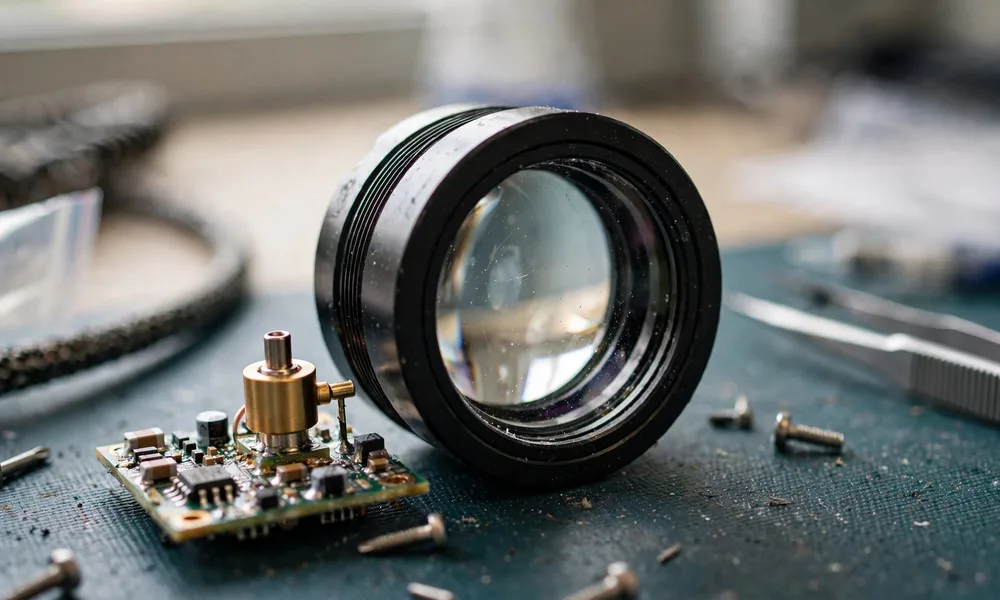
Between the laser and the world sits a set of lenses, made from optical glass with coatings tuned to the laser’s exact wavelength. The coatings are thin films of metal oxides, laid down layer by layer in a vacuum, that let the laser’s light through while blocking everything else — sunlight, headlights, street lamps. The lens must focus the beam tightly enough to resolve a pedestrian at distance, yet gather enough returning light to feed the detector.
Step 4: Steering the beam
A LiDAR must scan, sweeping its beam across the scene to build a three-dimensional map. Older sensors spin the whole optical assembly on a motor, a simple approach that works but wears out. Newer ones steer the beam with a MEMS mirror — a tiny chip of silicon, etched into a mirror on microscopic springs, that tilts thousands of times a second to aim the laser. Some sensors skip moving parts altogether, using optical phased arrays that steer the beam electronically. The optics in a smartphone camera lens face a similar challenge, at a fraction of the scale.
Step 5: The window and the housing
The sensor’s window is its face to the world: a curved piece of glass or polycarbonate that the laser passes through in both directions. It must be transparent at the laser’s wavelength, tough enough to survive stones and grit, and coated to shed water and resist fogging — a dirty window can cut a sensor’s range in half. Seals of silicone rubber keep rain and dust out, and the whole unit is tested against vibration, temperature swings and car-wash jets before it is allowed near a vehicle.
Step 6: The chip that reads the echoes
Every pulse the sensor fires returns as an echo, and a processor must time each one to within billionths of a second to work out how far away the reflecting surface is. That processor is a specialised chip, often a field-programmable gate array or a custom silicon design, mounted on a circuit board alongside the detector. It turns a storm of raw timings into a point cloud — millions of dots describing the shape of the world — and hands it to the car’s computer. The display technology in a micro-LED display depends on similar semiconductor precision, packed into an even smaller space.
Step 7: Calibration and the road test
A finished sensor is calibrated against targets at known distances — white boards, dark tyres, reflective signs — to check that its readings are accurate in every direction. A sensor that works perfectly in the lab can fail on the road, where a wet road reflects the beam away or a low sun floods the detector. Only when it survives the real world is it approved, and the same discipline applies to the drone gimbal that keeps a camera steady in the air: precision hardware is only proven in motion.

LiDAR Sensor at a Glance
| Specification | Detail |
|---|---|
| Laser material (905 nm) | Gallium arsenide |
| Laser material (1550 nm) | Indium gallium arsenide |
| Detector | Avalanche photodiode or SPAD array |
| Optics | Coated optical glass, tuned to laser wavelength |
| Beam steering | Spinning assembly, MEMS mirror or phased array |
| Housing | Machined aluminium with silicone seals |
| Typical range | Around 100–300 metres, depending on type |
What Does It Cost?
The first automotive LiDAR units cost around $75,000 (estimate) each, which is why early self-driving prototypes carried them like crown jewels. Today, a solid-state automotive LiDAR unit typically costs several hundred to around a thousand dollars (estimate), and prices keep falling as production scales up. The cost is dominated by the laser and detector materials — indium gallium arsenide is far more expensive than silicon — and by the precision assembly and calibration. A cracked window or a failed detector usually means replacing the whole unit, since the optics are sealed and aligned at the factory and cannot be repaired in a workshop.
A Rare Fact
LiDAR’s first great job had nothing to do with cars. In the 1960s, scientists used lasers to measure the distance to the Moon, bouncing pulses off reflectors left there by the Apollo astronauts — and they still do, tracking the Moon’s drift away from Earth at about 3.8 centimetres a year. The same principle — fire a pulse, time the echo — now sits on a car roof, measuring a pedestrian at a hundred metres with the same patience.


