A convertible roof has an impossible job. It must seal the cabin against rain and wind as tightly as a steel roof, hush the cabin at motorway speed, and then, at the touch of a button, fold itself away into a space barely bigger than a suitcase, all in under twenty seconds, without snagging, creaking or leaking. The specification sheet for a luxury convertible roof describes that machine in numbers, and each number decides whether open-air driving will feel like freedom or like a draughty compromise.
Most of those numbers are easy to misread. A faster folding time sounds better until you learn it comes with heavier motors and a smaller boot. A bigger glass rear window sounds like a luxury until you learn it adds weight exactly where the roof folds. The figures matter, but only when you know what each one is actually measuring.
This guide walks through the figures on a luxury car convertible roof specification sheet and explains what each one means in plain language, so the next time you compare two convertibles you will know which numbers deserve your attention and which ones are just decoration.
Luxury Car Convertible Roof Specs at a Glance
| Specification | Entry Luxury | Mid Luxury | Flagship |
|---|---|---|---|
| Open and close time | 22 seconds | 18 seconds | 14 seconds |
| Fabric layers | 2 layers | 3 layers, lined | 4 layers, insulated |
| Roof weight | 45 kg | 55 kg | 70 kg, hard top |
| Stowage volume | 180 litres | 150 litres | 120 litres |
| Wind noise, roof up | 72 dB at speed | 69 dB at speed | 66 dB at speed |
| Rear window | Plastic, fixed | Glass, heated | Glass, heated, tinted |
Open and Close Time: How Fast the Sky Arrives
Open and close time is listed in seconds, and it is the first number to check. An entry luxury roof takes about 22 seconds to fold away, a mid luxury one about 18, and a flagship about 14. The time matters because a roof is usually opened at a traffic light or in a car park, and a slow roof leaves the driver sitting with the mechanism half folded while the lights change. The speed comes from the motors and the hydraulics, and a faster roof needs stronger rams and a stiffer frame, which is why the quickest roofs are also the heaviest.
Speed is not the whole story, because the roof must also work while the car is moving. The sheet lists the maximum speed for operation, usually about 30 to 50 kilometres per hour, and a roof that can only fold when the car is standing still is far less useful than one that folds as you roll away from the lights. The way a luxury convertible works explains the body and chassis that make open-air driving possible, and the roof mechanism is only one part of that car.
Fabric Layers and Rear Window
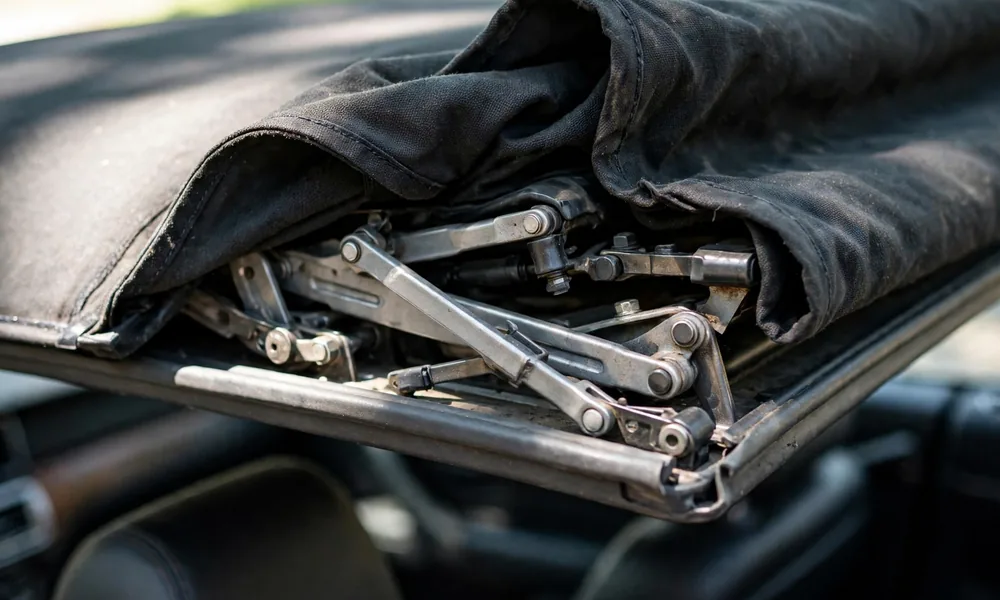
Fabric layers are listed as a simple count, and they decide how quiet and how warm the cabin feels with the roof up. An entry roof has two layers, an outer cloth that sheds rain and an inner lining that gives the cabin a finished look. A mid luxury roof adds a third layer, a rubber sheet that seals out water and hushes the wind. A flagship adds a fourth, an insulating layer that keeps the cabin warm in winter and cool in summer, so the car feels like a coupe even with a cloth roof. The way a luxury car convertible roof is made shows how that fabric is cut, sewn and stretched over the frame, and the spec sheet is where you see how many layers a car actually carries.
The rear window is listed beside the fabric, and it is worth reading carefully. An entry roof uses a plastic window, which is light and cheap but scratches and clouds with age. A mid luxury roof uses heated glass, which stays clear in frost and never clouds, and a flagship tints that glass against the sun. Glass is heavier and needs a stronger frame to carry it through the fold, which is why the window and the weight of the roof have to be read together.
Weight and Stowage: The Price of Folding Away
Roof weight is listed in kilograms, and it is the number that engineers argue about most. An entry soft top weighs about 45 kilograms, a lined mid luxury roof about 55, and a folding hard top about 70. The weight sits high on the car, above the seats, which is the worst place to add weight, because it raises the centre of gravity and dulls the handling. A lighter roof makes the car feel sharper, but a heavier roof is usually quieter and better insulated, so the sheet forces a choice between sharpness and silence.
Stowage volume is listed in litres, and it tells you how much boot space the folded roof eats. An entry roof leaves about 180 litres of boot, a mid luxury one about 150, and a flagship hard top about 120. The luxury convertible specifications show the same trade-off across the whole car, where every litre of boot and every kilogram of roof is fought over, and a convertible buyer has to decide how much luggage matters against how much sky.

Wind Noise: The Quiet Test
Wind noise is listed in decibels, measured at motorway speed with the roof up. An entry roof measures about 72 decibels, a mid luxury one about 69, and a flagship about 66. Three decibels sounds small, but the scale is logarithmic, so a roof that is three decibels quieter is roughly half as loud to the ear. The difference comes from the fabric layers, the seals and the way the roof presses against the windscreen frame, and it is the number that decides whether a long motorway drive feels relaxing or tiring.
A Rare Fact About the Convertible Roof
Here is a detail that surprises people who think of the convertible as a modern idea. The first folding car roofs were not powered at all. Early convertible owners had to get out of the car, unclip the roof by hand and fold it away themselves, a job that took several minutes and two people, and the roof often had to be stored in a separate cover. The powered roof of today, with its motors and sensors, is simply that same job done by hydraulics in fourteen seconds, while the driver sits still with one finger on a button.
What the Specs Mean for You
If you are comparing luxury convertibles, read the roof sheet in this order: open time under twenty seconds, three or more fabric layers, a heated glass rear window, and wind noise under 70 decibels with the roof up. Those four figures decide whether the roof will feel like a proper roof on the days you keep it up, which is most days of the year.
Then look at the weight and the boot, and judge them honestly. A lighter roof makes the car feel sharper, a bigger boot makes it easier to live with, and a folding hard top gives the quietest cabin of all. But none of them replaces the seals. A convertible roof is a machine that must disappear when it works, and the sheet tells you, in seconds and decibels, whether it will.