A dashboard used to be a row of dials and a radio with two knobs. It told you how fast you were going, how much fuel you had, and which station was playing, and that was enough. A luxury car today has a dashboard that is a computer, a telephone, a map, a music library and a voice assistant, all behind a sheet of glass, and the numbers on its specification sheet read more like the numbers for a laptop than for a car.
The strange part is that none of those numbers mean much on their own. A screen of 15 inches, a processor with eight cores, a sound system with twenty speakers: each one sounds impressive, and each one is meaningless until you know what the car does with it while you are driving at speed, in sunlight, with your eyes on the road.

Luxury Car Infotainment Specs at a Glance
Before the detail, here are the headline numbers for a typical luxury car infotainment system. A smaller car will sit at the modest end of each range, with a smaller screen and fewer speakers, while a top model pushes further, but the pattern of a big screen, a fast processor and a connected cabin stays the same.
| Specification | Typical figure | Why it matters |
|---|---|---|
| Screen size | 12.3 to 17 inches, central display | Big enough to read at a glance |
| Screen resolution | 1920 by 720 pixels or higher | Sharp maps and text in daylight |
| Processor | Octa-core, built for cars | Keeps menus fast for years |
| Memory and storage | 16 GB memory, 256 GB storage | Room for maps, music and apps |
| Audio channels | 16 to 30 speakers, up to 2,000 watts | Sound that fills the whole cabin |
| Connectivity | 5G, Wi-Fi hotspot and Bluetooth | The car stays online on the move |
| Voice control | Natural voice assistant, always listening | Change settings without touching |
| Software updates | Over-the-air, while parked | New features without a dealer visit |
The Screen: Size, Sharpness and Sunlight
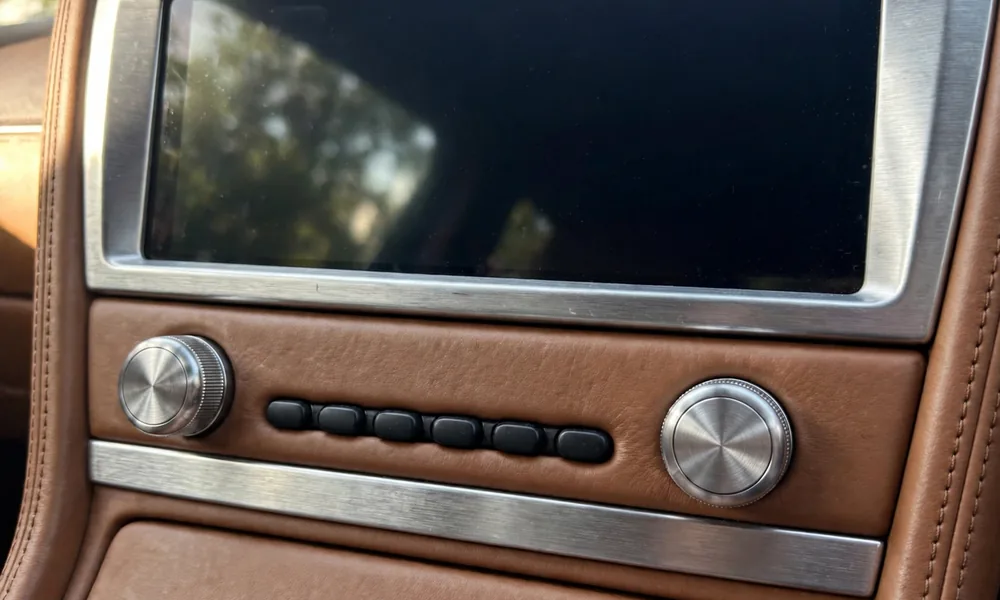
The screen is the part you touch, and its size is the first number people ask about, but size is the least important figure on the sheet. What matters is whether you can read it in bright sunlight, whether it responds to a gloved finger in winter, and whether the most important information sits where your eyes already are. A good screen is bright enough to beat a low sun, it has an anti-glare coating that keeps reflections soft, and its menus are large enough to use without looking away from the road for more than a glance.
Resolution is the number that decides whether a map looks crisp or fuzzy, and on a luxury car it is high enough that the lines of a road and the letters of a street name stay sharp at arm’s length. The screen is also bonded to its glass with no air gap, which stops condensation and keeps the colours true in heat and cold. It sounds like a small detail, and it is the difference between a screen that feels like a phone and a screen that feels like part of the car.
The Brain: Processor, Memory and Speed
The processor is the part you never see, and it is the part that decides whether the system feels fast in five years or slow in two. A luxury car is expected to last a decade or more, and the processor must still run new maps and new features long after the phone in your pocket has been replaced twice. That is why the chip is built for cars, rated to work from freezing mornings to baking afternoons, and paired with enough memory that the navigation, the music and the voice assistant can all run at once without stuttering.
Storage matters for a simpler reason: maps. A full set of maps for a continent is large, and the car keeps them on board so the navigation works in a tunnel, in the mountains or anywhere the signal drops. Music, voice recordings and system updates take the rest. The figure to watch is not the headline storage but the free space after the maps are loaded, because a car that is full on the day you buy it will be slow to update a year later.
Sound and Connection: What Travels With the Screen
The sound system is where the specification sheet is easiest to misread, because watts and speaker counts tell you almost nothing about how music sounds in a moving car. A luxury system is tuned for one cabin, with speakers placed to suit its exact shape, microphones that listen to the road noise and adjust the volume as you speed up, and an amplifier that can keep the bass clean at motorway speed without drowning the voices. The number of speakers matters less than where they sit and who tuned them.
Connection is the other half of the story, and a luxury car is online all the time. A 5G connection brings live traffic, weather and charging points to the map, a Wi-Fi hotspot lets the passengers use their own devices, and Bluetooth links your phone before you have closed the door. The connection is invisible when it works, and the specification that matters is not the speed of the link but whether it stays connected on the road you actually drive.
A Rare Fact About the Luxury Car Infotainment System
The dashboard computer has an unlikely ancestor. The first car radio appeared in 1930, and it was so large and so expensive that it cost almost a third of the price of the car itself, with an aerial that had to be fitted under the running board and a battery that needed charging at home. Drivers were warned that listening to the radio would distract them, and some towns tried to ban it outright. The first dashboard screens arrived decades later, small and monochrome, showing only a map or a reversing camera, and drivers treated them as a novelty. The modern infotainment system is simply those two ideas joined together: the radio that was once too expensive for most cars and the little map screen that nobody trusted, grown into a computer that navigates, entertains, connects and listens, all behind one sheet of glass in the middle of the dashboard.

What the Specs Mean for You
If you ever try a luxury car, ignore the size of the screen on the first drive and pay attention to three things instead: whether you can read it in sunlight, whether the menus respond instantly after a cold start, and whether you can change the music by voice without looking down. Give the voice assistant a real request, not a rehearsed one, because the way it handles a mumbled street name tells you more than any specification ever will.
The infotainment system is the most talked-about part of a modern luxury car, and its numbers make sense once you see what they are for: a screen you can read at a glance, a processor that will still be fast in five years, and a connection that keeps the car learning. The same thinking runs through the rest of the cabin, from the way a dashboard works behind the glass, to the reason a dashboard is so expensive to build, and the steering wheel specifications that put the controls at your fingertips. Read the figures, and the dashboard stops being a gadget and starts being the car’s quiet second brain.


