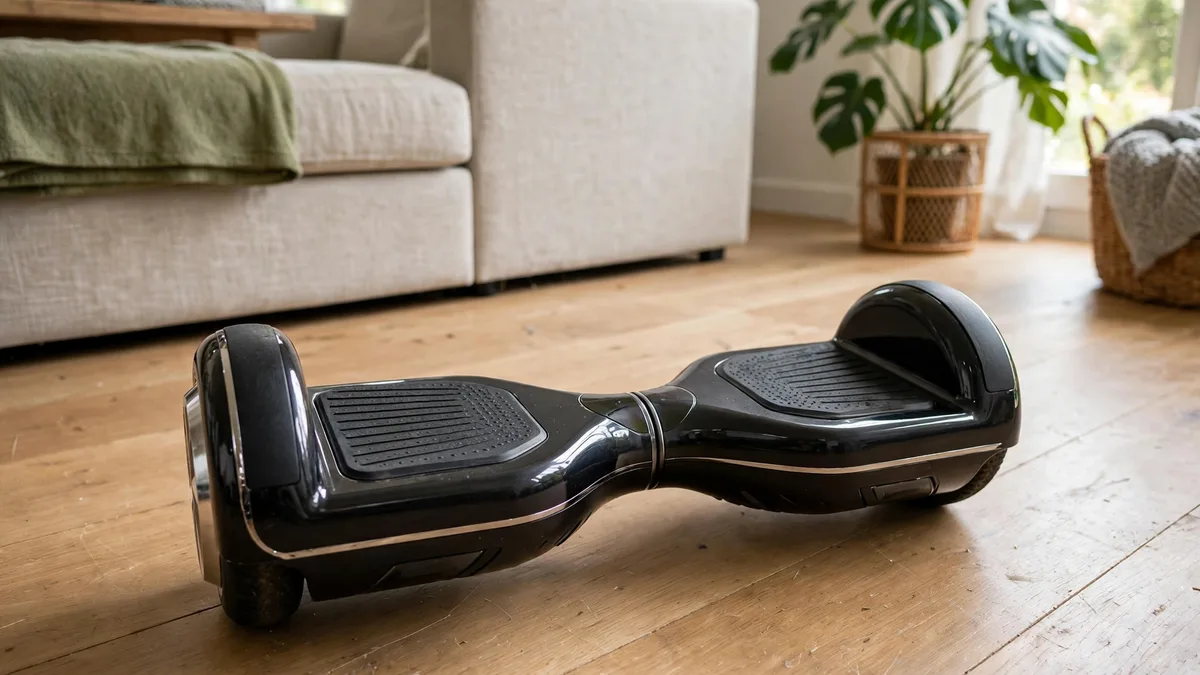
A luxury electric hoverboard has no handlebars, no seat and no brakes you can see, yet it carries a rider across a car park with nothing more than a shift of weight. Lean forward and it glides ahead, lean back and it slows, press one foot a little harder and it turns. To watch it is to wonder where the controls are hiding, and the answer is under the rider’s feet, where sensors read every small movement.
The board is a small machine packed tight, with two motors, a battery and a brain squeezed into a case barely thicker than a book. This is how a luxury electric hoverboard is made, from a split metal frame to the footpads that feel the rider lean.
How It’s Made
Step 1: The frame is split and shaped
Every hoverboard begins as two frame halves, left and right, joined in the middle by a pivot that lets each side tilt on its own. The halves are cast from aluminium alloy, then machined so the pivot turns smoothly without any sideways wobble. That split is the whole secret of steering, because each foot controls its own wheel, and a frame that binds in the middle would make the board fight its rider.
The pivot is fitted with a steel shaft and a pair of bearings, greased and sealed against dust, and the halves are flexed by hand to feel for any roughness. A board that creaks at the joint would soon wear loose, so the pivot is tested again after the motors are fitted, when the frame carries its full weight for the first time.
Step 2: The hub motors are built into the wheels
Each side holds a hub motor built straight into its wheel, a ring of copper windings and magnets that turns the wheel without gears, chains or belts. The windings are wound tight, coated against damp, and pressed into the hub, where they give a smooth push from a standstill. Two motors are needed because each foot drives its own wheel, and the difference between them is what turns the board.
The wheels are fitted with solid rubber tyres, chosen to grip smooth floors without marking them, and the motors are spun on a bench to check for any uneven pull. A motor that drags would make the board veer to one side, so any unit that draws more current than its twin is taken out and replaced before the board is closed up.

Step 3: The battery pack is assembled
The battery is a pack of lithium cells welded together and sealed in a metal case that bolts into one half of the frame, balanced by the controller in the other half so the board’s weight stays even. The cells are matched by capacity before assembly, because a weak cell would drain first and cut the ride short. A management board watches each cell, cutting the power if one gets too hot or too low.
Once sealed, the pack is charged and discharged on a bench to prove it holds its charge, and the case is checked for any gap where water could get in. A hoverboard lives close to the ground, where puddles and wet grass are a real risk, so the seal is tested twice, once on the bench and once after the pack is fitted into the frame.
Step 4: The sensors are fitted under the footpads
Under each rubber footpad sits a set of pressure sensors and a tilt sensor, mounted on a small board that reads where the rider’s weight is pressing. The sensors are cushioned against bumps and wired to the controller, which turns a lean into a motor command many times a second. If a sensor sits crooked, the board would think the rider is leaning when they are standing still, so each one is aligned with a gauge and locked down.
Calibration is done with the board on a flat table, switched on and left to learn what level means, while a technician presses each pad in turn and watches the motors answer. The response must be gentle at first and firm when the rider leans hard, because a board that leaps forward at a touch would throw its rider off. Only when the board holds still under a test weight does it pass.
Step 5: The shell and lights are finished
The frame is closed with moulded plastic shells, shaped to curve around the wheels and finished in gloss paint or a brushed metal look. Rubber footpads are glued on top, with a rough texture that grips shoes even when they are damp, and lights are set into the front and back of each shell, so the board can be seen at dusk. The shells are clipped and screwed in place, then checked for any gap where rain could reach the parts inside.
Step 6: The board is ridden, tested and checked
The last step is a real ride in a yard. A tester steps onto the board, rides it forward, back and in tight circles, listening for any whine from the motors and feeling for any delay between leaning and moving. The board is ridden over a small bump and a gentle slope, the lights are checked, and the battery is run down and charged again to prove the range. Only a board that feels calm and quick at the same time, with no lurch and no lag, is packed for sale.
| Spec | Detail |
|---|---|
| Frame | Two cast aluminium halves joined by a pivoting centre joint |
| Motors | Two hub motors, one in each wheel, steered by speed difference |
| Battery | Sealed lithium pack in one half, balanced by the controller in the other |
| Sensors | Pressure and tilt sensors under each footpad, calibrated on a flat table |
| Shell | Moulded plastic covers with rubber grip pads and front and rear lights |
| Range | Roughly 10 to 20 miles per charge, depending on battery size and rider weight |
What One Costs
A luxury electric hoverboard typically costs an estimated 400 to 1,500 dollars, set mostly by the size of the battery, the power of the hub motors and the finish of the shell and footpads. A simple board with a small battery sits near the bottom, while a long-range board with bright lights, a metal shell and stronger motors costs far more. The same board-making craft runs through other small rides, and the way an electric skateboard is made shows how a deck and motors come together, while how an electric scooter frame is made explains the metalwork underneath.
A Rare Fact
Some luxury hoverboards can be ridden backwards just as easily as forwards. Because each foot controls its own wheel, leaning back drives both wheels in reverse, and a skilled rider can spin the board on the spot by pressing one foot forward and the other back, turning in a circle no wider than the board itself.

A luxury electric hoverboard is made to vanish under its rider: a split frame, two hub motors, a sealed battery, sensors that read every lean and footpads that grip through it all. It is a small machine with a large job, turning balance into motion with no handlebars at all. The same motor thinking runs through bigger electric rides, and the way an e-bike mid-drive motor is made shows how a motor can sit at the centre of a machine and drive everything from there.