Sit in a luxury car and look forward, and the dashboard is the whole view. It stretches from door to door, a sweep of leather, wood and glass, with the instruments glowing softly and the vents sitting exactly where your hands expect them. A luxury dashboard can cost more than a whole small car, and the bill is hidden behind the very smoothness it pays for.
Most buyers never see that bill. They see leather and wood and screens, and they assume the cost is the materials. The money goes into the electronics buried inside, the frame that holds the airbags, the hours spent fitting trim to a fraction of a millimetre, and the testing that runs every screen, vent and airbag before the dashboard is allowed into the car.
This article breaks down where the money goes when a luxury car dashboard is built, and why the same sweep of trim costs so much more here than it does in an ordinary car.

Where the Money Goes: The Cost of a Luxury Dashboard
| Cost Driver | Ordinary Car | Luxury Car | Why It Costs More |
|---|---|---|---|
| Screens | One small display | Two or three large screens | Curved glass, bonded, tested |
| Carrier frame | Steel, shared design | Magnesium alloy, bespoke | Light, stiff, low volume |
| Wood trim | Plastic, printed grain | Real veneer, matched grain | One tree, one car, hand matched |
| Wiring | Simple loom | Kilometres, double checked | Every connector tugged twice |
| Gap tolerance | Millimetres | Under one millimetre | Hand refitting, feeler gauges |
| Testing | Sample tested | Every unit, full sequence | Screens, airbags, vents, rattles |
The Screens: Glass That Costs More Than the Wood
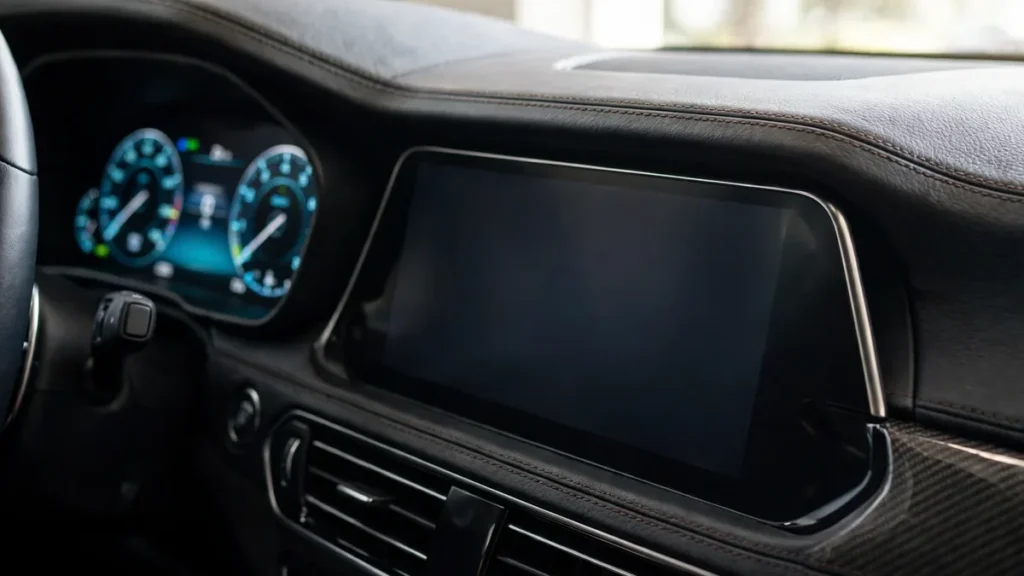
The first cost is the glass. An ordinary dashboard has one small display, a cheap panel bought in huge numbers and shared across many models. A luxury dashboard has two or three large screens, sometimes joined into a single sweep of curved glass that runs the width of the car. That glass is bonded to the display beneath it, tested pixel by pixel, and rejected if a single pixel is dead, because the owner will find it within a week and never be able to unsee it.
The instrument display, the central touchscreen and the passenger screen each need their own computer, and the three have to talk to each other instantly, showing the same information without a flicker. The way a luxury car dashboard is made shows those screens being mounted and tested on the bench, and every test is a cost: each screen is powered up, every pixel is run through its colours, and the touch surface is checked at every corner before the dashboard leaves the bench.

The Frame and the Trim: Strength You Never See
The second cost is the frame. Every dashboard starts with a carrier, a skeleton that has to hold the airbags, the screens and the steering column, yet stay light enough not to burden the car. An ordinary car uses a steel carrier shared across many models. A luxury car uses a magnesium alloy frame, moulded in a single piece and shaped with ribs and pockets that put strength exactly where the loads are.
The trim is where the hand work begins. The wood is sliced into sheets thinner than paper, matched so the grain flows across the dashboard in one continuous sweep, then lacquered until it is as smooth as glass. The reasons a luxury bumper costs so much show the same pattern of low volume tooling and hand finishing, and the dashboard applies it to a part the driver stares at for every minute of every journey.
Fitting and Wiring: A Millimetre Is a Fortune
The third cost is fitting, and it is measured in fractions of a millimetre. Each trim piece is fitted to the dashboard by hand and clipped into place, with the gaps checked using thin feeler gauges. On a luxury car the gap between two trim pieces is kept to less than a millimetre, and it must be the same all the way along. A stitch that wanders by a millimetre will be noticed, so the seam is checked against a straight edge before the cover is glued down.
The wiring is the part nobody sees and everybody depends on. The dashboard carries kilometres of it, tying the screens, the vents, the switches and the airbags to the rest of the car. Every connector is pushed home until it clicks, then tugged to prove it is locked, and the whole harness is checked against a diagram before the dashboard is signed off. The reasons carbon ceramic brakes cost so much follow the same logic, where double checking and low volume turn a simple assembly into an expensive one, and the dashboard is the most checked assembly in the car.

Testing: Every Dashboard, Every Function
The fourth cost is testing, and it is the one that separates a luxury dashboard from an ordinary one most clearly. An ordinary dashboard is sample tested: one in many is pulled off the line and checked. A luxury dashboard is tested as a complete unit, every single one, powered up on a rig that runs the instruments, the screens, the vents and the airbags through a full sequence, while an inspector looks for rattles, gaps and anything that does not sit quite right. The rig plays back road noise and engine vibration too, so a buzz that would only appear at motorway speed is caught on the bench.
The airbag testing alone is a large cost. The dashboard holds the passenger airbag, and its cover has to split along an invisible seam at exactly the right moment, without throwing trim at the occupants. The seam is scored into the leather and tested on sample units that are destroyed in the process, and the cost of those destroyed dashboards is spread across the cars that survive.
A Rare Fact About the Dashboard
Here is a detail that surprises people who think of the dashboard as furniture. The word dashboard comes from the board on a horse-drawn carriage that stopped mud thrown up by the horses’ hooves from dashing the passengers, and early cars kept the name for the board that kept the engine out of the cabin. The luxury dashboard of today, with its magnesium frame, its curved glass and its kilometres of wiring, is still doing the same job as that wooden board: standing between the driver and the machine, and making the machine feel like a room.
Is the Price Worth It
Whether a luxury dashboard is worth the money depends on how much time you spend looking at it, which is all of it. Every minute you drive, the dashboard is your view, and the difference between a gapless sweep of matched wood and a plastic panel with wide seams is something you feel even when you are not looking for it. The wood will still match from door to door, the leather will still sit tight, and the screens will still light up the same way.
But do not mistake the price for a markup on wood and leather. It is the cost of curved glass, a magnesium frame, hand matched veneer, kilometres of double checked wiring and a full test of every single unit, and the sweep in front of you is the only honest record of that you will ever see.