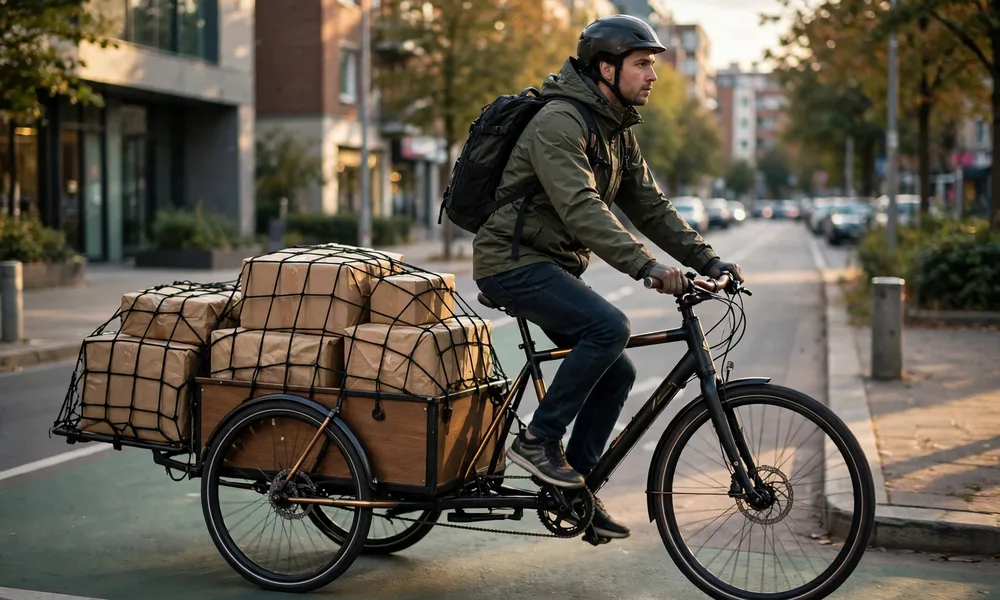
The school gate is crowded at half past eight, and the cars are queuing bumper to bumper, but one parent glides past them all on a long, low bicycle with a wooden box on the front. Inside the box are two children, a school bag, a violin case and a bag of shopping, all riding along as calmly as passengers in a car. Behind them a courier pedals a different machine, a long bike with a huge rack at the back, stacked with parcels that would fill a small van. These are luxury cargo bikes, and they carry loads that look impossible on two wheels.

The spec sheet at a glance
| Figure | Typical range | What it tells you |
|---|---|---|
| Motor | Mid-drive, roughly 250 watts, up to 85 newton-metres | How much help the motor gives your legs |
| Battery | Roughly 500 to 750 watt-hours, removable | How much energy the bike carries |
| Range | Roughly 40 to 100 kilometres | How far it goes on a charge, loaded |
| Max load | Roughly 180 to 250 kilograms, bike plus load | How much weight it can carry safely |
| Box capacity | Roughly 100 to 200 litres | How much the box or rack holds |
| Weight | Roughly 35 to 50 kilograms, without load | How heavy the bike is before you load it |
| Brakes | Hydraulic disc brakes, front and rear | How it stops a heavy load |
| Wheelbase | Roughly 1.9 to 2.3 metres | How long the bike is, and how stable it feels |
| Price | Roughly $5,000 to $10,000 | What the bike costs, as an estimate |
Motor and battery: the power that makes it possible
The motor on a luxury cargo bike is almost always a mid-drive unit, mounted at the cranks, and it is usually rated at roughly 250 watts with torque of up to roughly 85 newton-metres. The wattage looks small next to a car, but torque is the number that matters, because torque is what pushes a loaded bike up a hill from a standing start. A mid-drive motor works through the bike’s own gears, so it can spin fast on the flat and grind slowly up a hill, just like the rider’s legs do. The battery usually runs from roughly 500 to 750 watt-hours, and it is locked into the frame where it is protected from rain and theft, often under a cover that the rider unlocks with a key. Range usually runs from roughly 40 to 100 kilometres, and the spread is wide because range depends on the load, the hills and the assist mode. How the motor, the battery and the controller work together is the heart of the machine, as the guide to how a luxury cargo bike works explains, and the spec sheet is simply the numbers behind that teamwork.
Frame and load: built like a small truck
Maximum load on a luxury cargo bike usually runs from roughly 180 to 250 kilograms, counting the bike and everything on it, and that figure is the one that separates a real cargo bike from an ordinary bicycle with a basket. The frame is built around the load, and there are two main shapes. A longtail stretches the rear of the bike, with a long rack behind the rider that carries children on a bench seat or panniers full of parcels. A box bike, sometimes called a bakfiets, puts the load in front, in a wooden or plastic box between the rider and the front wheel, steered by rods that run under the box. Box capacity usually runs from roughly 100 to 200 litres, enough for two children plus bags, or a week’s shopping, or a stack of parcels. Wheelbase usually runs from roughly 1.9 to 2.3 metres, much longer than a normal bicycle, and that length is what keeps the bike stable. At low speed the long wheelbase makes the bike feel slow to turn, which is reassuring when the box is full, and at higher speed it feels planted, because the weight is low and the wheels are far apart. The price of a good electric bike is driven by the same expensive parts, as the guide to why a luxury electric bike is so expensive explains, and the cargo bike spends most of that money in the same places, the motor and the battery, only bigger.

Brakes, tyres and the details that keep it safe
Brakes on a luxury cargo bike are hydraulic disc brakes, front and rear, and they are the most important safety item on the whole spec sheet. A loaded cargo bike can weigh 200 kilograms or more, and it has to stop from cycling speed in the wet, downhill, with children in the box. Hydraulic discs do that job because they squeeze harder than cable brakes, they work the same in rain as in sunshine, and they stay consistent as they heat up on a long descent. Tyres are built for the same job. They are wide, often 55 millimetres or more, with a tough puncture-resistant layer and a tread that grips in the wet, and they run at lower pressures than a road bike, which gives them a bigger contact patch and a softer ride over bumps. The wheels carry the load as well, with strong rims and spokes counted in dozens rather than handfuls. Then come the details that make the bike livable. A double-legged stand holds the bike upright while children climb in, because a loaded bike cannot lean on a single kickstand. The bench seat has seatbelts, often a three-point belt for each child, and a padded backrest, with room under the seat for bags. A rain cover fits over the box, with clear windows so the children can see out and the rider can see in, and it folds away under the seat when the sun comes out. The folding bike is the closest relative in the family, a machine that trades load for portability, as the guide to luxury folding bike specs explained shows, and the cargo bike answers the opposite question, how much can two wheels carry.
What it costs
The estimated price of a new luxury cargo bike is roughly $5,000 to $10,000, and that figure is an estimate only, because the cost depends on the motor, the battery size and the box. The motor and battery account for a large share, followed by the frame and the box, and the seatbelts, rain cover and lights add the rest.
A rare fact
Few people know that cargo bikes are not a new idea at all. Bakers, butchers and postmen used them a hundred years ago, with huge front boxes and no motor at all, and the modern electric version is a return to that idea rather than an invention. The difference is the motor, which turns a job that once needed a strong pair of legs into something any parent can do on the way to school.