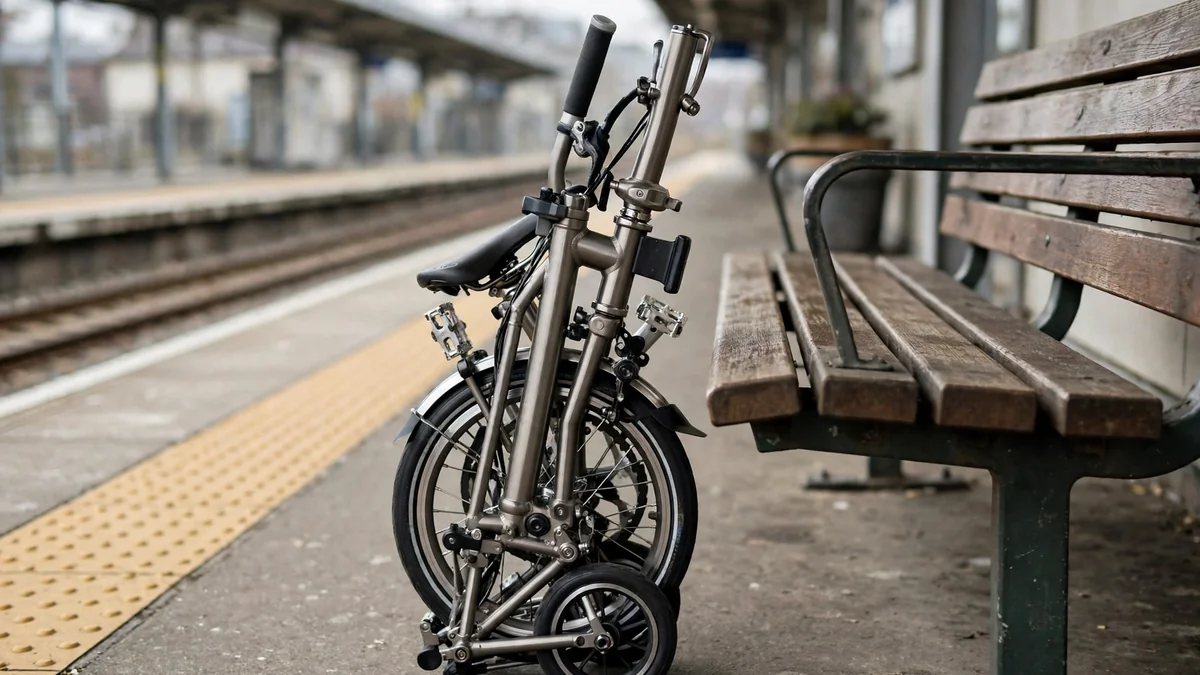
The train pulled into the station and the man beside the doors did something no other cyclist on the platform could do. He reached down, flipped a single lever, swung the handlebars sideways, and folded his bicycle in half. Then he folded it again. In less than twenty seconds the machine that had carried him ten miles through morning traffic was a neat package the size of a suitcase, standing upright on its own small wheels. He rolled it through the ticket barrier like a piece of luggage, and nobody gave it a second look.
That is the promise of a luxury folding bike: a full-sized ride that disappears when you do not need it. It is not a toy, and it is not a compromise dressed up as convenience. The best folding bikes are serious machines, built from titanium or high-grade steel, with hinges engineered to survive thousands of folds and frames stiff enough to feel like a normal bicycle once you are pedalling. The spec sheet, though, reads like a puzzle. Folded dimensions sit next to gear ratios, frame materials next to hinge counts, and a number that matters enormously to a commuter means almost nothing to a weekend rider. This guide explains the numbers one by one, so you can tell a genuine luxury folder from a cheap bike with a hinge bolted on.
The spec sheet at a glance
| Figure | Typical luxury folding bike | What it tells you |
|---|---|---|
| Weight | 9 to 12 kilograms | How heavy it is to carry folded |
| Folded size | About 60 x 60 x 30 centimetres | Whether it fits under a desk or on a train |
| Wheel size | 16 or 20 inches | How it rides and how small it folds |
| Frame material | Titanium or chromoly steel | Strength, weight and ride feel |
| Gears | 3 to 11 speeds | How it copes with hills and headwinds |
| Fold time | 15 to 30 seconds | How practical it is at a station |
| Rider weight limit | 100 to 110 kilograms | How much load the hinges can take |
The frame and the hinge
Everything about a folding bike starts with the frame, because the frame has to do something no ordinary bicycle frame ever does: come apart and go back together, perfectly, thousands of times. On a luxury folder the main hinge sits in the middle of the frame, and it is not a simple joint. It is a machined assembly with a clamp that pulls the two halves together under tension, so that when the bike is unfolded there is no play, no creak and no flex. A cheap hinge develops wobble within a year. A good one still feels solid after a decade of daily folding, and that difference is the single biggest gap between a luxury folder and a budget one.

Wheels, tyres and the ride
Small wheels are the most misunderstood number on a folding bike spec sheet. Sixteen-inch wheels look toy-like beside the wheels of a normal bicycle, but they are what make the fold possible, and they bring their own advantages. Small wheels accelerate quickly, they are strong because their spokes are short, and they let the bike fold into a genuinely small package. The trade-off is ride comfort: a small wheel drops further into every pothole, so the tyre and the frame have to do more work to keep the ride smooth. Luxury folders answer that with wider tyres, often around 35 millimetres, run at lower pressure, and with frames designed to flex just enough to take the sting out of the road.
Gears and brakes
A folding bike needs gears that work in a small space, and the same thinking shapes the foldable electric bike, where a motor and battery must fit around the fold. Many luxury folders use an internal hub gear, where all the mechanism sits sealed inside the rear wheel. A three-speed hub is simple, almost maintenance-free and perfectly adequate for flat city riding, while an eleven-speed hub or a derailleur system with a wide range suits riders who face real hills. The number of gears matters less than the range: the gap between the easiest gear and the hardest one. A folder with a wide range can climb a steep street and still cruise comfortably on the flat, which is exactly what a commuter needs.
Folded size and weight
The folded dimensions are the numbers that decide whether the bike actually fits your life. A folder that measures sixty centimetres in each direction will slide under most desks and stand in the corner of a train carriage. One that is ten centimetres bigger in any direction may not, and that difference is the difference between a bike you take everywhere and a bike you leave at home. Weight matters just as much, because the whole point of folding a bike is carrying it. At nine kilograms you can lift it with one hand. At thirteen you need two, and a flight of stairs becomes a chore. The lightest luxury folders achieve their weight with titanium frames and careful component choices, and every gram saved is a gram you will notice twice a day, every day.
What a luxury folding bike costs
Prices for a luxury folding bike start at around two thousand dollars for a well-made steel folder and rise to five thousand dollars or more for a titanium machine with a wide-range hub gear and hand-built wheels. The most exclusive hand-built folders, made to order with custom paint and bespoke fittings, can reach eight thousand dollars or more. These are estimates, not fixed prices, because the final figure depends on the frame material, the gearing, the wheels and the finishing. What you are paying for is not just the bike but the engineering that makes it fold without compromise: machined hinges, custom tubing and a frame that has been tested through thousands of folds before it ever reaches a shop.
A useful comparison is the luxury electric bike, where much of the price sits in the motor and battery. On a folding bike the money goes into the frame and the fold itself, and that is why a folder with no motor at all can cost as much as a good electric bike. The luxury electric scooter offers another point of comparison: a scooter folds too, but it asks far less of its hinge, because it never has to carry a rider’s full pedalling force through a joint.

A rare fact
One of the most famous folding bikes in the world was designed in a London flat in the 1970s, and its inventor spent years refining the fold in his own workshop before the first production bike appeared. The design has barely changed since, because the fold itself was so well thought out: the wheels tuck together, the chain stays protected inside the package, and the folded bike stands on its own small wheels so it can be rolled rather than carried. Modern luxury folders still borrow from that original idea, and the best of them fold into a package so neat that it fits in the luggage rack of a train or under the desk of an office, ready for the ride home.