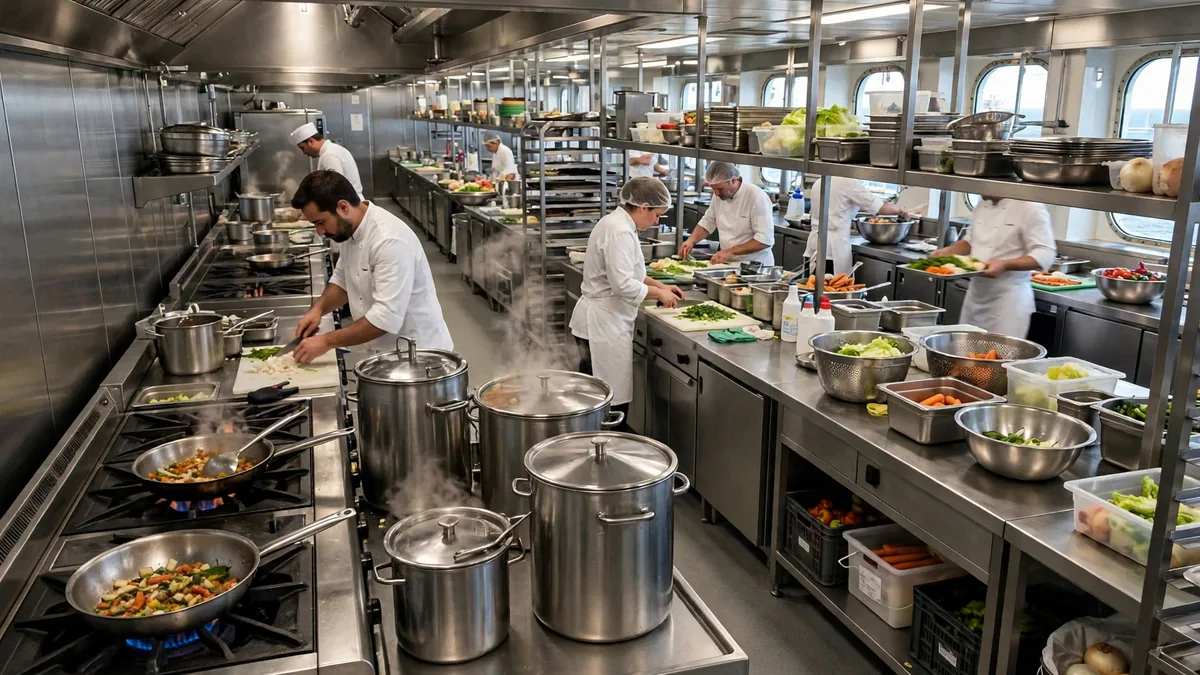
The first thing you notice in a cruise ship galley is the noise. It is not the clatter of a restaurant kitchen, which rises and falls with the orders. It is a steady, industrial hum: fans pulling air through long steel ducts, refrigeration compressors ticking over, and a dozen ranges burning at once, while a chef calls out numbers in a voice trained to carry over machinery. The room is bigger than most restaurants, and it never closes.
A galley like this feeds three thousand people a day, three times a day, from a room that has to fit inside a steel hull and keep working while the ship rolls. That is an engineering problem before it is a cooking problem.
1. Size and layout, and the meals that have to come out of it
The main galley of a large luxury cruise ship typically covers 800 to 1,500 square metres, spread across one or two decks, and it is laid out like a production line rather than a kitchen. Raw food comes in at one end, through its own cold rooms, and finished plates leave at the other end, through heated pass counters that face the dining rooms. Between those two ends sit the preparation areas, the hot cooking line, the bakery, the cold kitchen, and the dishwashing section.
The layout matters because of the numbers it has to serve. A ship carrying 3,000 guests and 1,200 crew needs roughly 9,000 to 12,000 meals a day, and the galley is expected to produce them in three concentrated rushes. The hot line alone may have twenty or more cooking stations. The way the whole kitchen is organised around its ovens, ranges, and cold rooms is explained in how a cruise ship galley works, which follows a meal from the cold store to the table.
2. Cooking power, and the ranges that never cool down
The cooking power of a ship galley is measured in the same way as a power station: in kilowatts, and in how many of them can run at once. A large galley typically draws 500 to 1,000 kilowatts for its cooking equipment alone, supplied by the ship’s generators. The hot line carries ranges, tilting bratt pans that hold 100 to 200 litres, combi ovens, and banks of fryers that run all day.
What makes the equipment marine rather than ordinary is the way it is built to keep working when the ship moves. Ranges are bolted to the deck and fitted with pot rails that stop a pan sliding off in a roll. The cooking suite is the heart of the room, and its dimensions and output are set out alongside the rest of the equipment in the luxury ship galley specifications, where the galley is treated as one machine with many stations.
3. Cold storage, and the weeks of food below the waterline
A cruise ship cannot stop at a supermarket. The galley has to carry days or weeks of food, and the cold storage that holds it is one of the largest systems on the ship. A large vessel typically carries 500 to 1,000 cubic metres of refrigerated and frozen storage, divided into separate rooms for meat, fish, dairy, vegetables, and frozen goods, each held at its own temperature.
The cold rooms are built as insulated boxes inside the hull, with their own refrigeration plants and backup compressors, because a failure at sea means losing food that cannot be replaced until the next port. A ship on a two-week voyage may load 200 tonnes of food before it sails, and every kilogram of it passes through those rooms before it reaches a plate.
4. Ventilation, steam, and the air the crew breathes
Cooking for thousands of people produces an enormous amount of heat, steam, and grease, and the ventilation system of a ship galley is sized to remove it all without letting it spill into the rest of the vessel. A large galley typically moves 30,000 to 60,000 cubic metres of air per hour through its extraction hoods, with grease filters, fire dampers, and a separate supply of fresh air to replace what is taken out.
Ventilation is also a fire safety system. The ducts are fitted with automatic dampers that close if a fire is detected, and the extraction fans can be shut down from the bridge. The dishwashing section alone, with its flight-type machines, can wash 10,000 plates an hour, and it needs a constant supply of water heated to 80 degrees or more.

5. Power, weight, and the galley as part of the ship
The last numbers on the specification sheet are the ones that tie the galley to the ship itself. All of the equipment together typically weighs 200 to 400 tonnes, including the ranges, ovens, cold rooms, dishwashers, and the stainless steel structure that holds them, and that weight is placed low in the hull, where it helps rather than harms the ship’s stability.
The galley also has to keep working when the ship loses power. It is a kitchen that cannot close, in a building that cannot stop moving, and the dining rooms it serves are the public face of all that machinery. The places where the food ends up are ranked in the best cruise ship restaurants ranked, from the main dining room to the speciality restaurants that sit above the galley decks.
The Specifications at a Glance
Here are the numbers that matter most on a luxury cruise ship galley, and what a good figure looks like for each one.
| Specification | Typical Luxury Range |
|---|---|
| Galley floor area | About 800 to 1,500 square metres |
| Meals per day | Roughly 9,000 to 12,000 for guests and crew |
| Cooking power | About 500 to 1,000 kilowatts |
| Cold storage volume | About 500 to 1,000 cubic metres |
| Ventilation rate | About 30,000 to 60,000 cubic metres per hour |
| Fresh water use | About 50,000 to 100,000 litres per day |
| Dishwashing capacity | About 10,000 plates per hour |
| Total equipment weight | Roughly 200 to 400 tonnes |
What Does a Luxury Cruise Ship Galley Cost?
A full galley fit-out for a large luxury cruise ship is estimated at roughly $15 million to $40 million, depending on the size of the ship, the number of dining venues, and how much of the equipment is custom-built. A mid-size galley with standard marine equipment is estimated at roughly $15 million to $25 million, while a large galley for a ship of 3,000 guests or more, with several speciality kitchens, a full bakery, and extensive cold storage, is estimated at roughly $30 million to $40 million.
A Rare Fact
The bakery on a large cruise ship bakes bread through the night, and it does so for a simple reason: the ovens in the galley are at their quietest after dinner, and the bread that comes out at four in the morning is still warm when breakfast is served.

The specification sheet of a cruise ship galley is a description of scale. Floor area decides how many people can work in the room, cooking power decides how fast the food can be cooked, cold storage decides how long the ship can stay at sea, and ventilation decides whether the crew can breathe while it all happens.


