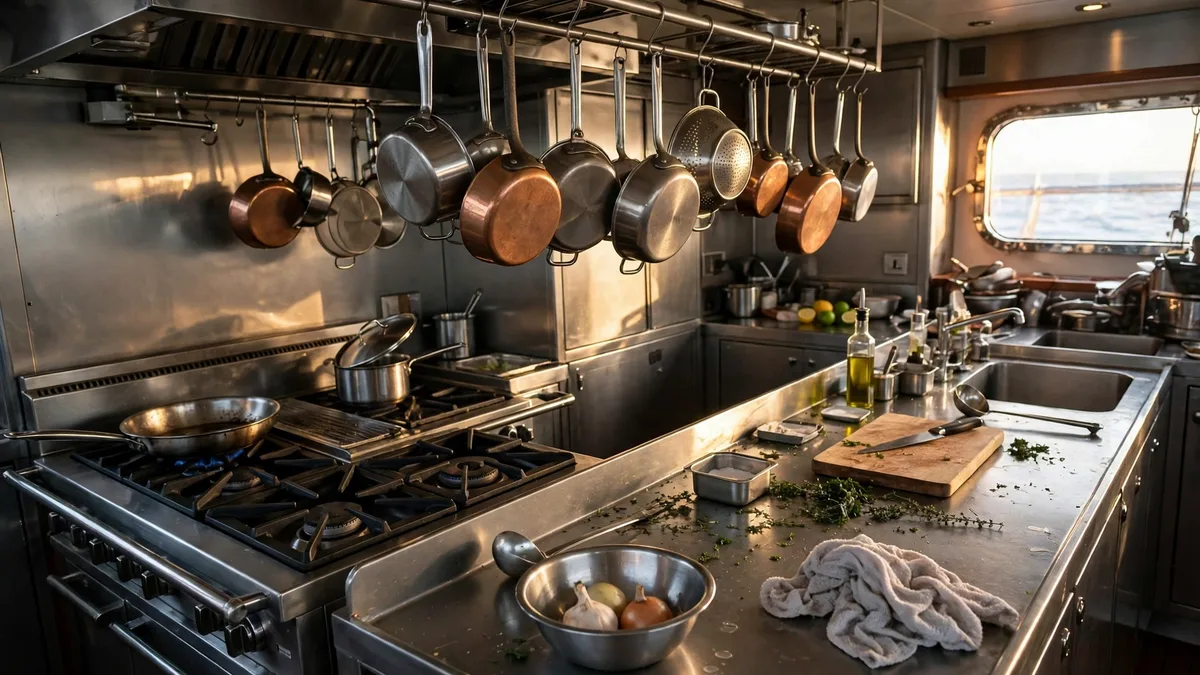
Deep inside a luxury ship, below the dining room with its white tablecloths, a kitchen the size of a small restaurant works around the clock. Stainless steel stretches in every direction, ovens glow, and a team in white moves between stoves and cold stores with practised rhythm. Dinner for hundreds of guests is cooked here, plated here, and sent up in lifts that arrive still hot. Yet none of that bustle tells you how the room actually performs, and that is what the spec sheet is for.
A luxury ship galley is the professional kitchen of a large ship, built to prepare thousands of meals a day in a space that rolls with the sea. Its spec sheet lists the numbers that decide whether dinner is served on time or an hour late: meals per hour, cold storage, oven recovery and power draw. This is what each figure means, and the build behind those numbers is what the making of a luxury ship galley describes.
The Spec Sheet, Line by Line
Read a galley spec sheet the way a chef reads a menu: start with capacity, then move to heat, cold, water and power.
Meals per hour and covers per service
The first number that matters is how many meals the galley can produce in an hour at full pace, usually given as covers per service, meaning the guests it can feed in one sitting. A large luxury ship galley is commonly rated for around 800 to 1,200 covers per service, with a peak output of roughly 400 to 600 plated meals per hour when every station is running. That pace depends on the menu, since grilled fish moves faster than a dish needing last-minute assembly, but the rating gives a fair comparison between ships. A galley rated below the guest count must serve in waves, so later tables wait longer, while one rated above it can serve everyone at once.
Cooking suite power and oven recovery
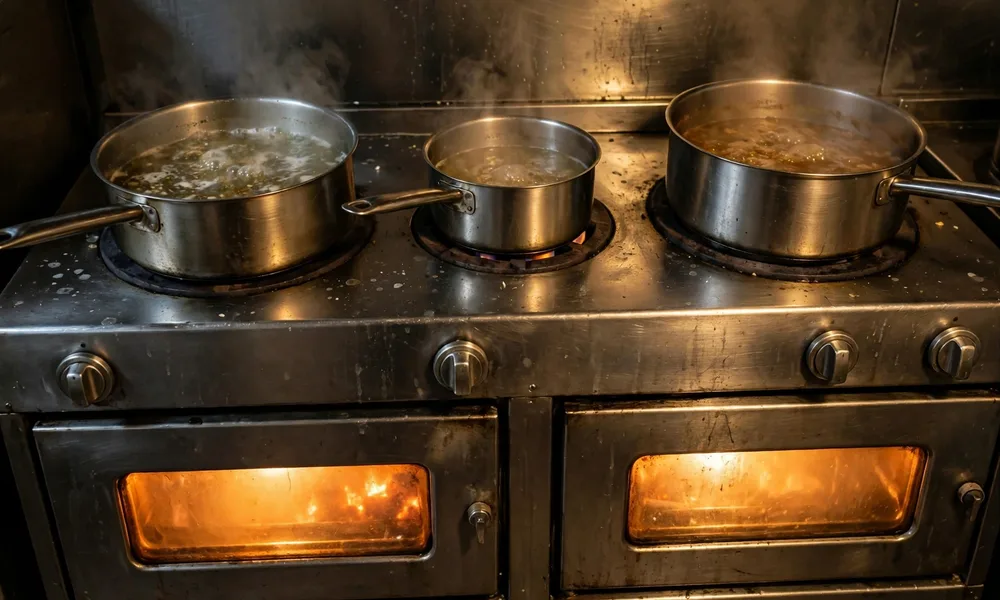
The cooking suite is the heart of the galley, a row of ranges, grills, fryers and ovens built into one steel block, and its power is usually listed in kilowatts. A large suite may draw 60 to 120 kilowatts in total, with individual ovens of 10 to 20 kilowatts each. What matters more than raw power is recovery time, the minutes an oven needs to return to its set temperature after its door is opened and a tray loaded. A good luxury oven recovers in three to five minutes, while a slow one takes eight or more, and over a service of hundreds of covers that gap becomes the difference between crisp pastry and soggy crust.
Cold storage volume and temperature zones
A ship at sea cannot send out for more butter, so cold storage is measured in cubic metres, and a large galley may list 40 to 80 cubic metres of chilled and frozen space across several rooms. The sheet breaks that volume into zones: a chill room near zero degrees for meat and fish, a cool room around four degrees for dairy and vegetables, and a freezer at minus eighteen or colder for ice cream and frozen stock. The sheet also lists pull-down time, how long a warm room takes to reach working temperature, which matters when tonnes of provisions arrive at once and must be chilled before they spoil.

Dishwashing throughput and water use
Every meal creates a mountain of plates, and the dishwashing line is rated in racks per hour, with a large galley machine handling 200 to 400 racks an hour. Each rack holds around eighteen plates, so the top end of that range clears thousands of plates before dessert is served. The sheet also lists water use per rack, often two to four litres, because fresh water at sea is made by the ship itself and every litre counts. A modern machine recycles rinse water through filters and reuses the heat, cutting both water and energy, and the best galleys add a separate glass washer, since wine glasses need a gentler cycle than roasting trays.
Ventilation, extraction and heat load
A galley full of ovens throws off enormous heat, and ventilation is given in cubic metres of air per hour, often 10,000 to 20,000 for a large room. The extraction hoods above the cooking suite must pull away steam, smoke and grease before they reach the dining room, and the sheet lists the capture rate of each hood as a percentage. Good hoods capture more than ninety percent of cooking fumes, while poor ones let grease settle on every surface. It is why the galley has its own air handling unit, as the engine room numbers that move a luxury ship show, since the same ship must also cool its engines and cabins.
Power draw, gas supply and backup
The galley is one of the hungriest rooms on the ship, and its total electrical load is usually listed at 150 to 300 kilowatts at peak service, roughly the draw of a small village. Some ships cook with gas instead, and the sheet then lists gas storage in kilograms and the days it lasts at full pace. Either way the galley needs a backup: a second feed from another generator, so a single failure does not stop dinner. The sheet also notes emergency lighting and the fire suppression system, which floods the cooking suite with fine mist if a pan catches fire. The captain checks these figures first, because a galley that loses power at seven in the evening ruins the night for a thousand guests.
| Specification | Typical luxury ship galley |
|---|---|
| Covers per service | Around 800 to 1,200 guests fed in one sitting |
| Peak meal output | Roughly 400 to 600 plated meals per hour |
| Cooking suite power | 60 to 120 kilowatts across ranges and ovens |
| Oven recovery time | Three to five minutes back to set temperature |
| Cold storage | 40 to 80 cubic metres across chill, cool and freezer zones |
| Dishwashing throughput | 200 to 400 racks per hour, two to four litres per rack |
| Ventilation | 10,000 to 20,000 cubic metres of air per hour |
| Peak power draw | 150 to 300 kilowatts, with a backup generator feed |
| Floor area and stations | 200 to 400 square metres, twelve to twenty crew stations |
A luxury ship galley costs an estimate of $2 million to $8 million to build and fit out, depending on the size of the ship, the number of covers and the standard of the equipment. The price covers the cooking suite, cold rooms, dishwashing line, ventilation and steelwork, plus the design work that squeezes a restaurant kitchen into a rolling steel box. Refitting an existing galley is cheaper, often $500,000 to $2 million. The smaller yacht version is a different scale again, as how a luxury yacht galley works shows, with fewer covers and a tighter crew, but the same demand that dinner arrives hot and on time.
Here is a rare fact worth knowing. The largest cruise ship galleys prepare more than 20,000 meals in a single day, with a kitchen brigade of over 150 cooks, bakers and pastry chefs, a team bigger than the staff of many hotels on land. They bake their own bread every morning and grow fresh herbs in a small hydroponic garden, so the mint in a dessert was picked a few decks below the dining room. A ship galley is not a scaled-up home kitchen. It is a floating food factory, and its spec sheet is the menu of what that factory can do.


