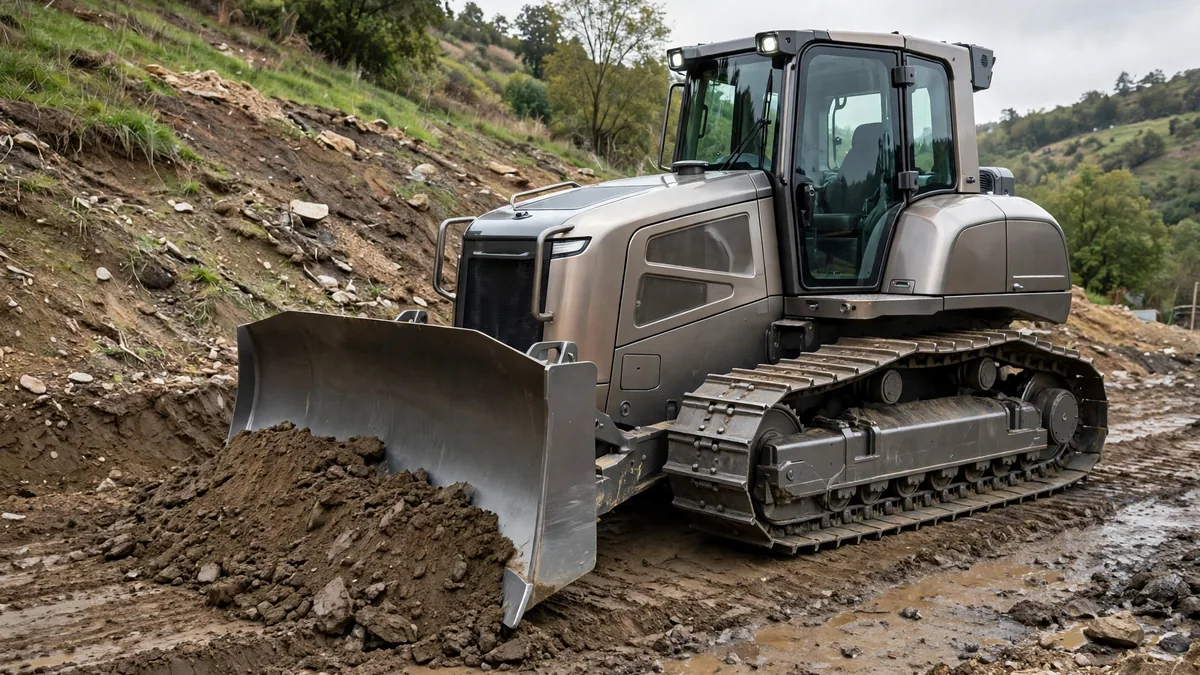
On a hillside above a new estate, a bulldozer pushes a wall of earth forward, its blade low and steady, its tracks gripping the wet ground. There is no diesel smoke drifting back over the driver, and no engine roar bouncing off the valley walls. The machine moves in a low hum, stops exactly where the driver wants it, and then pushes again, shaping the slope one careful pass at a time.
A luxury electric bulldozer is a battery-powered earthmoving machine built for heavy pushing, grading and levelling work. It replaces a diesel engine with electric motors and a large battery pack, while keeping the steel tracks, the wide blade and the strong frame that let a bulldozer work where wheeled machines cannot. The luxury part lies in the quiet cabin, the precise controls and the quality of the materials.
How It Works
A bulldozer specification sheet looks simple, with a few large numbers for power, weight and blade size. Those numbers only make sense together. Power without grip is wasted, weight without balance is dangerous, and a wide blade is useless if the machine cannot push it through hard ground.
Step 1: The battery pack sets the working day
The battery is the heart of an electric bulldozer, and its size decides how long the machine can work before it needs charging. A large luxury model carries a pack of several hundred kilowatt-hours, enough for a full shift of normal pushing and grading, with charging overnight from a site supply. The pack sits low in the frame, protected by steel plates, which also keeps the centre of gravity low.
That low, heavy battery helps the bulldozer grip. Weight presses the tracks into the ground, and the tracks spread it so the machine does not sink into soft soil. A machine that is too light will spin its tracks, while one that is too heavy will damage the ground it works on.
Step 2: The motors turn power into pushing force
Electric motors drive the tracks, one on each side, and they deliver their full turning force from the moment they start. That is a real advantage over a diesel engine, which needs to build up speed before it pulls hardest. When the blade meets a hard bank of earth, the motors keep pushing steadily instead of stalling or jerking, and the driver can feel the load through the controls.
The sheet lists motor power in kilowatts and pushing force in kilonewtons, and both numbers deserve attention. Power tells you how fast the machine can work, while pushing force tells you how hard it can shove. A luxury bulldozer may offer more than 200 kilowatts and a drawbar pull above 400 kilonewtons, enough to move heavy soil, break up compacted ground and push a full blade uphill. The same idea of electric power turned into careful movement appears in other large machines, and how a luxury electric excavator works shows how motors and hydraulics work together to move heavy loads with precision.
Step 3: The tracks and the frame carry the load
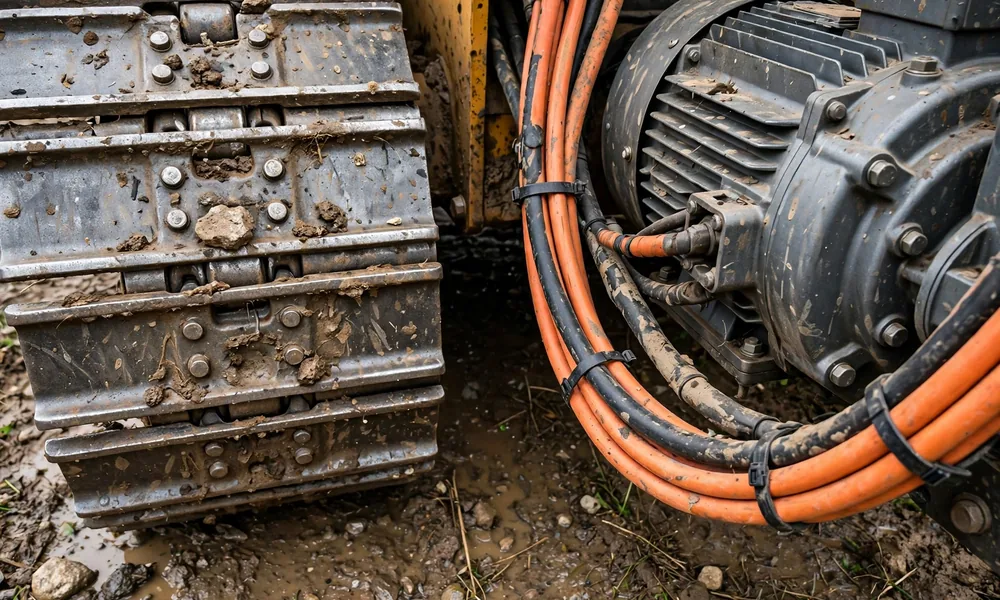
The tracks are wide steel plates linked together, running over rollers and driven by a sprocket at each end. They give the bulldozer its grip and let it cross mud, rubble and steep slopes that would stop a wheeled vehicle. The specification sheet lists the track width, the ground pressure and the overall width, because a wider track spreads the weight further and lowers the pressure on soft ground.
The frame holding the tracks, battery and blade is a single heavy steel structure, welded and bolted to resist twisting. When the blade hits a buried rock, the shock travels through the frame, and a weak frame would crack over time. Luxury makers use thicker steel and stronger welds, so the machine can work for years in dust, mud and rain.
Step 4: The blade shapes the ground
The blade is the working tool, a curved steel plate mounted at the front on strong arms and lifted by hydraulic rams. Its width is listed on the sheet, often between 3 and 4 metres, and its capacity is measured in cubic metres of loose earth. A wider blade moves more soil in each pass, but it also needs more power to push, so blade size and motor power must match.
The driver controls the blade with a joystick, raising it, lowering it and tilting it to cut a slope or level a surface. Modern luxury bulldozers add a satellite guidance system that reads the planned ground level and moves the blade automatically to match it, within a few centimetres. That guidance turns a skilled driver into a precise one, and it saves the repeated passes that used to be needed to finish a surface by eye. The cost of that precision is part of what makes these machines so dear, as why a luxury electric bulldozer is so expensive explains, from its battery and motors to its guidance and cabin.
Step 5: The cab, cooling and tests finish the machine
The cab sits high and forward, with a clear view of the blade and the ground ahead. It is sealed against dust, fitted with air conditioning and a comfortable seat, and quiet enough for the driver to hear a warning or a radio call. A good cab matters more than it looks, because a driver who is hot, deafened or shaken all day will make mistakes and tire quickly.
Cooling is just as important. The battery and the motors produce heat under heavy load, and radiators and fans keep them within safe limits. Before delivery, the bulldozer is tested on a slope and on soft ground, pushing a known load while engineers check the battery temperature, the track tension and the blade controls. Only when it pushes, turns and stops smoothly is it ready for work. The same careful testing of a heavy electric vehicle appears elsewhere, and how a luxury electric forklift is made shows how a strong frame, a battery and careful assembly come together before a machine is trusted with real loads.

| Specification | Typical luxury electric bulldozer |
|---|---|
| Motor power | About 200 to 300 kilowatts |
| Operating weight | About 20 to 30 tonnes |
| Blade width | About 3 to 4 metres |
| Battery capacity | Several hundred kilowatt-hours |
| Ground pressure | Low, thanks to wide steel tracks |
| Guidance | Satellite blade guidance, centimetre accuracy |
A luxury electric bulldozer of this size typically costs an estimated 500,000 to 1,000,000 dollars, depending on its power, battery size, blade width and guidance system. That estimate covers the machine itself, not transport, spare tracks or the driver. Smaller models cost less, while the largest machines with full guidance cost more, and hiring one for a single project is often the sensible choice for a smaller builder.
A rare fact worth knowing is that an electric bulldozer can hold a slope without touching the brakes. Its motors can resist rolling backwards, holding the machine still on a hill while the driver plans the next push. A diesel machine needs its brakes and transmission to do the same job, and they wear with every hold, while the electric motor simply stands still and waits.
In the end, a bulldozer is judged by the ground it leaves behind. A flat, firm surface, cut to the right level, is the proof that the power, the tracks and the blade all worked together. The luxury electric bulldozer leaves that surface behind without smoke and without noise, and that quiet finish is part of its value.