The first cut was so quiet that the man holding the saw checked twice to see whether the chain was moving at all. There was no cough of a two-stroke engine, no cloud of blue smoke, no tug on a starter cord, just a soft whirr and a log falling open in two clean halves on the workbench.
A luxury electric chainsaw is a battery-powered cutting tool built to the standard of a professional forestry saw, with a brushless motor, a long guide bar, and a battery pack that costs as much as some whole saws. Its spec sheet is a list of numbers about power, bar length, chain speed, and battery, and this is a plain translation of those numbers, and what each one means when you are choosing a saw for serious work.

1. Motor power, and the quiet push behind the chain
Motor power is the first number on the sheet, and on a luxury electric chainsaw it is usually given in watts, often between 1,800 and 3,600 watts, or in volts, often 40 to 80 volts.
The number to look for next to power is torque, because a chainsaw does its work by twisting the chain through wood, and an electric motor gives its full twist from the moment it starts turning. How the motor and the chain share the work is described in how a luxury electric chainsaw works, where the sealed motor and the instant torque are explained in detail.
2. Bar length, and how big a log it can cut
Bar length is measured in inches or centimetres, and on a luxury electric chainsaw it usually runs from 14 to 20 inches, which is 35 to 50 centimetres. The bar is the steel rail the chain runs around, and its length decides the thickest log the saw can cut through in a single pass, because the bar must reach across the whole width of the wood.
Most owners choose a 16-inch bar for garden and firewood work, and keep the 20-inch bar for felling and for logs too wide to roll. The way the bar and the chain are put together is shown in how a luxury electric chainsaw is made.
3. Chain speed, and how fast the cut happens
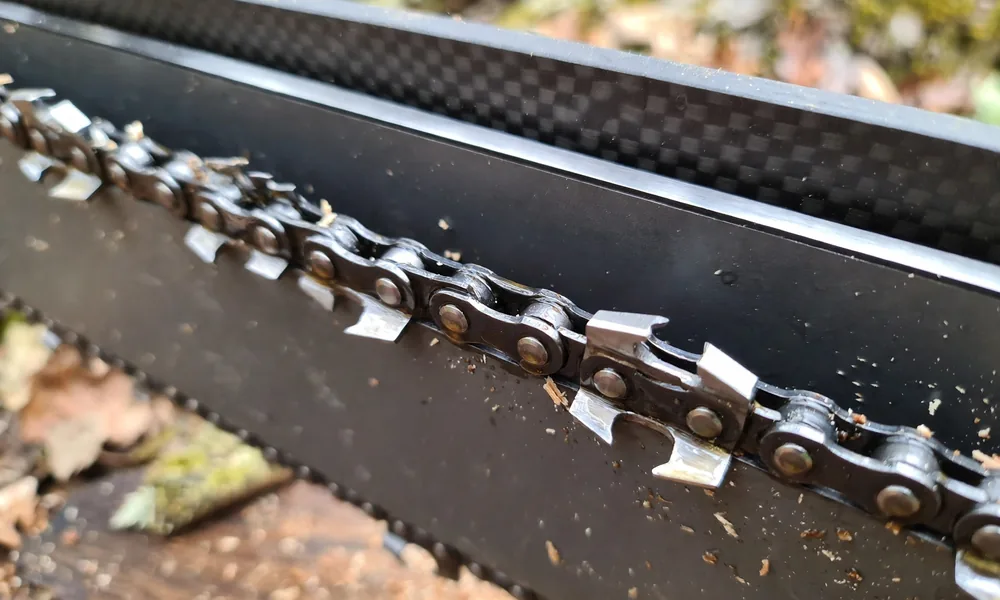
Chain speed is measured in metres per second, and on a luxury electric chainsaw it usually falls between 20 and 30 metres per second. The chain is a loop of steel links with cutting teeth, and the faster it travels around the bar, the faster it shaves wood away, and the cleaner the cut it leaves behind.
The best saws hold their speed under load, which is the number that matters in a thick oak log. A saw that keeps its chain speed steady through the cut is doing what its price promises.
4. Battery capacity, and how many cuts one charge gives
Battery capacity is measured in amp-hours, and on a luxury electric chainsaw it usually falls between 5 and 12 amp-hours, on a 40-volt or 80-volt pack. The pack clips into the back of the saw, locked inside a sealed housing, and it is usually the single dearest part of the whole tool, often a third of the price of the saw itself.
The runtime figure printed next to the battery is where the sheet gets slippery. A maker may claim an hour of cutting, but that figure is usually measured in soft pine, with short cuts and long pauses, and with a sharp chain. The honest measure is cuts per charge, not minutes, and most owners carry a second battery. The same battery logic applies across the garden, as the numbers on luxury electric string trimmer specs explained show, where the pack is again the dearest part.
5. Weight, and why a light saw is a safe saw
Weight is measured in kilograms, and on a luxury electric chainsaw it usually falls between 4 and 7 kilograms with the battery fitted. The body is usually magnesium or a tough glass-filled plastic over a metal frame, built to survive being dropped on a forest floor, and the weight decides how long you can work before your arms give out.
The balance matters as much as the total weight, and a well-built saw balances just ahead of the rear handle, so the bar feels light even when the battery is full. Weight is the number to check before you buy, not after your first afternoon of cutting.
6. Safety, noise, and the numbers that protect you
The last numbers are about safety, and they decide whether the saw is a tool or a hazard. Chain brake time is measured in fractions of a second, and a good brake stops the chain in under a tenth of a second when the guard is knocked forward. Kickback protection, a chain catcher, and a hand guard are all part of the same system, and they are not optional extras on a luxury saw.
Noise is measured in decibels, and on a luxury electric chainsaw it usually falls between 85 and 95 decibels, which is loud enough to need ear protection, but far quieter than a petrol saw at 110 decibels or more.
The Specifications at a Glance
Here are the numbers that matter most on a luxury electric chainsaw, and what a good figure looks like for each one.
| Specification | Typical Luxury Range |
|---|---|
| Motor power | 1,800 to 3,600 watts, brushless electric |
| Battery voltage | 40 to 80 volts, lithium-ion |
| Battery capacity | 5 to 12 amp-hours |
| Bar length | 14 to 20 inches, 35 to 50 centimetres |
| Chain speed | 20 to 30 metres per second |
| Weight with battery | 4 to 7 kilograms |
| Chain brake time | Under 0.1 seconds |
| Noise level | 85 to 95 decibels |
| Charging time | 45 minutes to 2 hours |
| Body construction | Magnesium or glass-filled plastic over metal frame |
What Does a Luxury Electric Chainsaw Cost?
A luxury electric chainsaw is typically priced at an estimated $800 to $2,500. The smaller end of that range buys a 14-inch saw with a single 5 amp-hour battery, typically priced at an estimated $800 to $1,200, while the top end buys a 20-inch flagship with a large 80-volt pack, a spare battery, and a fast charger, typically priced at an estimated $1,800 to $2,500.
A Rare Fact
The chainsaw began life in the operating theatre, not the forest. The first chain-driven cutting tool was built in the late eighteenth century by two Scottish doctors, for cutting bone during surgery, and it was more than a hundred years before the same idea was scaled up into a tool for felling trees. The electric version waited for a battery light enough to carry into the woods, and that took another century after that.

Watts decide pull, bar length decides the size of the log, chain speed decides how fast the cut happens, and the battery decides how many cuts you get before lunch. Read those four first, and the rest of the sheet is detail.