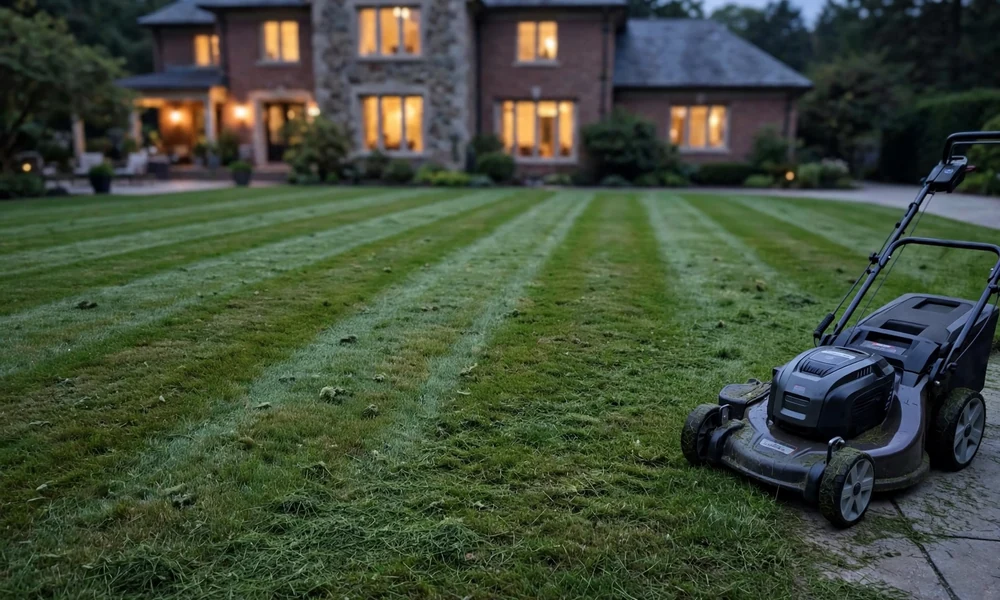
The gardener pressed a button, and the mower woke without a cough, a pull cord or a smell of petrol. It moved across the lawn of a large country house in near silence, leaving a stripe of clipped grass so even that it looked combed, while the only sound was the soft whirr of the blade.
A luxury electric lawn mower is a battery-powered mower built for large, immaculate gardens, where quiet running, a clean cut and a flawless finish matter as much as the grass itself. Its specification sheet is full of figures about batteries, blades and cutting widths, and each one changes how the mower behaves on a real lawn. This is a plain translation of those numbers.

1. Battery voltage and capacity, and how long a charge lasts
The first figures are battery voltage and capacity, and on a premium mower the battery is often a 56 or 80 volt pack, holding between 5 and 12 amp hours. Voltage is the push behind the motor, and a higher voltage usually means the blade keeps its speed when the grass is thick or damp, instead of slowing and tearing the leaves.
Capacity decides the working time, and a large battery typically runs for 45 to 90 minutes of mowing, covering roughly 1,000 to 2,000 square metres on a single charge. The number to check is the area covered on a real lawn, not the laboratory maximum, because long grass, slopes and frequent turns all shorten the run. Some mowers carry two batteries at once, swapping automatically when the first is spent. How such a mower works in practice is explained in how a luxury electric lawn mower works.
2. Cutting width and height, and the finish a wide deck gives
Cutting width is the width of grass cut in a single pass, and a luxury mower usually cuts between 48 and 56 centimetres wide. A wider deck finishes a large lawn faster, with fewer passes and fewer wheel marks, but it is heavier to push and harder to turn around flower beds and trees, so the best width depends on the shape of the garden.
Cutting height is measured in millimetres, often adjustable from about 20 to 80 millimetres, and it is changed with a single lever that lifts the whole deck evenly. A fine lawn is usually kept near 25 millimetres, while a rougher lawn can be left longer, and the mower should hold its height exactly across the whole width, so the stripes stay level. A deck that tilts under its own weight leaves a wavy finish no gardener can forgive.
3. Blade speed and motor power, and what a clean cut needs
Blade speed is measured in revolutions per minute, and a premium mower spins its blade at roughly 2,800 to 3,500 revolutions per minute. Speed matters because a fast blade slices the grass cleanly, while a slow blade tears it, leaving brown tips that show for days and invite disease into the lawn.
Motor power is usually given in watts, often between 1,000 and 2,000 watts for a large electric mower, and the figure to watch is whether the motor holds its speed under load. A good mower senses thick grass and feeds in more power before the blade slows, while a cheap one bogs down and leaves tufts standing. The larger machines that share the same garden are described in how a luxury electric lawn tractor works.

4. Grass collection and mulching, and where the clippings go
Grass collection is measured by the size of the collector box, usually between 55 and 75 litres on a large mower, and a bigger box means fewer stops to empty it. A full box of damp grass is heavy, so the collector should lift off easily and empty without spilling clippings back onto the finished lawn.
Mulching is the alternative, where the blade chops the clippings finely and drops them back into the lawn to feed it, and a good mulching mower needs a specially shaped deck that keeps the clippings circulating until they are small enough to vanish. The figure to check is the mulch plug and the blade design, because a mower that claims to mulch but leaves visible clumps has failed its own test. Some owners switch between collecting and mulching with the seasons.
5. Weight, drive and the feel of pushing it
Weight is a figure that divides opinion, because a luxury mower often weighs between 25 and 35 kilograms, heavier than a basic mower, yet it should feel lighter in use. The reason is the drive system, which is usually a self-propelled rear-wheel drive with a variable speed control, so the mower pulls itself along and the gardener only steers it.
The number to look for is the drive speed range, often up to about 5 kilometres per hour, and whether it adjusts smoothly instead of jumping between gears. A mower that surges forward on a slope is tiring to control, while one that creeps steadily lets the gardener walk at a natural pace. The smaller trimming tool that finishes the edges is covered in luxury electric string trimmer specs explained.
Noise is the figure that decides whether a mower can be used early in the morning, and a luxury electric mower usually runs at about 75 to 85 decibels, far quieter than a petrol mower. The quiet running comes from the electric motor, which has no exhaust and no rattling engine, and it means the gardener can work near the house without waking anyone. A sheet that quotes a noise figure should also say where it was measured, because a reading taken at the handle is louder than one taken a few metres away.
6. The numbers at a glance, the price, and the rare fact
| Figure | Typical range | What it means |
|---|---|---|
| Battery | 56 to 80 volts | Higher voltage holds blade speed |
| Run time | 45 to 90 minutes | About 1,000 to 2,000 square metres |
| Cutting width | 48 to 56 cm | Wider deck, fewer passes |
| Cutting height | 20 to 80 mm | One lever lifts the whole deck |
| Blade speed | 2,800 to 3,500 rpm | Fast blade slices, slow blade tears |
| Collector | 55 to 75 litres | Bigger box, fewer emptying stops |
As a typical and indicative range, a luxury electric lawn mower usually costs roughly 1,500 to 4,000 dollars, depending on battery size, cutting width and drive system, with spare batteries adding several hundred dollars each. That is far more than a basic mower, but the price buys quiet running, a cleaner cut and a machine built to last many seasons in daily use.
The rare fact is that the striped finish on a fine lawn is not painted or pressed, but made by the mower’s rear roller bending the grass in opposite directions as it passes, so the light reflects differently from each stripe. A mower without a roller cannot make true stripes, however sharp its blade, which is why the roller, not the motor, is often the feature a head gardener checks first. Read the run time, the blade speed and the cutting width before the price, and the sheet will tell you whether the mower can keep a large garden looking combed.