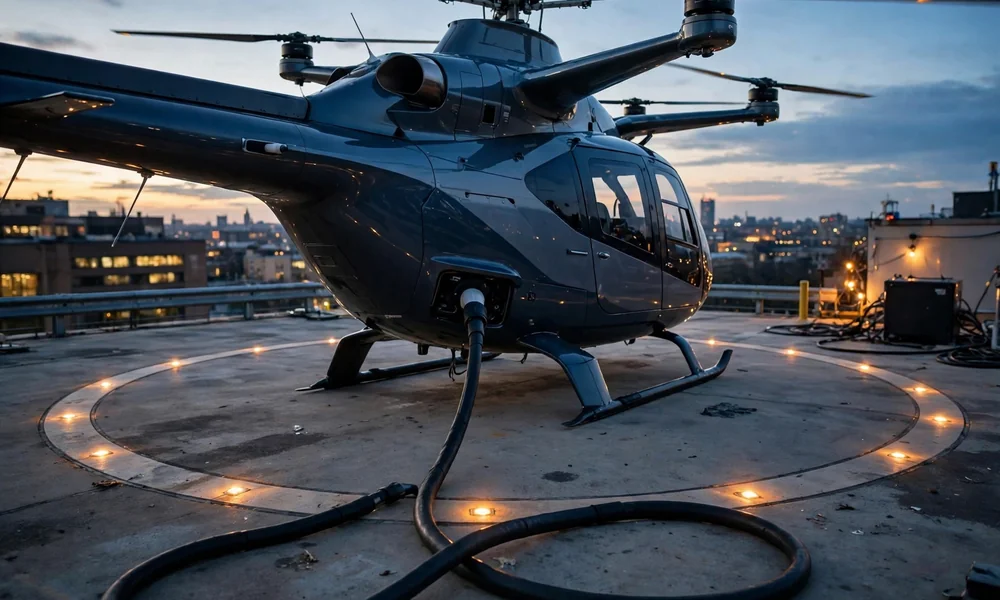
The test pilot lifted the small helicopter off the pad, and the first thing everyone noticed was what they did not hear. No turbine whine, no gearbox growl, just the soft rush of the rotor and the wind. The second thing they noticed, once the applause faded, was the question on the spec sheet that nobody could answer from the flight alone: how far can it actually go, and how long before it has to land and charge?
A luxury electric helicopter is a rotorcraft powered by batteries and electric motors instead of a turbine engine, built for short hops between cities, yachts and private estates, with far less noise and vibration than a conventional helicopter. It looks like a helicopter, it flies like a helicopter, and its spec sheet hides a trade that every other number depends on: the battery is heavy, the flight is short, and the range is the number that decides everything else. This is a plain translation of the figures that matter, and the ones that are mostly decoration.

1. Range and endurance, and the battery that sets the limit
The first numbers on the sheet are the range and the endurance, and a luxury electric helicopter usually flies between 100 and 250 kilometres on a charge, staying in the air for 45 to 90 minutes.
The figure to check beside the range is the reserve, because aviation rules demand enough energy left to reach an alternate landing site and hover while waiting, and that reserve is often 20 to 30 minutes of flight. A sheet that quotes the range without the reserve is quoting a flight that no pilot is allowed to fly. The electric yacht that shares its charging logic is covered in luxury electric yacht specs explained.
2. Battery capacity and weight, and the trade in the floor
Battery capacity is measured in kilowatt hours, and a luxury electric helicopter usually carries between 100 and 300 kilowatt hours, in a battery pack that weighs 500 to 1,000 kilograms. That pack sits low in the fuselage, where its weight helps stability, but it is also the single heaviest item on the aircraft, heavier than the pilot, the passengers and their luggage combined.
The number to check beside the capacity is the energy density, measured in watt hours per kilogram, because a denser battery flies further for the same weight, and the density of the cells decides the range more than the size of the pack. The pack must also be cooled, because a battery that is charged and discharged hard gets hot, and a hot battery is a battery that must be throttled back, which means less power exactly when the pilot needs it most. The electric boat that faces the same trade is measured in luxury electric boat specs explained.
3. Motors and rotor speed, and the quiet that changes everything
Motor power is measured in kilowatts, and a luxury electric helicopter usually has one or two motors delivering 200 to 500 kilowatts in total, driving the main rotor through a gearbox or, in some designs, directly. Electric motors deliver their full torque from a standstill, so the rotor spools up smoothly, and there is no turbine to warm up, no fuel to ignite, and no gearbox full of hot oil screaming under load.
The figure that matters most is the noise, usually 60 to 70 decibels at a distance of 100 metres, against 85 to 95 decibels for a turbine helicopter of the same size. That quiet is what lets an electric helicopter land on a rooftop in a city or on a yacht at anchor without waking the neighbourhood, and it is the reason the aircraft exists at all. The conventional helicopter it replaces is covered in luxury helicopter specs explained.
4. Payload and seats, and who actually gets to fly
Payload is measured in kilograms, and a luxury electric helicopter usually lifts between 200 and 400 kilograms of people and luggage, with two to five seats. That sounds small, and it is, because the battery has already taken the weight that a turbine helicopter would spend on fuel, and the passengers are what is left over.
The number to check is the payload with a full battery and a full reserve, not the payload on paper, because a sheet that quotes the payload with a half-charged battery is quoting a flight that cannot be flown. A pilot, two guests and two small bags is a typical real load, and a fourth guest usually means a shorter flight, not a heavier one.
5. Charging time and power, and the wait between flights
Charging time is measured in minutes, and a luxury electric helicopter usually takes 30 to 60 minutes to recharge to 80 percent on a fast charger, and several hours on a standard charger. That wait is the hidden cost of the electric trade, because a turbine helicopter refuels in ten minutes and flies again, while an electric helicopter spends more time on the pad than in the air on a busy day.
The figure to check beside the time is the charger power, usually 150 to 350 kilowatts, because a charger that powerful needs a serious electrical supply, and many private estates, rooftops and yachts do not have one. The battery must also be kept within a narrow temperature range while it charges, so the pad needs cooling as well as power, and the aircraft needs a ground crew who understand high-voltage batteries, not just aviation fuel.
6. The numbers at a glance, the price, and the rare fact
| Figure | Typical range | What it means |
|---|---|---|
| Range | 100 to 250 kilometres | Before the reserve, not after it |
| Endurance | 45 to 90 minutes | A fraction of a turbine flight |
| Battery capacity | 100 to 300 kilowatt hours | 500 to 1,000 kilograms of pack |
| Motor power | 200 to 500 kilowatts | Full torque from a standstill |
| Noise at 100 metres | 60 to 70 decibels | Quiet enough for a rooftop |
| Fast charge to 80 percent | 30 to 60 minutes | Needs a 150 to 350 kilowatt charger |
As a typical and indicative range, a luxury electric helicopter usually costs roughly 2 million to 5 million dollars, depending on seats, range and interior finish, before the cost of the fast charger, the pad and the battery replacement that will be needed after several years of flying. A two-seat machine for short hops sits at the low end, while a five-seat machine with a long-range pack and a car-like cabin sits at the high end.
The rare fact is that an electric helicopter can be quieter on the ground than in the air, because on the ground its motors are off and its battery is silent, while a turbine helicopter on the ground is still burning fuel, still turning its engine and still making noise while it waits. An electric helicopter parked on a yacht can sit for hours without a sound, and the first sign it is leaving is the rotor turning, not the engine starting. Read the range, the reserve and the charging time before the motor power, and the helicopter will tell you the truth about itself.