A luxury electric monorail looks like the future gliding past on a single beam, silent and smooth, with no driver visible and no smoke behind it. People who ride one notice the wide windows and the soft ride, but few stop to ask what the numbers behind it mean, and those numbers are the real story of the machine.
Every monorail has a spec sheet full of figures for power, speed, capacity and gradient, and each one answers a practical question: how many people can it carry, how steep a hill can it climb, and how often does it need to stop and charge. Read the sheet with those questions in mind and the machine starts to make sense.

How It Works
Step 1: Power comes from the beam itself
A monorail does not carry a giant battery the way a car does. It draws electricity from a rail or a wire running beside its concrete beam, through shoes or a pantograph that stay in contact as the train moves. That steady supply is why a monorail can run all day without stopping to charge, and why its motors can be smaller than you might expect.
Some modern monorails do carry a battery as a backup, enough to crawl to the next station if the power fails. The battery is a safety net rather than the main fuel tank, and its size is listed on the spec sheet as the emergency range, usually just a few miles.
Step 2: The motors grip the beam and pull
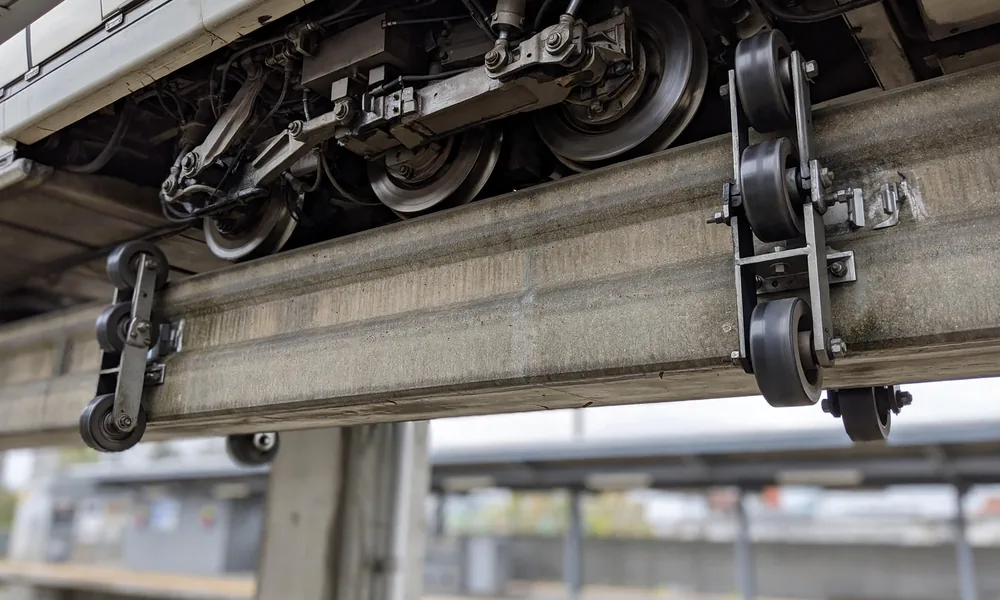
The train sits on top of the beam or hangs beneath it, and its motors drive rubber tyres that run along the beam. Rubber grips concrete far better than steel grips steel, which is how a monorail climbs slopes that would defeat an ordinary train. The spec sheet lists the gradient as a percentage, and a luxury monorail can often manage ten percent or more.

Step 3: The guide wheels keep it on track
Alongside the driving tyres sit smaller guide wheels that press against the sides of the beam. They steer the train through curves and stop it swaying, and they are the reason a monorail feels so smooth in a bend. The spec sheet gives the smallest curve the train can take, and a tighter number means the line can wind through a city centre instead of needing long straight runs.
Those wheels are checked constantly, because a worn guide wheel makes the ride noisy and rough. Maintenance crews measure them with gauges and replace them long before they fail, and the whole train is lifted off the beam on jacks for the job, a sight that still surprises first-time visitors to the depot.
Step 4: The carriages carry the crowd
Capacity is the number that matters most to a city. A luxury monorail train might carry two hundred people in four carriages, with wide doors that let a crowd board in seconds. The spec sheet lists standing room as well as seats, because at rush hour most passengers stand, and the floor is kept flat so wheelchairs and pushchairs roll on without a step.
Air conditioning is part of the capacity story too. A carriage full of people on a hot day needs powerful cooling, and the units sit on the roof, humming quietly above the passengers. Without them the train would be unbearable by mid-afternoon, and the spec sheet lists their cooling power alongside the seat count.
Step 5: The brakes stop it gently
A monorail brakes with its motors first, turning them into generators that slow the train and feed power back into the line. Friction brakes take over only for the final stop, or in an emergency, and the spec sheet lists the braking distance from full speed, a figure the safety engineers guard closely.
The ride stays smooth because the braking is blended so carefully that passengers barely feel it. A driver or an automatic system eases the train to a stop at exactly the right mark on the platform, and the doors open level with the platform edge, so no one steps up or down.
Step 6: The control system runs the line
Many modern monorails run without a driver, guided by a control system that watches every train on the line. It keeps safe distances, sets the speed for each section, and stops a train if anything blocks the beam ahead. The spec sheet calls this the headway, the shortest gap allowed between trains, and a short headway means more trains per hour.
Engineers in a control room watch screens that show every train, and they can take over manually if a sensor fails. The system is tested for years before passengers ever ride it, because a driverless train must be safer than one with a driver, not merely as safe.
| Spec | Detail |
|---|---|
| Power supply | Electricity from a rail or wire beside the beam, with a small backup battery |
| Top speed | Usually 50 to 60 miles per hour on a city line |
| Capacity | Around 200 passengers per four-carriage train, seated and standing |
| Gradient | Can climb slopes of 10 percent or more on rubber tyres |
| Curve radius | Tightest curve often under 50 metres, so the line can wind through streets |
| Braking | Motor braking first, friction brakes for the final stop |
| Headway | Trains can run as little as 90 seconds apart on an automated line |
The figure most people misunderstand is top speed, because a monorail almost never reaches it. Stations sit close together on a city line, so the train spends its time speeding up and slowing down, and the average speed is closer to twenty miles per hour. The number that decides whether the line feels fast is headway, how often a train arrives, and a train every two minutes beats a faster train every ten.
What One Costs
A luxury electric monorail train typically costs an estimated 8 to 15 million dollars per train, set mostly by the number of carriages, the motors, the control system and the finish of the interior. The beam and stations cost far more than the trains themselves, which is why a whole line runs into hundreds of millions. The same electric thinking shapes smaller machines, and the way a luxury electric chopper’s specs are explained shows how a motorcycle balances power and range, while the way a luxury electric touring bike’s specs are explained covers a machine built for long, quiet miles.
A Rare Fact
The first monorails were built more than a century ago, and one famous early line carried passengers across a German river valley on a track that still runs today. Its trains hang beneath the beam rather than riding on top, and the design has survived wars, floods and a century of daily use, which is a longer life than almost any other form of city transport can claim.
A luxury electric monorail is not really about speed. It is about capacity, gradient, curves and how often a train arrives, and those four numbers tell you whether the line will serve a city or merely decorate it. The same trade-offs between power, range and weight shape every electric vehicle, and the way a luxury electric touring bike works shows how the same ideas play out on two wheels instead of one beam.