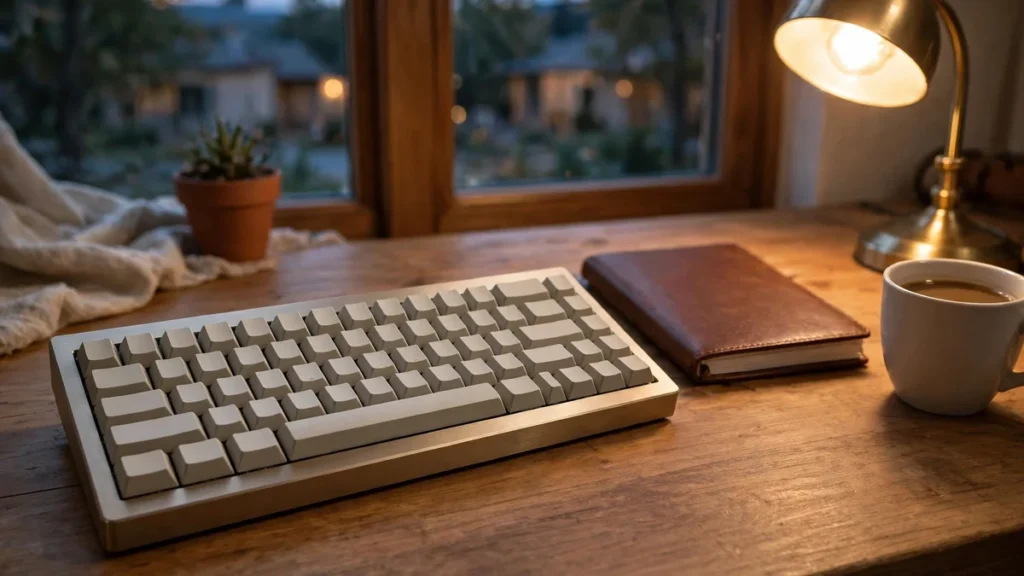
The first thing he noticed was the sound. It was not the flat tap of the keyboard he used at work, but a deep, soft thock, like a wooden door closing in a quiet house. The second thing was the weight. When he lifted it, the keyboard did not flex or rattle; it sat in his hands like a small ingot, solid and cool. The third thing was the price tag, which made him laugh out loud, and then, after an hour of typing on it, made him stop laughing.
A luxury mechanical keyboard is the strangest object in the world of expensive machines, because it does the same job as a twenty-dollar keyboard and does it with parts that cost a hundred times more. It has no engine, no screen and no motor. It has switches, springs, keycaps, a plate, a case and a cable, and every one of those parts has been chosen, tuned and finished by hand.
This guide translates every number on a luxury mechanical keyboard spec sheet into plain English, from switches to acoustics to the metal that makes it heavy.
How to Read a Luxury Mechanical Keyboard Spec Sheet
Switches: the heart of every keypress
Switches are the small mechanisms under each key, and they are the heart of the keyboard. A luxury mechanical keyboard usually uses hand-lubed linear, tactile or clicky switches, and the spec sheet quotes their type, their actuation force and their travel distance. Actuation force is usually about 45 to 65 grams, which is the weight needed to press the key down far enough to register, and total travel is usually about 3.5 to 4 millimetres. A lighter switch feels faster and easier on the fingers, while a heavier switch feels more deliberate, and the difference between them is the difference between a keyboard you love and one you merely use.
Actuation and travel: where the key actually fires
Actuation point is the depth at which the key registers, usually about 1.8 to 2.2 millimetres into the press, which is well before the key bottoms out. That gap is what makes a mechanical keyboard feel fast: the computer knows you pressed the key before your finger has finished moving. Pre-travel, the distance before actuation, and bottom-out force, the force at the very bottom of the press, are also quoted on better spec sheets. The precision of a mechanical device is a story that runs through luxury engineering, as our guide to luxury mechanical watch specs, explained shows for its tiny gears and springs.
Plate and case: why the keyboard weighs so much
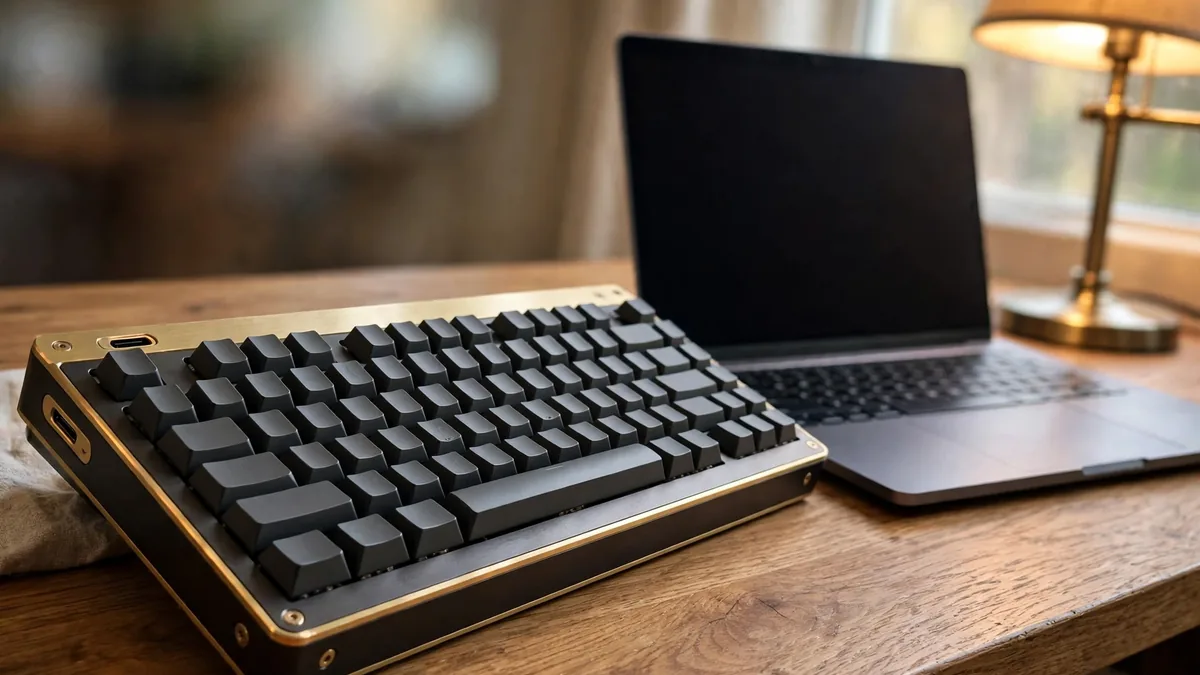
The plate is the sheet of metal or plastic that holds the switches in place, usually brass, aluminium or carbon fibre, about 1.5 millimetres thick, and the case is the body that holds everything together. A luxury keyboard case is usually machined from a solid block of aluminium or brass, and the finished keyboard weighs about 2 to 4 kilograms, which is ten times the weight of an ordinary keyboard. That weight is not an accident: a heavy case absorbs vibration, stops the keyboard sliding across the desk, and gives every keypress a deep, solid sound. A hollow plastic case rattles; a brass case rings like a bell, softly.
Acoustics: the sound that sells the keyboard
Acoustics is the most talked-about spec on a luxury keyboard, and the hardest to measure. The sound of a keypress is shaped by the switch, the plate, the case, the keycaps and the foam or silicone inside the case, and enthusiasts describe it with words like thocky, creamy, marbly and clacky. The spec sheet cannot capture the sound, so makers quote the materials and the mounting style instead: gasket mount, plate mount or tray mount, each of which changes how the plate flexes and how the sound travels. How the same parts work in a gaming keyboard is a close cousin, as our guide to how a luxury gaming keyboard works explains.
Layout, connection and polling: the practical numbers
Layout is the arrangement of the keys, and luxury keyboards usually come in 60 percent, 65 percent, 75 percent or full-size layouts, with 61 to 108 keys depending on the size. A smaller layout saves desk space and looks cleaner, but it hides some keys behind layers and shortcuts. Connection is usually USB-C, sometimes with Bluetooth or 2.4 gigahertz wireless, and the polling rate is usually 1,000 hertz, which means the keyboard reports to the computer a thousand times a second. Battery life on a wireless luxury keyboard is usually about 40 to 100 hours, depending on the backlight. The same spec language appears across gaming hardware, as our guide to luxury gaming keyboard specs, explained shows.
Stabilisers and lubrication: the details that separate good from great
Stabilisers are the small mechanisms under long keys like the spacebar, the enter key and the shift keys, and they stop those keys wobbling or rattling. On a luxury keyboard the stabilisers are hand-lubed, clipped and tuned, and a well-tuned spacebar sounds like the rest of the keys instead of rattling like a loose shutter. Lubrication is applied by hand to every switch, a job that takes hours, and it is the single biggest difference between a factory keyboard and a luxury one. A dry switch scratches; a lubed switch glides, and the sound changes from a scrape to a soft thock.
Luxury Mechanical Keyboard Specs
| Specification | Typical range |
|---|---|
| Switch type | Linear, tactile or clicky, hand-lubed |
| Actuation force | About 45 to 65 grams |
| Actuation point | About 1.8 to 2.2 millimetres |
| Total travel | About 3.5 to 4 millimetres |
| Keycaps | Double-shot ABS or thick PBT, 1.5 mm or more |
| Plate | Brass, aluminium or carbon fibre, about 1.5 mm |
| Case material | Machined aluminium or brass |
| Weight | About 2 to 4 kilograms |
| Layout | 60 to 100 percent, 61 to 108 keys |
| Polling rate | About 1,000 hertz |

What Does a Luxury Mechanical Keyboard Cost?
A luxury mechanical keyboard typically costs an estimated 500 to 2,000 dollars to buy, depending on the case material, the switches and the keycaps, with rare limited editions passing an estimated 3,000 dollars. The case alone is estimated at 300 to 800 dollars, because it is machined from a solid block of metal, and a set of custom keycaps is estimated at 100 to 300 dollars. Hand-lubing and tuning the switches takes hours of skilled work, and that labour is a large part of the price.

A Rare Fact
The sound of a luxury keyboard is so prized that enthusiasts record it, share the recordings online, and argue about them like wine tasters argue about vintages. Some makers tune the sound by changing the foam inside the case, the thickness of the plate, or even the screws that hold the case together, and a single millimetre of foam can change the sound from a sharp clack to a deep thock.
A luxury mechanical keyboard is switches, keycaps, a plate and a heavy metal case, and the spec sheet is really a description of how those parts feel and sound together. The actuation force tells you how heavy the keys feel, the travel tells you how fast they fire, the keycaps tell you how they feel under your fingers, and the case tells you how they sound. Read those four numbers first, and the rest of the sheet falls into place.