The box arrived on a Tuesday, and the spec sheet inside it read like a riddle. Suction power in pascals, battery life in minutes, a water tank measured in millilitres, and a word I had to look up twice. The robot mop itself looked simple enough, a quiet disc that wandered the kitchen and left clean floor behind it. The numbers, though, were doing a lot of heavy lifting, and most of them were not saying what they seemed to say.
This is a plain translation of the numbers that matter, what each one measures, and which ones deserve your attention before you spend the money.

1. Suction power, and why pascals are only half the story
The first number most people notice is suction, measured in pascals, and on a luxury robot mop it usually falls somewhere between 5,000 and 12,000. A pascal is a unit of pressure, and a bigger number means the motor can pull harder at the floor. That matters for a robot that also vacuums, because dust and crumbs need to be lifted before the mop pads can do their work. But suction alone does not clean a floor.
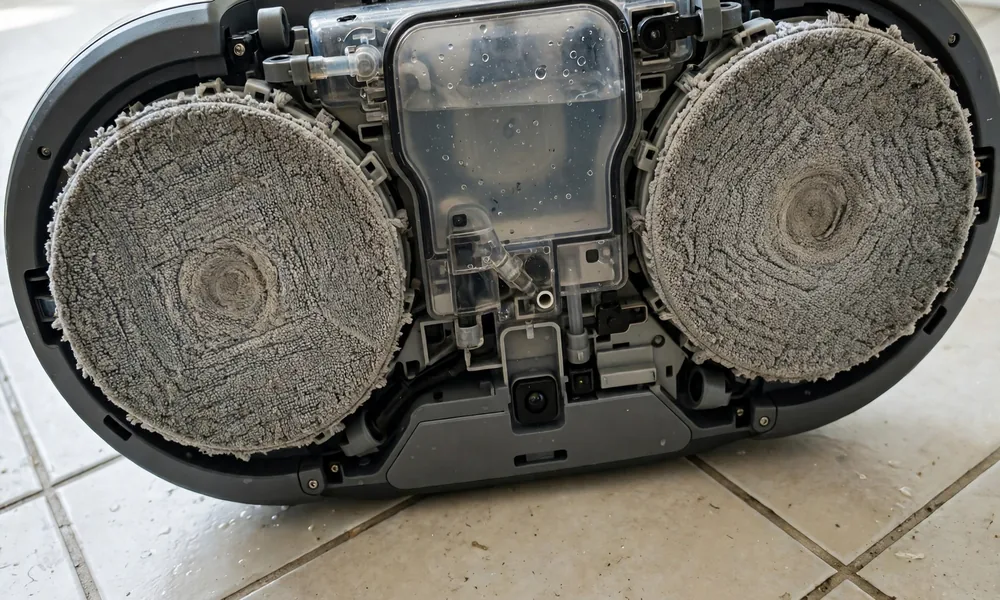
The number to look for next to suction is the downward pressure of the mop pads, usually given in grams or described as a lifting and pressing system. The best machines press their pads down with real force and spin or vibrate them as they go, so the pad scrubs rather than slides. The way the whole machine is put together is described in how a luxury robot mop is made, where the motor, the pads, and the frame are fitted into a disc only a few inches tall. If the sheet gives you suction but says nothing about pad pressure, the maker is showing you the easy number and hiding the one that does the mopping.
2. Battery life, and the square metres that matter more
Battery life is usually printed as a proud number of minutes, often between 120 and 240, and it sounds like plenty until you ask what the robot was doing during those minutes. A robot mopping on its quietest setting with the pads barely damp will run far longer than the same robot scrubbing a sticky kitchen floor at full power. The honest figure is not the minutes but the area covered on one charge, usually given in square metres, and a good luxury mop covers 150 to 250 square metres before it needs to go home.
3. Navigation, and how the robot sees your home
Navigation is the difference between a robot that cleans in tidy lines and one that bumps around like a lost guest. Luxury mops use one of two systems: a spinning laser turret on top that maps the room in detail, or a camera that reads the room visually. Laser navigation, usually called LiDAR, works in the dark and builds an accurate map on the first run. Camera navigation can recognise objects, like a sock or a charging cable, and steer around them, but it needs some light to see.
The spec sheet may list obstacle avoidance, cliff sensors, and mapping as separate features, and they are all worth having. Cliff sensors stop the robot from falling down stairs. Obstacle avoidance keeps it from eating a shoelace. Mapping lets you tell it to clean only the kitchen after dinner, and to stay out of the bedroom entirely. How that mapping works in practice is explained in how a luxury robot mop works, where the sensors and the software take turns doing the thinking.
4. The water system, and what clean water really means
A mop is only as good as its water. A luxury robot mop carries a clean water tank, usually 200 to 400 millilitres, and either a dirty water tank or a dock that washes the pads for it. The better systems keep the two separate, so the pad is always scrubbing with fresh water and the dirt goes somewhere else. Cheaper machines drag the same damp pad through the whole house, spreading yesterday’s kitchen across today’s hallway.
5. Noise, size, and the numbers nobody reads twice
Noise is measured in decibels, and a luxury robot mop usually runs between 55 and 68 decibels while mopping, which is roughly the sound of a normal conversation. The number is easy to ignore until the robot starts its self-cleaning cycle at midnight, when the dock can be noticeably louder than the robot itself. If the machine will run while you sleep, look for a quiet mode and a dock that can be scheduled to wash pads during the day.
Size matters more than the sheet suggests. The robot’s height decides whether it can slide under the sofa, and most luxury models stand between 9 and 11 centimetres tall. Its width decides whether it fits between chair legs. Its weight, usually 4 to 5 kilograms, decides how much pressure the pads can put on the floor. None of these numbers is exciting, and all of them decide whether the robot can actually reach the dirt in your home. A robot vacuum cousin faces the same trade-offs, and how a luxury robot vacuum works shows how suction, size, and navigation balance against each other in a machine built for dust rather than damp.
The Specifications at a Glance
Here are the numbers that matter most on a luxury robot mop, and what a good figure looks like for each one.
| Specification | Typical Luxury Range |
|---|---|
| Suction power | 5,000 to 12,000 pascals |
| Mop pad pressure | Pressing and spinning pads, not sliding |
| Battery life | 120 to 240 minutes per charge |
| Area per charge | 150 to 250 square metres |
| Navigation | Laser mapping, obstacle avoidance, cliff sensors |
| Clean water tank | 200 to 400 millilitres, separate dirty tank |
| Noise while mopping | 55 to 68 decibels |
| Height | 9 to 11 centimetres |
What Does a Luxury Robot Mop Cost?
A luxury robot mop is estimated to cost roughly $800 to $1,800, with the self-cleaning dock included. A good mid-range luxury model with laser navigation and a washing dock is estimated at roughly $800 to $1,200, while a flagship with hot-water pad washing, automatic detergent, and the strongest suction is estimated at roughly $1,200 to $1,800. The dock itself accounts for much of the price, and replacement pads, filters, and detergent are estimated at roughly $100 to $200 a year.
A Rare Fact
The first robot mops were not mops at all. Early floor robots only vacuumed, and their makers discovered that owners wanted a machine that could handle a spilled drink as well as dust. The first mopping robots simply dragged a damp cloth behind them, which cleaned the middle of a room and spread the dirt to the edges.

The spec sheet stops looking like a riddle once you know which numbers do the work. Suction lifts the dust, pad pressure scrubs the floor, the water system keeps the pad clean, and the map makes sure none of it is wasted. Read those four, and the rest of the sheet is decoration.


