At three in the morning, when the house is dark and everyone is asleep, a small disc wakes up in its dock, rolls out across the marble, and starts mopping the kitchen floor. Nobody told it to. Nobody is watching it. A luxury robot mop is not a toy with a wet cloth. It is a small, quiet machine that has to navigate, clean, and wash itself, and building one means fitting a whole cleaning crew into something the size of a dinner plate.
The luxury robot mop is a self-navigating floor-cleaning machine that vacuums, mops, and washes its own pads, built around a laser mapping system, a water management unit, and a docking station that empties, refills, and dries it. It is the patience of the engineering: every sensor, seal, and spinning pad has to survive years of daily contact with dirty water and still work on the first try.

How It’s Made
Step 1: The chassis and the drive system
Every robot mop starts as a low, round chassis, moulded from tough ABS plastic with a metal frame inside. The shape is no accident: a circle turns in place, slips under furniture, and never gets wedged in a corner. Inside the chassis sit two drive wheels, each with its own motor and a suspension spring, so the mop can climb a rug edge of about two centimetres without losing contact with the floor. A small caster wheel at the front steadies it. The motors are chosen for torque at low speed rather than top speed, because a mop that rushes leaves dirty water behind.
Step 2: The brain, the laser, and the map
On top of the chassis goes the navigation tower, a small spinning turret that houses a laser rangefinder. It spins several times a second, firing invisible pulses and measuring how long they take to bounce back from walls and furniture, building a live map of the room. Around it, the circuit board carries the processor, memory, and Wi-Fi radio, all sealed against the damp air that a mop lives in. The board is tested on a bench that feeds it a fake room, and only boards that draw the map correctly are allowed into a body.
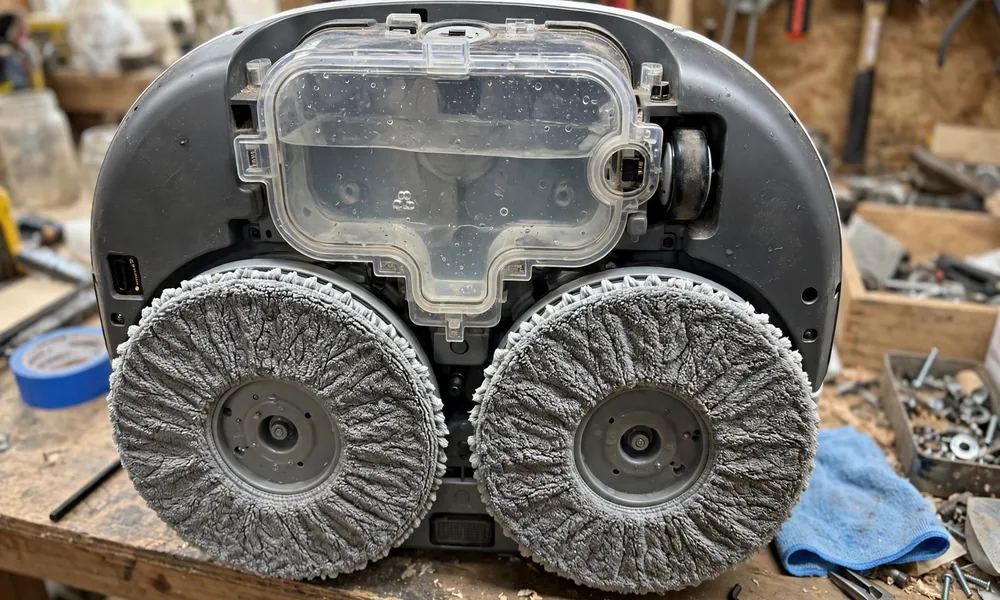
Step 3: The water system and the mopping pads
The part that makes a mop a mop is its water system. A sealed tank holds clean water, and a small pump pushes it through fine nozzles onto two round pads that spin in opposite directions, scrubbing the floor rather than dragging across it. A separate dirty-water path in the dock pulls the grime back out of the pads after each run. Engineers spend weeks tuning the flow rate: too much water and the floor stays wet for an hour; too little and the pads smear instead of cleaning. The same care that goes into a luxury robot pool cleaner goes into keeping the water where it belongs and nowhere else.
Step 4: The battery, the dock, and the self-washing station
A lithium battery pack, usually around five thousand milliamp-hours, sits low in the body to keep the centre of gravity down. It gives the mop roughly two to three hours of cleaning before it returns to its dock on its own. The dock is the real luxury: it is a small appliance in its own right, with a clean-water tank, a dirty-water tank, a washboard that scrubs the pads, and a warm-air dryer that stops them smelling. When the mop docks, the station empties the dustbin, refills the water, washes the pads, and dries them with heated air. The dock’s own plumbing is pressure-tested with dyed water so that any leak shows up as a coloured stain before the unit is boxed.
Step 5: Software, sensors, and the first clean
Once assembled, the mop is loaded with its mapping and cleaning software. The software decides the cleaning path, remembers the rooms, marks the no-go zones, and learns where the floor is dirtiest. Each finished unit runs a test clean on a small mock floor with coffee stains, dust, and a pet-food spill, while a camera above records whether it missed a spot. A unit that leaves a streak fails and goes back for recalibration. The navigation thinking is close kin to the luxury robot lawn mower, which also has to map a space and work through it methodically without a human watching.
Step 6: Final inspection, packaging, and the box
The last step is a full inspection: the pads spin, the water flows, the laser maps, the dock washes, and the app connects. The mop is wiped down, the pads are sealed in a bag, and the dock, charger, spare pads, and manual are packed around it in moulded foam. Luxury packaging is part of the product, so the box is designed to survive a drop from a warehouse shelf and still open like a gift. A final sticker carries the serial number, which ties the mop to its factory test record, so that if a customer ever reports a fault, the maker can look up exactly which bench it passed on.
Specifications
| Specification | Typical luxury robot mop |
|---|---|
| Diameter | About 35 cm |
| Height | About 10 cm |
| Navigation | Laser mapping with cliff and bumper sensors |
| Battery | Lithium, about 5,200 mAh, two to three hours per run |
| Mopping system | Twin spinning pads, auto-lift over carpets |
| Dock | Self-washing, self-refilling, warm-air drying |
| Noise | About 60 decibels while mopping |
What a Luxury Robot Mop Costs
A luxury robot mop with a self-washing dock typically costs between about $900 and $1,800, with flagship models reaching around $2,000. These are estimates based on current premium models, not fixed prices. The dock accounts for much of the cost, since it is effectively a second machine. Cheaper models mop with a damp pad and no dock, but the luxury tier is defined by the self-washing station, the laser mapping, and the pad-lifting system. Running costs are modest: replacement pads every few months, a filter now and then, and a small amount of electricity. The real price is the engineering time spent making a machine that can be trusted alone in a house full of rugs, cables, and sleeping pets. The build quality is the point, much like the luxury robot pool cleaner, where the hard part is making a machine that works unsupervised in water.

A Rare Fact
Some luxury robot mops can detect the difference between a spilled drink and a pet accident, and they refuse to mop the second one. Early robot mops famously spread pet messes across entire floors, and the fix was a small camera and a trained model that recognises the shape and shine of the mess and backs away. It is a strange feature to advertise, but for pet owners it is the one that matters most.
A luxury robot mop is a quiet argument that housework is an engineering problem. The laser, the spinning pads, the self-washing dock, and the software all exist so that one small machine can do a job that used to take a bucket, a pair of hands, and half an hour, and do it while nobody is home. The next time it rolls out at three in the morning, it is worth remembering how much thought went into something that only ever gets noticed when it stops working.


