It is three in the morning, the sea is black glass, and the captain of a luxury yacht is steering through fog so thick that the bow disappears ten metres ahead. There is no moon, no horizon, and no other light except the soft green glow of the instruments on the bridge. On the screen in front of him, though, the world is clear: the coastline curves away to port, a fishing boat is crossing a mile ahead, and a buoy marks the channel into harbour. That picture comes from the radar, a scanner turning slowly on the mast above his head, and on a luxury ship the radar is not an afterthought. It is one of the most expensive and most carefully specified pieces of equipment on board.
A ship’s radar works by sending out short bursts of radio waves and listening for the echoes that bounce back from anything solid. The time each echo takes to return tells the system how far away the object is, and the direction of the antenna tells it where the object sits. On an ordinary boat the set is modest, a small dome and a screen, good enough for fair weather and familiar water. On a luxury ship the demands are different: the vessel is bigger, it travels further, it sails at night and in bad weather, and the owner expects the bridge to see everything, from a distant storm front to a small wooden boat with no lights. The spec sheet of a luxury radar is a list of the ways its makers have answered those demands, and it reads very differently from the sheet of a harbour runabout.
Range, Power and the Size of the Beam
The first numbers on any radar spec sheet are range and power, and they belong together. Range is the furthest distance at which the radar can still pick up a useful echo, and on a luxury ship it is usually quoted as something like 48 to 96 nautical miles for a large target such as another ship or a coastline. Power is the strength of each transmitted pulse, measured in kilowatts, and a luxury open-array radar typically transmits at 12 to 25 kilowatts. More power pushes the signal further and makes faint echoes, like a small boat in rain, easier to see, but it also needs a bigger power supply and a heavier antenna, so the numbers are always a balance between what the ship needs and what it can carry.
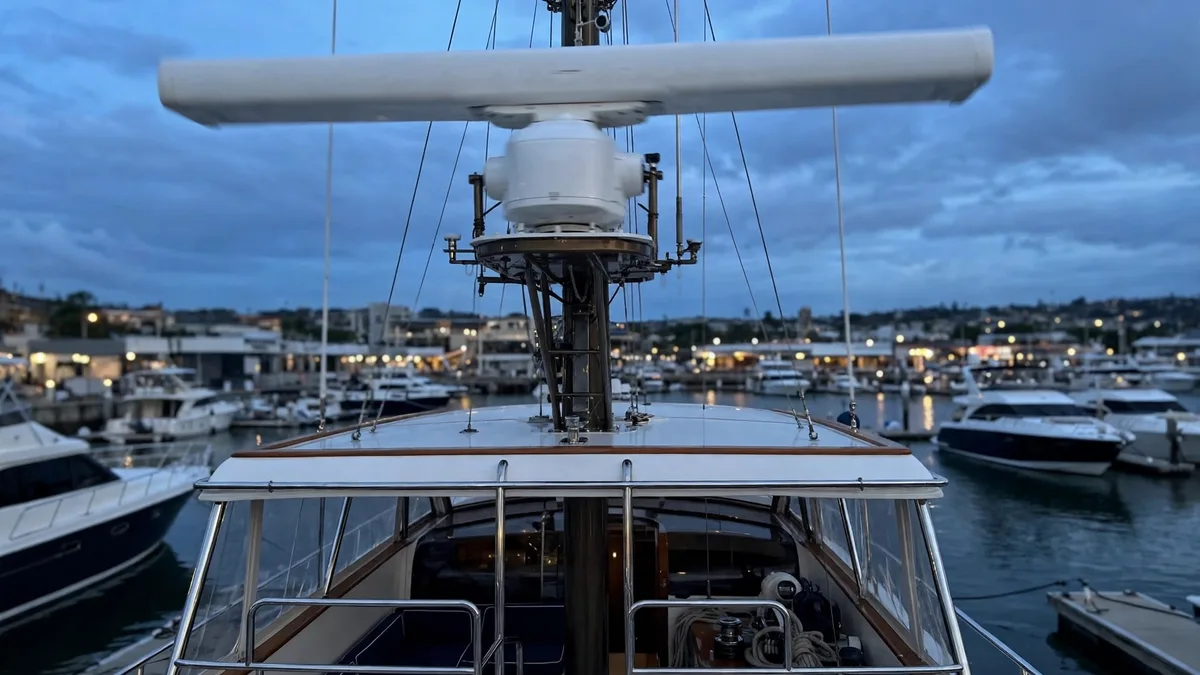
The third number that matters is the beam width, which is how narrow the radar’s view is. A narrow beam, often less than one degree on a luxury open array, paints a sharper picture, because it can tell two close objects apart instead of merging them into one blob on the screen. A wide beam, which is what a small dome radar gives, is cheaper and smaller, but it smears the picture. The trade is size: a narrow beam needs a long antenna, often two metres or more, which is why the biggest luxury radars sit on tall masts with a long bar turning slowly above the bridge. The antenna length is on the spec sheet for a reason, and it is the reason a superyacht radar looks nothing like the dome on a fishing boat.
The Spec Table, in Plain Numbers
| Specification | Typical luxury ship radar | What it means |
|---|---|---|
| Maximum range | 48 to 96 nautical miles | How far away it can still see a large target. |
| Transmitter power | 12 to 25 kilowatts | Stronger pulses see faint targets further away. |
| Antenna length | 1.8 to 2.4 metres, open array | A longer antenna gives a narrower, sharper beam. |
| Beam width | Under 1 degree, open array | Narrow beams separate two close objects on screen. |
| Rotation speed | 24 to 48 revolutions per minute | Faster rotation refreshes the picture more often. |
| Minimum range | About 20 metres | How close a target can be and still show up. |
| Display | 19 to 24 inch colour screen | A large screen shows detail without crowding. |
| Target tracking | 50 to 100 tracked targets | The system follows moving ships and warns of collision. |
| Weather modes | Rain and sea clutter filters | Cleans up the picture in storms and heavy seas. |
| Power draw | About 100 to 200 watts | What the set takes from the ship’s electrical system. |
Reading the Numbers Like an Engineer
The numbers only make sense together. A radar with a very long range but a wide beam will see far, yet it will blur two boats sailing close together into a single smear, and the captain will not know whether he is looking at one ship or two. A radar with a narrow beam but low power will paint a sharp picture nearby and lose faint targets at distance, which is no help when the ship is crossing open water at night. The way to read the sheet is to look for balance: range, power and beam width should all point at the same kind of sailing, and if one number looks far better than the others, the set is probably being asked to do a job its antenna cannot support.
What a Luxury Ship Radar Costs
A luxury ship radar is not bought off a shelf and screwed to the mast. Prices are estimates, and they vary with size and brand, but a complete open-array set for a luxury yacht, antenna, processor and display included, is generally estimated at roughly $15,000 to $60,000, while a full superyacht system with a second dome radar, dual displays and installation can be estimated at $100,000 or more. A small dome set for a coastal boat might cost a tenth as much, which is why the big open arrays remain a luxury choice rather than a standard one.

A Rare Fact Worth Knowing
Here is the detail that surprises even experienced sailors: a ship’s radar can see rain. The same radio waves that bounce off a steel hull also bounce off heavy rain, and on the screen a storm shows up as a bright, shifting patch. A good luxury radar turns that weakness into a tool, because the crew can read the shape and movement of the rain and steer around the worst of a squall before it arrives. On a superyacht crossing an ocean, that weather picture is sometimes more valuable than the picture of the ships around it, and it is the reason the weather filters on the spec sheet are listed as carefully as the range.
For anyone comparing radars, the advice is simple: start with the sailing, not the numbers. Know whether the ship crosses oceans or stays near the coast, whether it sails at night, and how busy its waters are, and then read the spec sheet to see whether the range, beam width and rotation speed match that life. The biggest set is not always the best one, and a well-matched dome can serve a coastal yacht better than an oversized open array. When the numbers line up, though, there is nothing quite like it: a quiet bar turning on the mast, painting a picture of the sea that no eye could ever see. The story of how a luxury ship radar is made shows the building behind the set, how a luxury ship radar works explains the physics of the echo, and luxury titanium propeller specs explained covers another part of the ship where the numbers decide everything.


