Watch a submarine slip beneath the surface and you will see it happen slowly, almost politely. The bow dips, the water closes over the deck, and the sail sinks last, leaving only a swirl behind. Nothing about it looks dramatic, and that is the point. A submarine does not crash-dive like a stone. It is flown down, gently and precisely, by a pair of small wings near the bow that most people never notice. Those wings are the diving planes, and they do the same job for a submarine that the elevators do for an aeroplane.
A diving plane is a flat fin that sticks out from the side of the hull and tilts up or down on command. Tilt it one way and the water rushing past pushes the bow down. Tilt it the other way and the bow rises. On a luxury private submarine the planes must be small, quiet and exact, because the whole point of the boat is to glide through clear water while its guests watch fish through the windows.

Luxury Submarine Diving Plane Specs at a Glance
| Spec | Detail |
|---|---|
| Plane span | About 1 to 3 metres each side on a luxury private submarine |
| Plane area | Roughly 1 to 4 square metres per plane, sized to the hull |
| Deflection range | About 30 degrees up and 30 degrees down from level |
| Actuator type | Hydraulic rams inside the pressure hull, sealed through the hull |
| Response time | Full deflection in about 2 to 5 seconds at cruising speed |
| Material | Stainless steel or marine-grade alloy, often with composite fairings |
| Depth rating | Built to the same depth rating as the hull, often 300 metres or more |
| Control | Joystick or autopilot with depth and pitch sensors feeding back |
These are typical figures, not promises. One maker may fit larger planes for a heavier boat while another uses smaller planes and a faster actuator, and the numbers only make sense together.
How a Small Fin Moves a Whole Submarine
The secret of the diving plane is leverage. The plane sits near the bow, far from the centre of the submarine, so even a small push from the water creates a large turning force. When the plane tilts down, the water strikes its upper surface and presses the bow down. When it tilts up, the water presses the bow up. The submarine pivots around its centre, and the stern planes, if the boat has them, help keep the trim level. It is the same principle as a seesaw, played out in water at a few knots.
Speed matters more than size. A plane that works beautifully at cruising speed does almost nothing when the submarine is barely moving, because there is no water rushing past to push against. That is why a submarine changes depth with its ballast tanks when it is slow and uses its planes when it is moving. The how the luxury submersible works story explains the same balance, where buoyancy sets the depth and the planes fine-tune it, and the pilot learns to think in both at once. A good diving plane is not the biggest one. It is the one that stays useful across the speeds the boat actually travels at.
Deflection range is the number that shows how hard the planes can work. Thirty degrees up and thirty down sounds generous, but in practice the pilot rarely uses more than ten or fifteen degrees, because a sharp tilt at speed can pitch the boat steeply and throw the guests around the cabin.
Hydraulics, Seals and the Pressure Hull
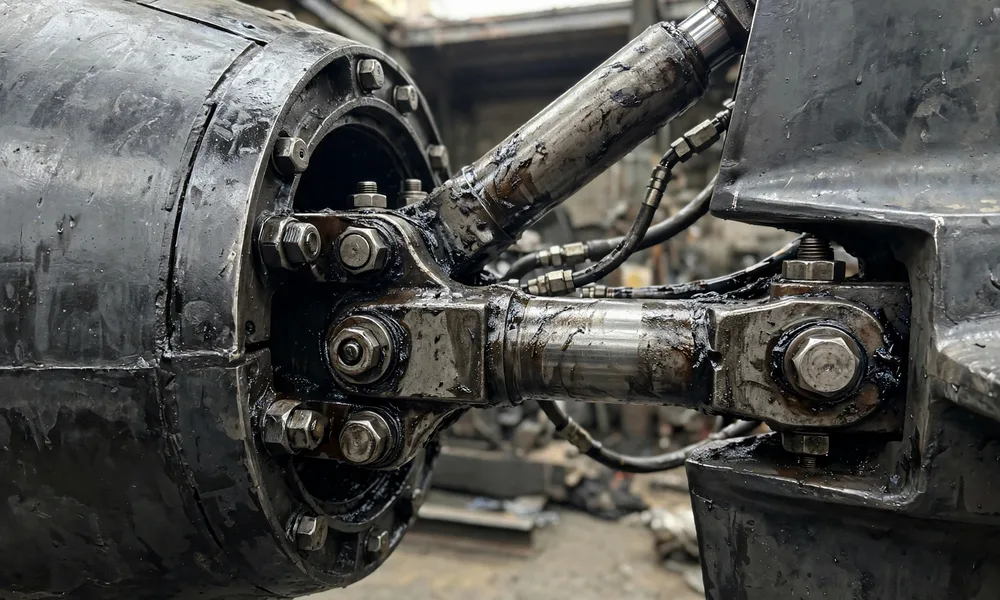
The hardest part of a diving plane is not the fin itself but the place where it joins the hull. The fin must move, the hull must stay watertight, and the sea outside is pressing in with the full weight of the water above. The answer is a shaft that passes through the pressure hull on a seal, driven by hydraulic rams mounted safely inside. The rams push oil under pressure, the shaft turns, and the plane tilts, while the seal keeps the sea out. It is a simple idea that demands perfect workmanship, because a leak at depth is not a nuisance. It is an emergency.
The materials have to survive the same punishment. Stainless steel and marine-grade alloys resist the salt water, and composite fairings smooth the shape so the plane slips through the water quietly. The luxury submarine periscope specs show the same sealing challenge in a different mast, where a moving part must pass through the hull without letting the sea in, and the diving plane faces it under far greater loads.

Flying the Boat by Wire
On a modern luxury submarine the pilot does not wrestle with the planes by hand. A joystick sends the command, an autopilot holds the depth, and sensors measure the pitch and the depth many times a second, feeding corrections back to the actuators. The pilot asks for a depth, and the system tilts the planes just enough to get there and hold it, smoothing out the bumps from waves and currents. The ride feels calm because the machine is working hard behind the scenes.
That calm is the luxury. Guests in a private submarine are not submariners, and they expect the boat to glide, not lurch. The luxury research submarine specs show the same control thinking in a working boat, where scientists need the submarine to hover steady over the seabed while they film, and the planes and thrusters work together to hold it still.
As an estimate, a pair of diving planes for a small luxury submarine costs about $30,000 to $80,000, the hydraulic actuators and seals about $40,000 to $100,000, and the control system about $20,000 to $60,000, before fitting. The fitting itself means cutting into the pressure hull in a specialist yard, which adds weeks and tens of thousands more. The planes are a small share of a submarine’s price, but they are the share that decides whether the boat flies or wallows.
A Rare Fact From the World of Diving Planes
Here is a detail few submarine fans ever learn: some early submarines had diving planes that folded away. The designers worried that the fins would snag on nets and cables, so they built planes that tucked flat against the hull when the boat surfaced and swung out again for diving. The idea worked, but the hinges leaked, the mechanism jammed, and crews soon decided that a fixed plane they could trust beat a clever one they could not. Modern luxury submarines keep their planes fixed, and the bow carries the fins proudly in the open, where they can be inspected at a glance.
What the Specs Mean for You
If you are comparing submarine diving planes, start with four numbers: plane area, deflection range, response time and depth rating. A plane sized to the hull, with generous deflection, a fast response and a depth rating that matches the boat, is worth its price. Material matters less than the brochures suggest, and the seal matters more than anyone admits, because a watertight shaft is what keeps the sea on the outside. The best diving plane is the one the pilot forgets about, because the boat goes where it is asked and the guests never feel a thing.