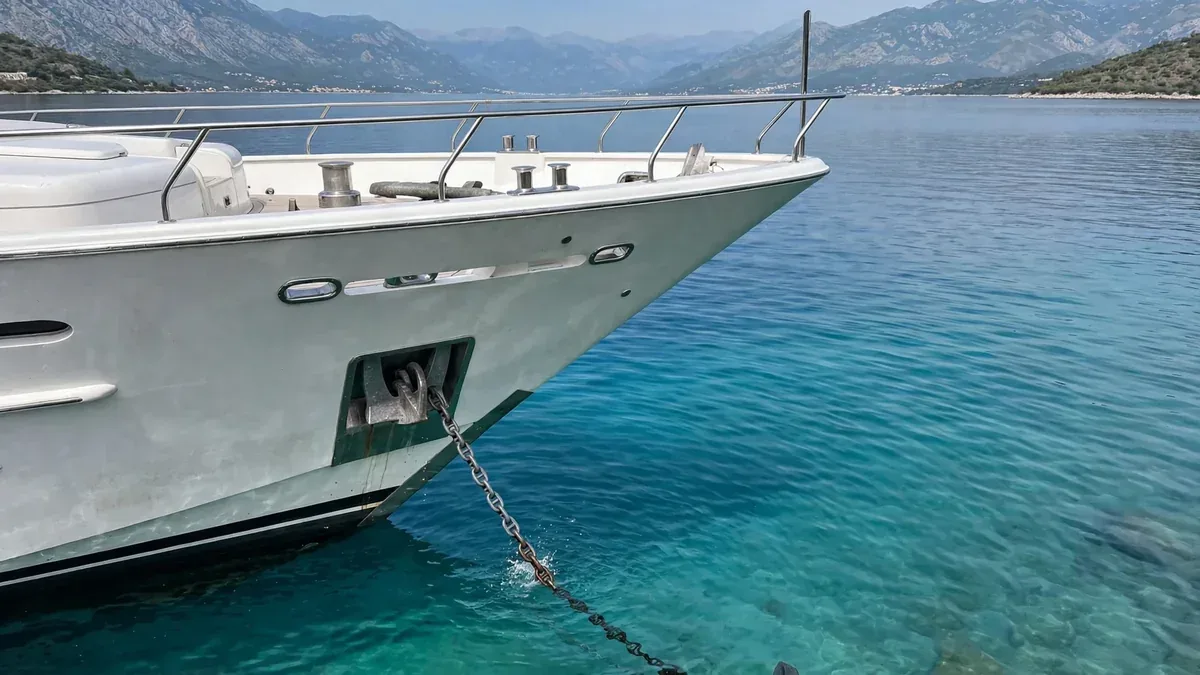
At sunset off a quiet coast, a superyacht swings gently at anchor, its lights coming on one by one as the crew sets the table on the aft deck. Nobody on board is thinking about the lump of steel hanging from the bow, but that anchor is the only thing between a floating palace and the rocks. A luxury yacht anchor looks simple, a heavy piece of shaped metal on a chain, yet it is a precision instrument with a spec sheet full of numbers that decide whether the yacht stays put through the night.
Those numbers describe the weight of the anchor, the strength of the chain, the pull of the windlass and the length of chain the crew must let out for the depth below. Read them together and you can tell how much wind the yacht can ride out, how quickly it can set its anchor, and how much strain the bow can take. This is what each figure means, and which ones the captain checks first.
The Spec Sheet, Line by Line
Anchor weight and the size of the yacht
The first figure on any anchor spec sheet is the weight, and for a superyacht it is measured in hundreds of kilos. A 60-metre yacht might carry a main anchor of 500 kilos, with a second anchor of similar size as a backup, and the weight is matched to the yacht’s windage, which is the area of hull and superstructure the wind can push against. A tall yacht with many decks catches far more wind than a low one of the same length, so it needs a heavier anchor.
Holding power and the seabed below
Holding power is the figure the captain trusts most, and it is stated in tonnes of pull. A good superyacht anchor might be rated to hold 20 tonnes or more in sand, which is several times the force the wind can apply even in a strong blow. The rating changes with the seabed, though, and the spec sheet lists separate figures for sand, mud and weed, because an anchor that grips sand perfectly can slide across weed without ever biting.
Chain size, grade and the weight that helps
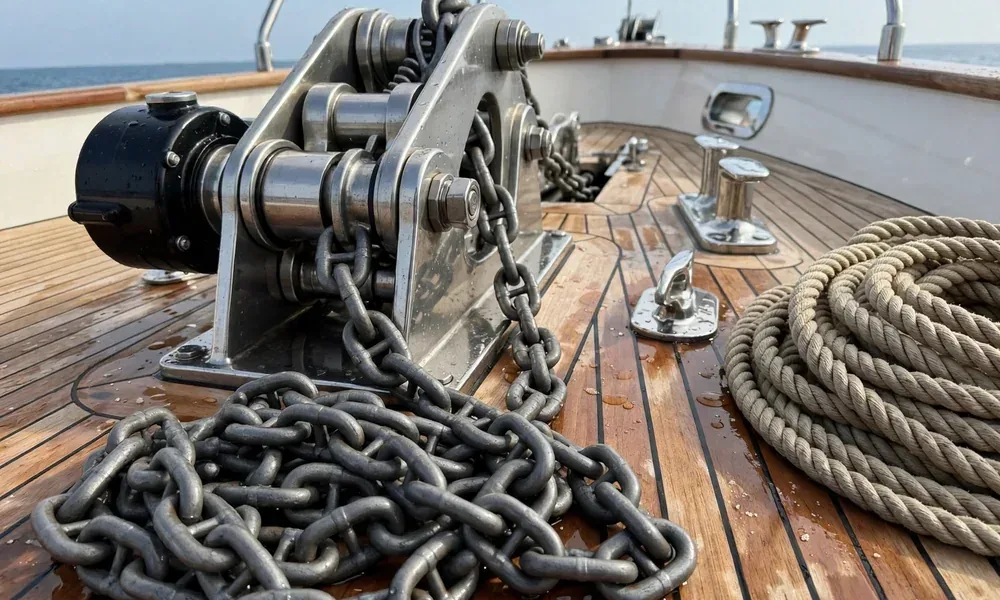
Behind the anchor hangs the chain, and its spec sheet is almost as detailed as the anchor’s. It lists the diameter of each link, usually 16 to 22 millimetres on a superyacht, and the grade of the steel, which decides how much load the chain can take before it stretches or breaks. A higher grade means thinner links can carry the same load, which saves weight in the bow, and the sheet states the breaking load in tonnes.
Windlass pull and getting it back
The windlass is the machine that hauls the anchor and chain back aboard, and its spec sheet lists its pulling power in tonnes. A superyacht windlass might be rated to pull 5 tonnes or more, which sounds generous until you remember it must lift the anchor plus the full weight of chain hanging in deep water, and break the anchor free when it is buried deep in mud. The rating is the working pull, not the maximum, and the sheet says so.
Scope ratio and how much chain to let out
Scope is the ratio of chain let out to the depth of water, and the spec sheet states the range the anchor is designed for, usually five to seven times the depth. In 10 metres of water the crew lets out 50 to 70 metres of chain, and the extra length is what lets the chain lie flat on the seabed and hold the anchor down. Too little chain and the pull comes from above, lifting the anchor out; too much and the yacht swings in a wide circle.
The ratio changes with the weather, and the spec sheet gives the figures for both calm and rough conditions. In a rising wind the crew lets out more chain, trading swinging room for holding power, and in a crowded anchorage they let out less, accepting a smaller margin to avoid drifting into a neighbour. The numbers on the sheet are the starting point, and the captain adjusts them by eye, by feel and by the forecast.
The bow roller, the locker and the details
The last figures on the sheet cover the parts nobody photographs: the bow roller the anchor rides on, the chain locker below deck, and the wash system that cleans the mud off as the chain comes up. The roller is specified by its diameter and its load rating, because a roller that is too small bends the chain and wears it out, and the locker is sized to hold the full length of chain without tangling.
The wash system has its own figures too, listing the pump pressure and the flow of seawater that hoses the chain as it rises. Mud left on the chain ends up in the locker, where it smells, corrodes the steel and adds weight in the wrong place. A good wash system is a small detail with a big effect, and the spec sheet treats it as seriously as the anchor itself.
| Spec | Detail |
|---|---|
| Anchor weight | Around 500 kilos on a 60-metre yacht, matched to windage |
| Holding power | 20 tonnes or more in sand, less in weed |
| Chain size | 16 to 22 millimetre links, graded steel |
| Windlass pull | Around 5 tonnes working pull, with a brake and release |
| Scope ratio | Five to seven times the water depth |
| Chain weight | Often heavier than the anchor itself |
| Bow roller | Sized to the chain, rated for the full load |
The figure most people misunderstand is the anchor weight, because heavier is not always better. A heavy anchor that cannot dig in will drag across the seabed no matter how much it weighs, while a lighter anchor with the right shape will bury itself and hold fast.
What One Costs
A luxury yacht anchor system typically costs an estimated 80,000 to 250,000 dollars, set mostly by the size of the anchor, the length and grade of the chain, and the power of the windlass. The chain is often the most expensive single part, because hundreds of metres of high-grade steel add up quickly. The same care with load and holding runs through the deck gear, and the way a luxury anchor windlass is so expensive explains where the money goes in the machine that hauls it all back, while the way a luxury yacht anchor is made covers the forging and shaping behind the steel.
A Rare Fact
The largest anchors ever made weighed more than 30 tonnes and belonged to aircraft carriers, yet they used the same idea as a yacht anchor: a shape that digs in rather than weight alone. The principle has barely changed in a century, which is why a modern superyacht anchor would still be recognised by a sailor from a hundred years ago, even if the steel is far better.

A luxury yacht anchor is not really about weight, even though weight is the first number everyone asks for. It is about holding power, chain, scope and the windlass that brings it all home, and those numbers tell you whether a yacht will sleep soundly or drag toward the rocks. The same careful arithmetic holds a yacht to a quay as well as to the seabed, and the way a luxury ship mooring works shows how lines and bollards take over once the anchor is stowed.


