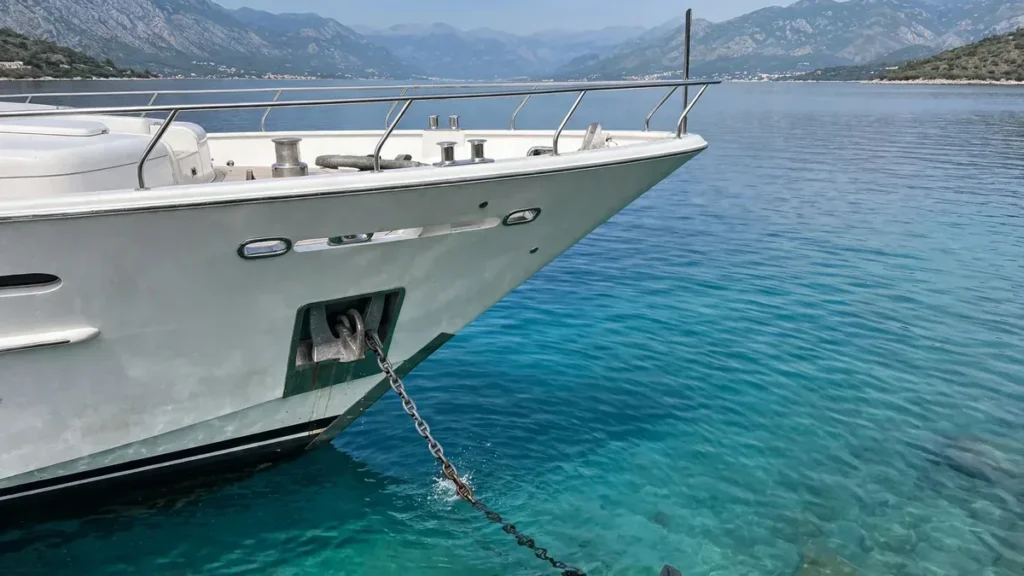
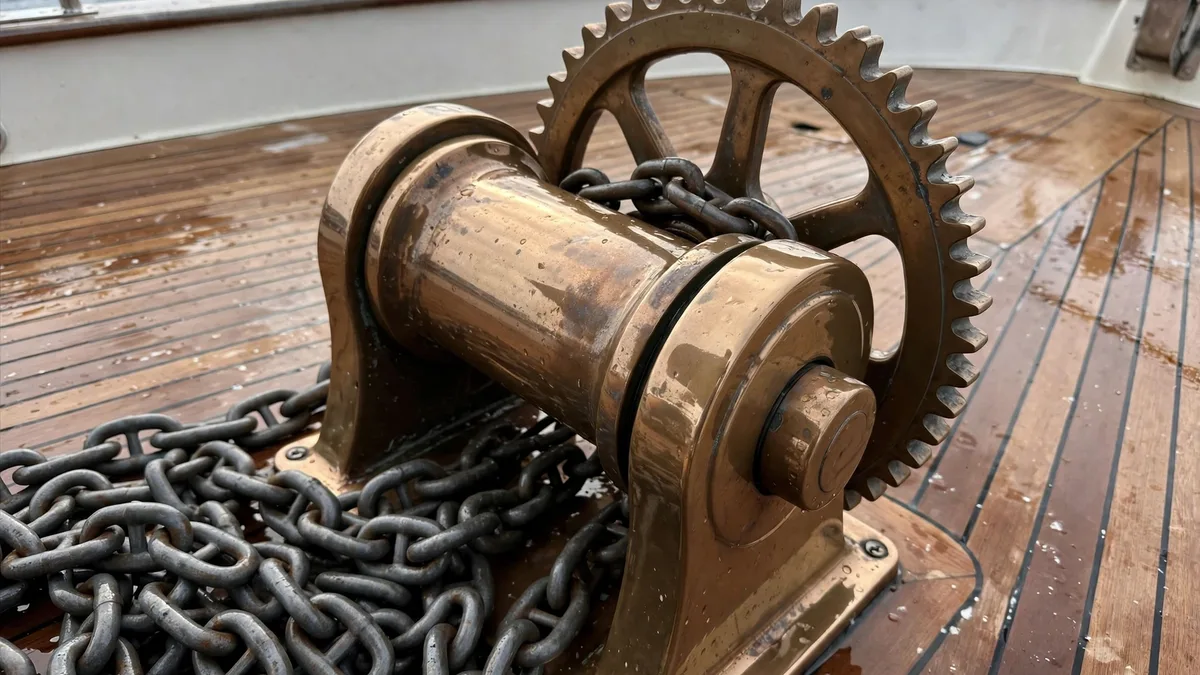
Stand on the foredeck of a luxury yacht and the windlass looks almost modest: a polished drum, a toothed wheel, and a length of chain disappearing into the deck. It is easy to walk past it without a second thought. Then you learn the price, and the modest machine suddenly looks very different. A luxury anchor windlass can cost as much as a family car, and on the largest yachts it can cost as much as a small house.
The shock is understandable, because a windlass does only one job. It hauls the anchor and chain back aboard, and it lets the chain run out when the anchor drops. Yet that one job is harder than it looks. The machine must lift tonnes of chain and anchor from the seabed, hold them in a swell with no power at all, survive salt water every day of its life, and do it all from a deck where everyone can see it.
This guide explains where the money goes, from the bronze in the gypsy wheel to the hours of hand finishing, so the price of a luxury anchor windlass starts to make sense.
Where the Money Goes
| Cost Driver | Typical Share | Why It Costs |
|---|---|---|
| Bronze and stainless steel | 25–30% | Marine alloys that resist salt |
| Gearbox and motor | 20–25% | Sealed, high-torque, stall-safe |
| Machining and hand finishing | 20–25% | Millimetre fits, mirror polish |
| Brake and safety systems | 10–15% | Holds tonnes with no power |
| Testing and certification | 10–15% | Load tests, class approval |
The Metals: Bronze and Stainless, Never Ordinary Steel
The biggest single cost is the metal itself. A luxury windlass is built from bronze and marine grade stainless steel, never from ordinary steel, because ordinary steel rusts in salt water within a season. Bronze resists corrosion for decades, machines beautifully, and takes the mirror polish that owners expect on a foredeck, but it costs many times more than steel by weight, and a windlass on a large yacht can weigh several hundred kilograms.
The gypsy wheel, the toothed wheel that grips the chain, shows where the money goes most clearly. It is cast in bronze, then machined so its pockets fit the chain links exactly, because a pocket even a millimetre out of shape will let the chain slip or jam. Each gypsy is measured against a sample of the very chain it will haul, then balanced and polished by hand. The how a luxury anchor windlass is made guide follows the gypsy from casting to deck, and every step in that journey is paid for in skilled hours.

The Gearbox and Motor: Slow, Strong and Sealed
The second cost is the gearbox and motor, the part of the windlass nobody sees. The motor spins fast, but the gypsy must turn slowly with enormous force, so a gearbox of hardened steel gears steps the speed down in stages, trading revolutions for torque. Each gear is cut, hardened and ground, then meshed by hand and checked for backlash, the tiny play that would let the gypsy rock back under load.
The motor itself is a sealed unit wound with heavy copper, built to pull hard for minutes without overheating and to stall safely against a load again and again. A motor that cannot stall safely is a fire risk, so the bench test is brutal on purpose. The whole assembly is sealed against salt spray, with a breather that lets it breathe without letting water in, and that sealing alone adds hours of fitting and testing. The ship anchor winch guide shows the same muscle at a larger scale, and the same sealed, stall-safe thinking behind it.
The Brake: The Part That Must Never Fail
The brake is the cheapest looking part of a windlass and one of the most expensive to get right. It is a band or disc that holds the chain when the windlass is not turning, and it must hold the full weight of chain and anchor in a swell, with no power at all. It is spring loaded to grip by default and only releases when the motor drives, so a power failure leaves the anchor safely held rather than running free.
Every windlass is tested by hanging its full rated load on the brake overnight, and the brake is then inspected for the smallest sign of slip. That test costs time and ties up a test rig, but no builder will skip it, because a brake that slips at anchor can lose the anchor, the chain, and the yacht’s ability to hold her position. The yacht anchor winch guide explains the same safety thinking from the crew’s side, where the brake is the part they trust most.
Small Numbers, Hand Finishing and the Price of Being Seen
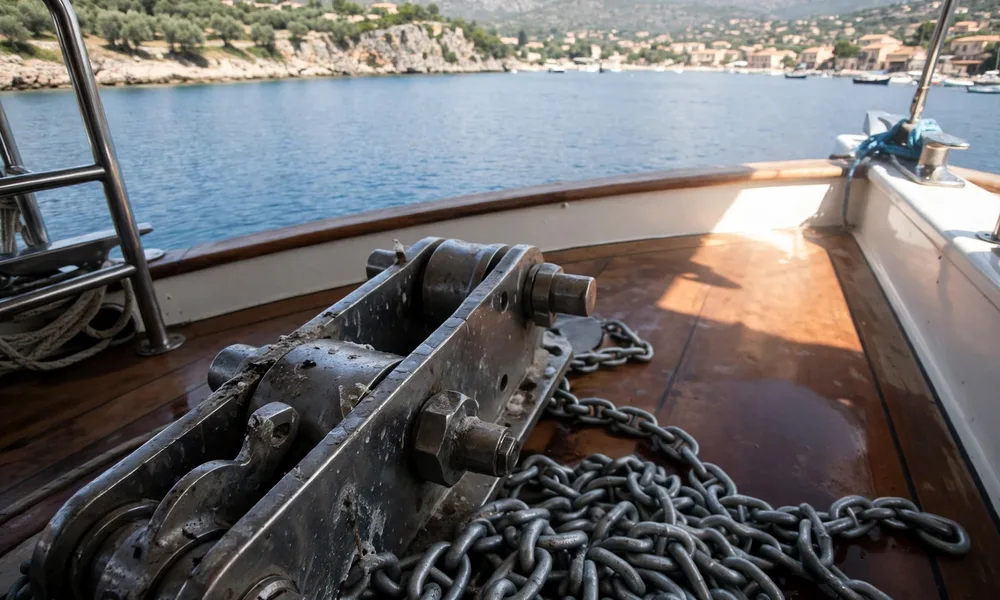
The last cost driver is the least technical and the hardest to argue with: the windlass is built in small numbers and finished by hand, in plain view. A car factory makes thousands of the same part a day, but a luxury windlass maker may build a few dozen a year, each one matched to a particular yacht, a particular chain size, and a particular deck layout. There is no production line to spread the cost across, so every hour of design, every pattern for a casting, and every test is divided among a handful of machines.
Then there is the finish. A windlass sits on the foredeck where guests walk, photographs are taken, and owners look every morning. It is polished to a mirror, not because the shine makes it stronger, but because a luxury yacht is judged by what can be seen. The polishing is done by hand, it must be redone after every season at sea, and the builder knows the owner will notice a flaw long before the crew notice a fault.
A Rare Fact About Windlass Prices
Here is a detail that surprises people who price a windlass by weight. The chain it hauls often costs nearly as much as the machine itself. A hundred metres of high-test anchor chain, each link forged, galvanised and proof tested, can run into many thousands, and the windlass must be matched to that exact chain. Buy the chain first and the windlass second, and the two together can cost more than the tender that carries guests ashore. The windlass is expensive, but it is only half of the anchoring bill.
What the Price Buys You
If you are buying a windlass, the price buys three things: metal that will not rust, a gearbox that will not quit, and a brake that will not let go. A cheap windlass can look the same on the day it is fitted, and the difference only shows in the third season, when the bronze still shines, the gears still mesh, and the brake still holds.
If a price looks too good, ask what was left out. A windlass without a proper brake test, without a gypsy machined to your chain, or without sealed electrics is not a bargain. It is a machine that will ask for its money later, at anchor, in bad weather, when there is no one to call. A good windlass is expensive once, and a cheap one is expensive forever.