The yacht was not moving fast, but the water ahead of it was doing something I had never watched closely before. It parted in a clean white line that ran back along the hull without a splash, and the bow barely rose as the swell passed underneath. On the boat next to it, a blunter bow was throwing spray over the deck with every wave. The two boats were the same length and the same price, and the difference between them was written into the shape of the first few metres of the hull.

1. Rake, and the angle that cuts the water
Rake is the angle of the bow as it leans forward from the waterline, and it is the first thing a naval architect draws. A bow with a steep rake leans far forward, so the point of the bow meets the water gently and the hull slides into a wave instead of hitting it. A bow with little rake stands almost upright, and it meets the water with a harder slap. Luxury yachts usually carry a moderate to steep rake, because a gentle entry means a quieter ride and less spray thrown up over the deck.
Rake also decides how the yacht looks at anchor. The long, leaning profile of a raked bow is the classic shape of a fast yacht, and it gives the foredeck more length for the anchor gear and the crew to work. The way that shape is built, plate by plate and frame by frame, is described in how a luxury yacht bow is made, where the curve of the stem is shaped long before the hull is painted. A bow with the right rake does not fight the sea. It persuades it to move aside.
2. Flare, and the curve that keeps the deck dry
Flare is the way the sides of the bow curve outward as they rise from the waterline to the deck. A bow with generous flare grows wider as it goes up, so when a wave rises against the hull, the flaring side pushes the water outward and down instead of letting it climb onto the deck. A bow with no flare, called a plumb or straight side, lets the water keep rising, and the deck gets wet in any real sea.
3. Deadrise, and the V that softens the ride
Deadrise is the angle of the V shape of the hull at the bow, measured from the horizontal, and it is the number that decides how hard the yacht lands when it comes down off a wave. A deep V, with a deadrise of 20 degrees or more at the bow, cuts into the water and lands softly, because the angled hull pushes the water aside gradually. A flat bottom, with a deadrise close to zero, lands with a slam that shakes the whole boat and everyone in it.
Luxury yachts carry a deep V at the bow that flattens toward the stern, where a flatter section gives the boat stability at rest and room for the engines. The rest of the hull is built around the same choices, and how a luxury yacht is made shows how the bow, the midship, and the stern are shaped as one continuous piece of engineering.
4. Freeboard, and the height that keeps the sea out
Freeboard is the height of the deck above the waterline at the bow, and it is the simplest number on the sheet and one of the most important. More freeboard means more distance between the sea and the deck, which means a drier boat and more room below for cabins and storage. Luxury yachts carry generous freeboard forward, often two metres or more, because the bow is where the waves are tallest and the crew needs headroom below.
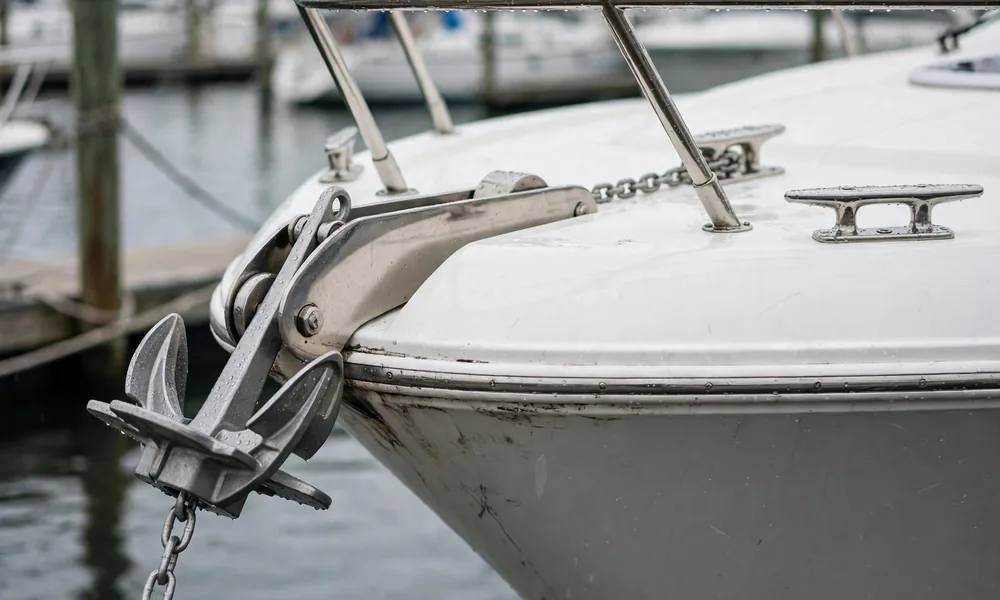
Freeboard also decides how the yacht handles at anchor and in a marina. A high bow catches more wind, so the yacht swings more at anchor and needs a stronger windlass to hold its position. The anchor itself lives in the bow, and its weight, its chain, and the windlass that hauls it are all sized to the yacht. The anchor gear is a small machine in its own right, and how a luxury yacht anchor is made explains how a piece of steel that spends its life underwater is forged to hold a yacht worth millions.
5. Stem, bulb, and the hidden shapes below the water
Not all of the bow is visible. Below the waterline, the stem curves down into the keel, and on many modern luxury yachts a bulbous bow, a rounded bulb of steel at the very front, sits just under the surface. The bulb creates its own small wave that cancels out the wave the bow would otherwise make, and the result is less drag, less fuel burned, and a smoother ride. It looks odd on dry land, like a nose the boat forgot to tuck in, but at cruising speed it can save a noticeable amount of fuel over a long passage.
The Specifications at a Glance
Here are the numbers that matter most on a luxury yacht bow, and what a good figure looks like for each one.
| Specification | Typical Luxury Range |
|---|---|
| Rake | Moderate to steep, leaning well forward |
| Flare | Generous, deck wider than the waterline |
| Deadrise at the bow | 20 degrees or more, deep V |
| Freeboard at the bow | About 2 metres or more |
| Bulbous bow | Fitted on larger yachts, below the waterline |
| Stem construction | Thickened plate, reinforced framing |
| Length to beam ratio | About 3 to 4 to 1 |
| Build time for the bow section | Weeks of shaping, welding, and fairing |
What Does a Luxury Yacht Bow Cost?
The bow is not sold on its own, but its share of a luxury yacht’s price is estimated at roughly $500,000 to $3 million, depending on the size of the yacht and the complexity of the shape. A bow for a 30-metre yacht, with its stem, anchor gear, windlass, and fairing, is estimated at roughly $500,000 to $1 million, while the bow of a 60-metre superyacht, with a bulbous bow, a helipad overhang, and a custom anchor system, is estimated at roughly $2 million to $3 million. The cost is in the shaping: every curve has to be fair, which means smooth to the eye and to the water, and fairing a compound curve by hand takes weeks of skilled work.
A Rare Fact
The clipper ships of the nineteenth century carried bows so sharply raked that sailors called them clipper bows, and the shape was copied from the fastest ships of the age. A clipper bow was designed to cut the water rather than push it aside, and it let a sailing ship cross an ocean weeks faster than its rivals.
The spec sheet of a yacht bow is a description of a conversation with the sea. Rake decides how the meeting begins, flare decides where the water goes, deadrise decides how hard the landing is, and freeboard decides how much of the sea stays outside. Read those four, and the bow stops being a shape and starts being an answer.


