Climb the stairs from the main deck of a luxury yacht and the whole boat changes. Up here, on the flybridge, the wind is stronger, the view stretches to the horizon in every direction, and the captain sits at a second helm with the sun on their face. It is part steering station, part open-air living room, and on a warm evening it is usually where everyone on board ends up.
A flybridge is not just a flat roof with chairs on it. It is a structure that must carry its own weight high above the water, survive storms and green water over the bow, and house engines controls, electronics and plumbing, all while feeling like a relaxed place to spend an afternoon. The specifications behind it, from the height of its rails to the size of its helm screens, decide how safe it feels and how much of the yacht’s life happens up there.
How It Works
Step 1: Building the flybridge deck and supports
The flybridge starts as a deck moulded in fibreglass or aluminium, light enough to sit high on the yacht without making it top-heavy, but strong enough to carry a dozen people, a hot tub on some yachts, and the helm station itself. The deck is supported by the superstructure below, and the supports are placed so the deck does not flex when people walk across it or when the yacht rolls in a swell.
Weight is the enemy up high. Every extra kilogram on the flybridge raises the yacht’s centre of gravity and makes it roll more, so builders use foam-cored panels and thin, strong laminates wherever they can. The deck is then fitted with drains that clear rain and spray quickly, because a pool of water on a high deck is both a slipping hazard and dead weight the yacht must carry.
Step 2: Fitting the second helm station
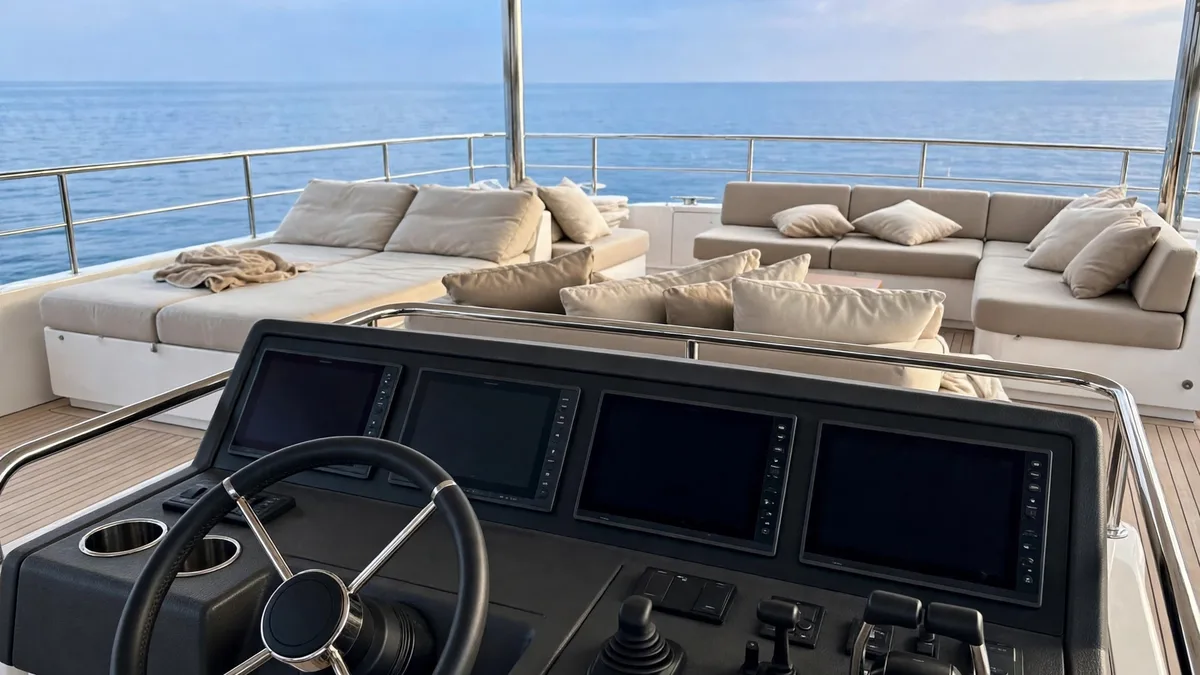
At the front of the flybridge sits the second helm, a duplicate of the steering position inside. It has its own wheel or joystick, throttle controls, and screens showing charts, radar, depth and engine data, so the captain can drive the yacht from up here with a better view. The screens are built to stay readable in bright sun, and they are shaded by a hard top or a canvas bimini that keeps the glare off without blocking the view forward.
All the controls are wired down through the yacht to the engines and the rudder, with backup cables so a single fault cannot leave the captain without steering. The helm seat is placed so the captain can see over the bow and down both sides of the yacht, which matters most when docking, when a few centimetres of visibility can be the difference between a smooth landing and a scrape. The furniture around the helm is built for the same outdoor life, and the way yacht deck furniture is specified shows how every seat and table up here is made to survive sun, salt and spray.
Step 3: Adding seating, shade and a wet bar
Behind the helm, the flybridge becomes a living space. Builders fit wide sun pads, a dining table with seating for the whole party, and often a wet bar with a fridge, a grill and a sink, so nobody needs to climb down for a drink. The seating is upholstered in marine fabrics that dry quickly and resist mould, and the cushions are held down with fixings that stop them blowing away in a strong wind.
Shade matters as much as seating. A hard top gives solid cover and a place to mount solar panels or a radar arch, while a canvas bimini can be folded away when the owner wants full sun. Either way, the structure must be strong enough to take the force of wind at cruising speed, and the fixings are checked after sea trials to make sure nothing rattles or works loose.
Step 4: Wiring power, water and electronics
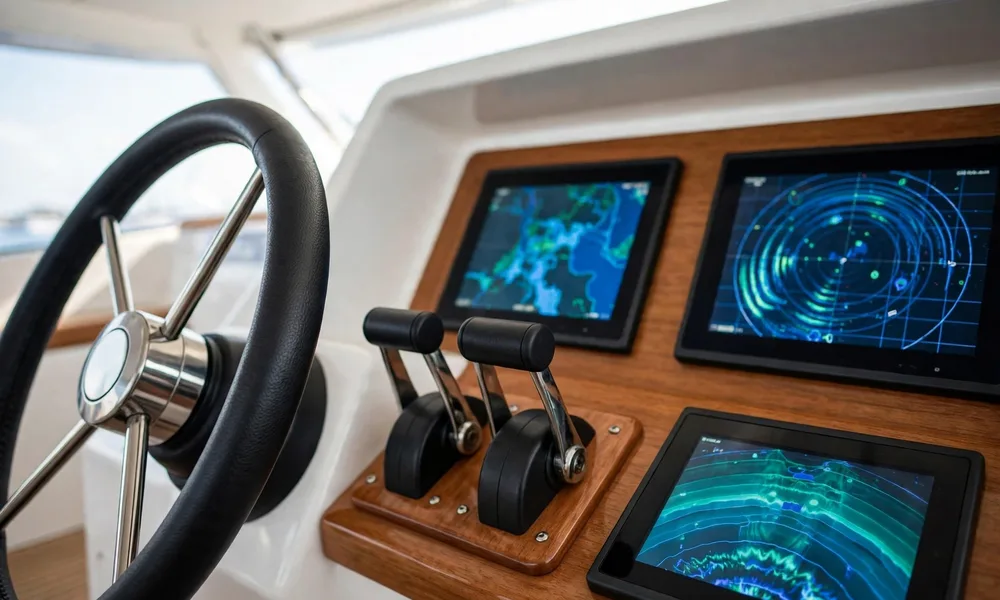
A flybridge needs power for its screens, lights, fridge, sound system and sometimes a hot tub, so cables run up from the engine room through sealed conduits. The wiring is protected against salt spray, and every circuit has its own breaker below deck, so a fault on the flybridge cannot knock out the rest of the yacht. Fresh water is piped up for the bar and any shower, and waste water drains back down to the tanks.
The electronics are the same grade as those on the main bridge, with antennas for GPS, radar and radio mounted on the arch above. A flybridge that works well in a seaway owes much to the systems below it, and the way a luxury yacht stabilizer is specified shows how the yacht is kept steady enough for the flybridge to be comfortable even when the sea is up.
Step 5: Rails, safety and sea trials
Safety is built into the edges of the flybridge. The rails are high enough to stop a person falling overboard in a roll, and they are strong enough to take the weight of someone thrown against them. The deck surface is non-slip even when wet, the stairs have handrails on both sides, and the lighting is bright enough to move around safely at night without ruining the captain’s night vision.
During sea trials, the flybridge is tested at full speed and in rough water. Engineers check for vibration, for water coming over the sides, and for any flex in the deck or the hard top. Only when it is quiet, dry and steady is it signed off. The navigation gear up here mirrors the main bridge below, and the way a yacht navigation bridge is specified shows how the two steering positions are built to work as one system, so the captain can move between them without missing a beat.
| Specification | Typical luxury yacht flybridge |
|---|---|
| Deck material | Foam-cored fibreglass or aluminium, built light and strong |
| Helm station | Second helm with wheel, throttles and sun-readable screens |
| Seating | Sun pads, dining table and marine-fabric sofas |
| Shade | Hard top or folding canvas bimini |
| Power and water | Cabled and piped from below deck, own circuit breakers |
| Rails | High, strong rails with non-slip deck surface |
| Electronics | Charts, radar, GPS and radio antennas on the arch |
| Extras | Wet bar, fridge, grill and sometimes a hot tub |

A luxury yacht flybridge is an estimate of $200,000 to $1.5 million as part of a new yacht, depending on the size of the yacht, the size of the deck, and whether it carries a hard top, a hot tub and a full second helm. The figure covers the deck structure, the helm electronics, the seating and the plumbing, and it is the part of the yacht where owners spend most of their time at anchor.
Here is a rare fact worth knowing. On some of the largest yachts, the flybridge is higher than the bridge of a small cargo ship. The captain up there can see over the roofs of harbour buildings and spot shallow water by its colour long before the instruments warn of it. That height is also why flybridge stairs are so carefully designed: a fall from that deck in rough weather is one of the most serious accidents on a yacht, so the rails and handholds are treated as seriously as the engines.


