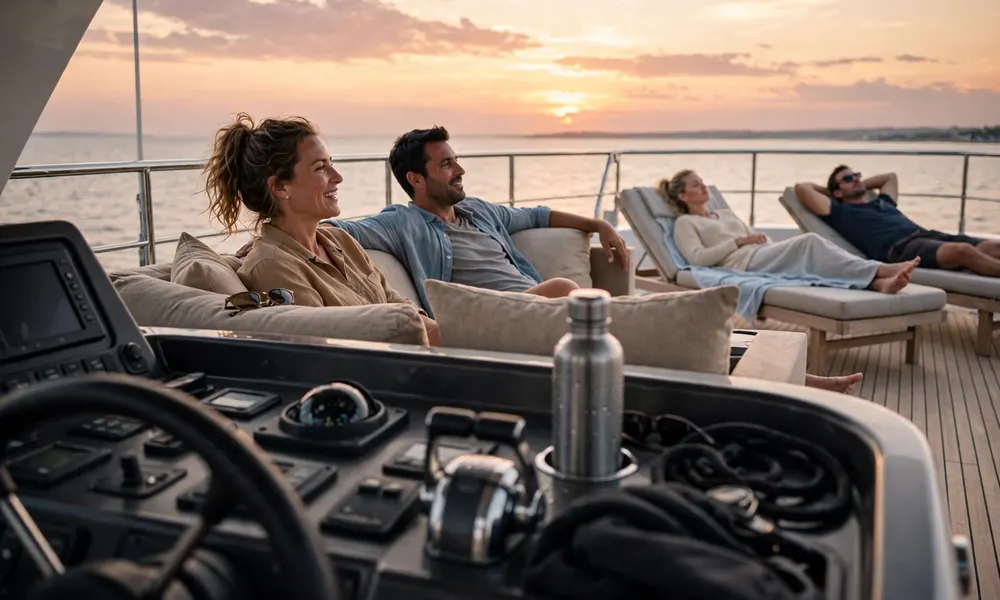
Climb the stairs from the main deck of a luxury yacht on a warm evening and the whole boat changes. The wind is stronger up here, the view runs to the horizon in every direction, and the captain sits at a second helm with the sun on their face while guests settle into deep sofas behind them. It is the flybridge, both a working bridge and an open-air living room.
A luxury yacht flybridge is a second helm station and living deck built high above the main deck, and it works by repeating the controls of the main bridge in the open air, so the captain can steer with a clear view over the bow while guests enjoy the best seat on the boat. Under the sofas there is a web of steering cables, engine controls, electronics and drains, all of which must work in sun, salt and spray.
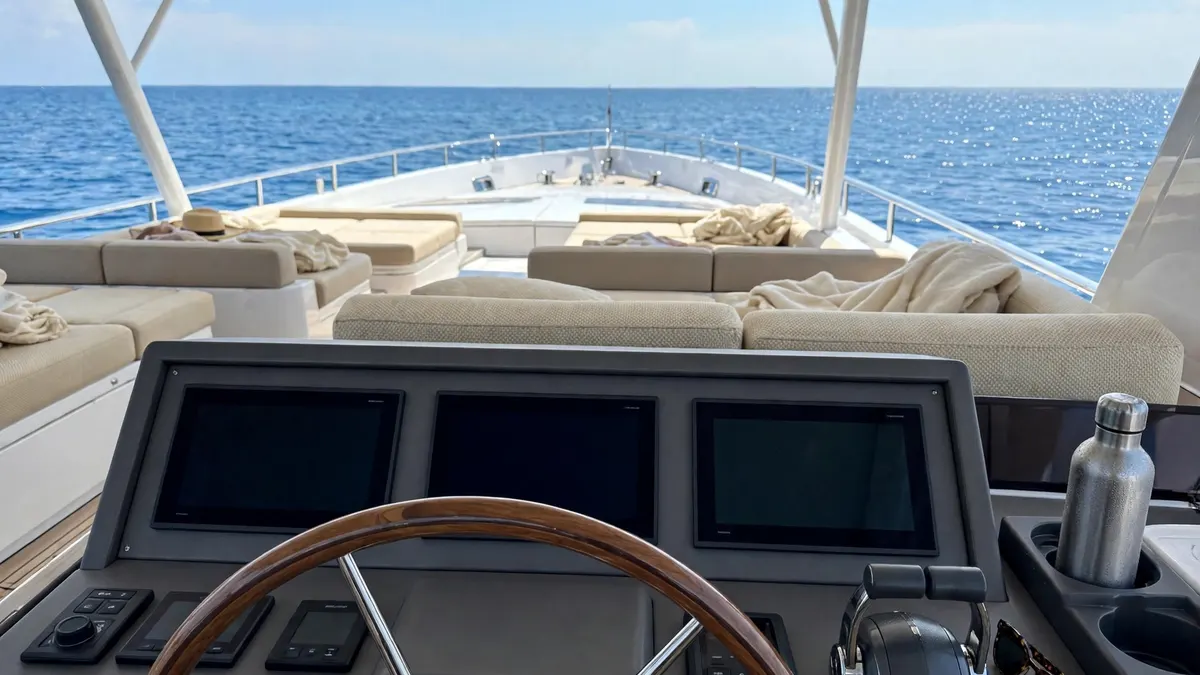
How It Works
The second helm and the steering
The heart of the flybridge is its helm, a second steering station that mirrors the main bridge below. The wheel or joystick at the flybridge sends its signal down to the steering gear, either through hydraulic lines or through an electronic link, and the rudders answer just as they would from below, so the captain can choose whichever station gives the better view for the manoeuvre. In a tight marina the high view lets the captain see the stern and the dock at once, which is why so many skippers berth from up here. If the flybridge helm fails, the main bridge takes over at once.
Engines, throttles and the dashboard
Beside the wheel sits the engine control, a pair of levers that set the speed of each engine and the pitch of the propellers, and the flybridge dashboard repeats the vital readings from below, engine revs, fuel, oil pressure, water temperature, and the state of the generators. The screens are built to be read in full sunlight, and the gauges are sealed against spray. The navigation screens are up here too, so the flybridge is a full bridge in its own right, and the autopilot can be engaged from the top.
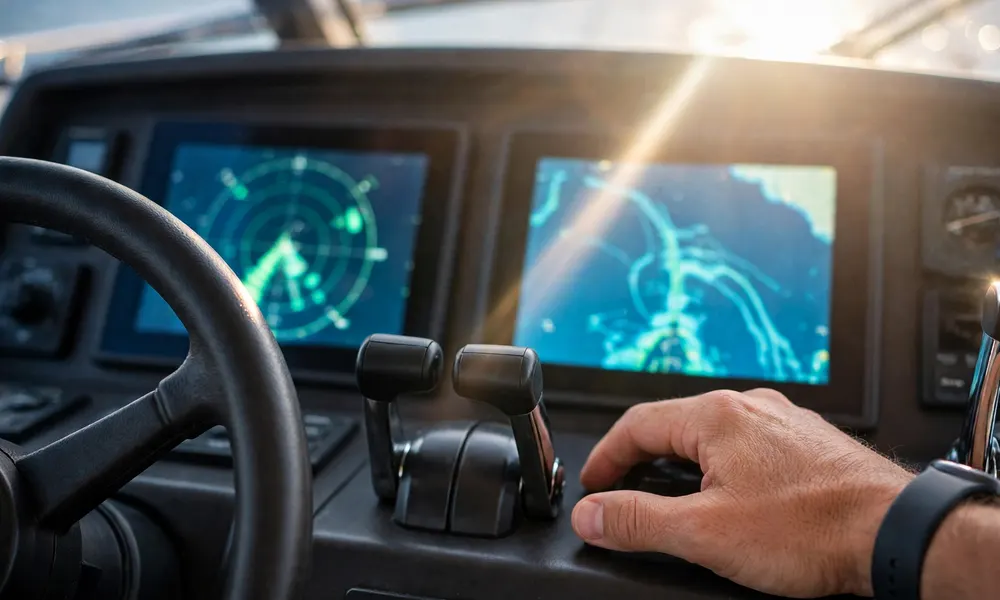
The deck itself is a structure built to carry all of this weight high up, and the way it is put together is the story of a luxury yacht flybridge being built step by step, from the first mould to the sea trial.
Stability, weight and the high centre of gravity
Everything on the flybridge sits high above the water, and height is the enemy of stability, because every kilogram up top raises the yacht’s centre of gravity and makes her roll more in a swell. That is why the flybridge is built light, and the heavy things are kept low in the hull. The yacht’s stabilisers, the fins or gyroscopes that damp the rolling, work hardest when the flybridge is loaded with people, and the captain feels the difference at once when a dozen guests climb the stairs at anchor. The rails up here are higher than on the main deck, and the stairs have deep treads and solid handrails.
Shade, water and the open-air living room
A flybridge is also a living room, and it has to work as one in sun, rain, and spray. A hard top or canvas bimini shades the helm and seating, built to take the force of a wave, while the sofas are made from marine foam and fabric that dry quickly. Rainwater and spray drain through scuppers in the deck, channels that carry the water overboard before it can pool around the helm electronics, and the deck itself is laid with a non-slip surface so wet feet do not slide. On some yachts there is a bar, a grill or a hot tub up here, each one plumbed through the deck.
Electronics, lights and talking to the boat below
The flybridge talks to the rest of the yacht through cables run inside the supports, carrying power, steering signals, navigation data, and the intercom that links the helm to the crew below. The lights dim at night to protect the captain’s night vision, and the searchlight can be aimed from the flybridge helm. The radio, the horn, and the anchor windlass controls are all repeated up here, so the captain can drop the anchor while watching the chain run out, and the cameras that look down the sides of the yacht feed their pictures to the flybridge screens, letting the captain see the blind spots that the high deck creates.
The figures behind the deck, from the height of its rails to the size of its helm screens, are the ones that the flybridge decoded as a spec sheet lays out, and they are what decide how safe the deck feels.
Safety, access and the stairs
The stairs to the flybridge are part of how it works, because a deck that is hard to reach is a deck nobody uses, and a deck that is easy to fall from is a danger. The stairwell is wide, with solid handrails on both sides and steps that are deep enough for bare feet, and the opening at the top is guarded by a gate or a rail so nobody walks into it in the dark. In heavy weather the flybridge is closed off and the captain steers from the enclosed bridge below. The crew check the flybridge before every departure, testing the helm, the throttles, the drains, and the rails, and a loose fitting up here is fixed at once, because a failure at height is felt by everyone on board.
The enclosed bridge below is the flybridge’s partner, and the navigation bridge explained shows how the two stations share the work of steering the yacht.
| Specification | Typical flybridge |
|---|---|
| Position | Open deck above the main deck, reached by stairs |
| Helm | Second steering station, hydraulic or electronic link to rudders |
| Engine control | Twin throttles, repeating revs, fuel, oil and temperature |
| Navigation | Chart plotter, radar, depth sounder and autopilot |
| Structure | Light composite deck, supported by the superstructure below |
| Shade | Hard top or canvas bimini, built to take wave loads |
| Drainage | Scuppers and channels carrying rain and spray overboard |
| Safety | High rails, gated stairwell, closed off in heavy weather |
A luxury yacht flybridge costs an estimate of $150,000 to $800,000 as part of the yacht, depending on its size, its helm equipment, and the extras such as a bar or a hot tub, with the electronics and the sun shades a large part of the bill. The price covers the deck, the supports, the helm station, the screens, the seating, the shade, and the drainage that keeps it all working in the open air.
Here is a rare fact worth knowing. The flybridge was once the preserve of working boats, where the captain climbed to a high open platform to see over the cargo, and luxury yachts borrowed the idea because the view was too good to leave to fishermen. On the largest yachts the flybridge has grown into a second saloon in the sky, with its own bar and dining table. It is also the deck where the captain does most of the real work of the voyage, watching the traffic, the weather and the water, while everyone else thinks it is just a place to sit in the sun.


