Ask a guest what they remember most about a yacht trip and the answer is rarely the food or the view. It is whether they felt ill. A yacht rolls with every wave, and on a bad day that roll turns a luxury holiday into a miserable one, with glasses sliding across tables and guests turning green. The stabilizer is the machine that stops that happening, and it does its work invisibly, hidden below the waterline, while the guests on deck never know it is there.
A stabilizer is a fin, or a spinning wheel, that pushes back against the roll of the sea, and the numbers behind it decide whether a yacht feels like a hotel or a fairground ride. Here is what the specifications mean, and why each one decides how steady the yacht feels when the weather turns.
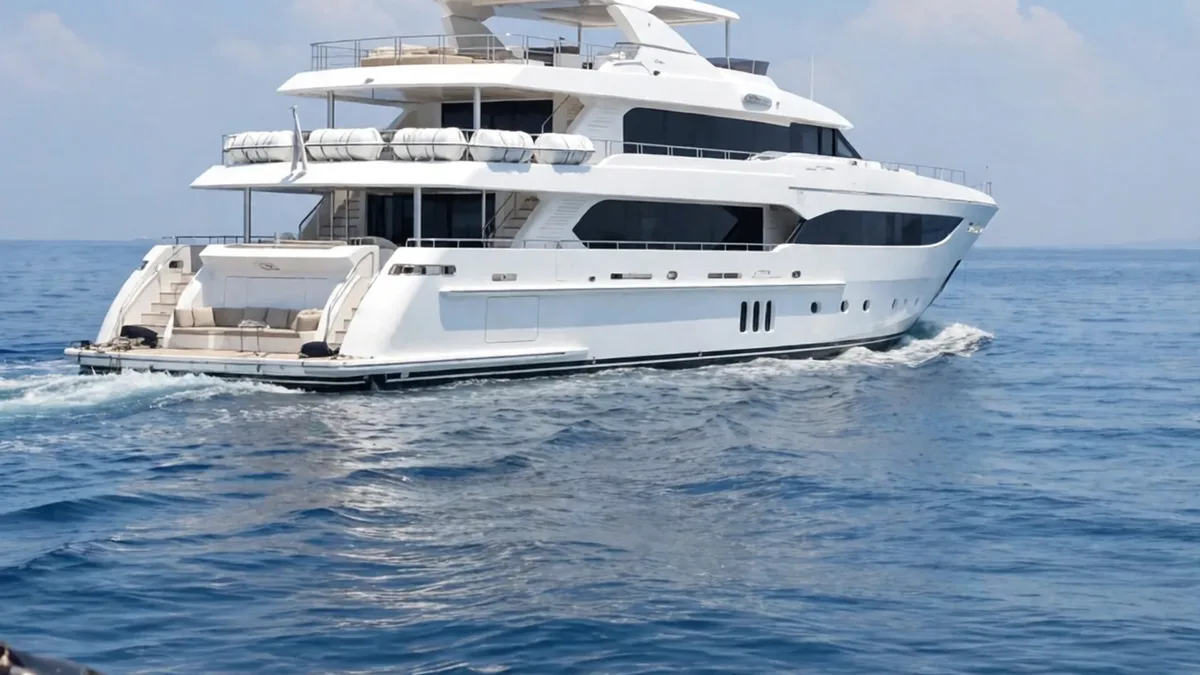
Luxury Yacht Stabilizer Specs at a Glance
Before the detail, here are the headline numbers for a typical luxury yacht stabilizer system. A smaller yacht will sit at the modest end of each range, with smaller fins and a simpler system, while a superyacht stabilizer pushes further, but the pattern of fins or a gyro fighting the roll stays the same.
| Specification | Typical figure | Why it matters |
|---|---|---|
| Fin area, each side | 1 to 3 square metres | The wing that pushes against the water |
| Roll reduction underway | 70 to 90 percent | Most of the roll simply disappears |
| Roll reduction at anchor | 50 to 80 percent | Steady even when the yacht is stopped |
| Working speed range | 0 to 25 knots | From anchor to full cruising speed |
| Fin movement speed | Up to 60 degrees per second | Fast enough to catch each wave |
| Gyro spin speed | Up to 10,000 revolutions per minute | A heavy wheel spinning very fast |
| Power demand | 10 to 40 kilowatts | A real load on the generators |
| System weight | 1 to 5 tonnes | Heavy machinery, kept low in the hull |
Fins in the Water: How Size Becomes Steadiness
The most common stabilizer is a pair of fins, one on each side of the hull below the waterline, and each fin is usually 1 to 3 square metres in area, about the size of a large door. When the yacht starts to roll, sensors feel the movement and the fins twist, pushing against the water to lift the falling side and hold the rising side down. The fins move fast, up to 60 degrees in a single second, because a wave does not wait, and the system must catch each roll as it begins rather than after it has already happened.
The result is dramatic: underway, a good fin system cuts roll by 70 to 90 percent, turning a lurching deck into a gentle sway, and at anchor, with special zero-speed fins that flap rather than relying on the yacht’s forward motion, it still cuts roll by 50 to 80 percent. That matters most at anchor, because that is when guests are eating, sleeping and swimming, and it is when the yacht is broadside to the swell with nothing to steady it.

Zero Speed and the Gyro Alternative
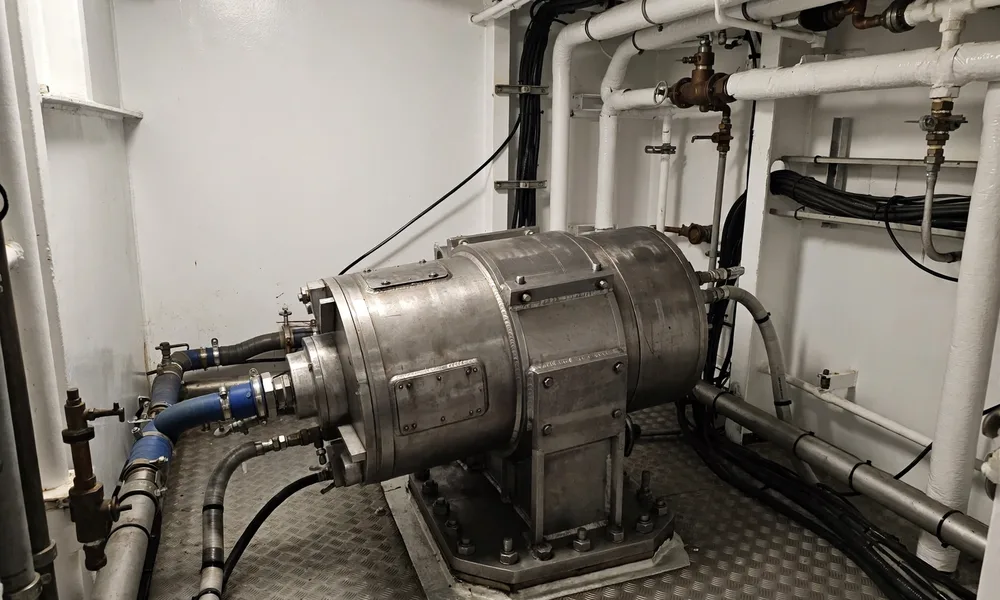
Not every yacht uses fins. The other answer is a gyroscope: a heavy steel wheel, sometimes weighing more than a tonne, that spins at up to 10,000 revolutions per minute inside a vacuum housing, mounted low in the hull. When the yacht rolls, the spinning wheel resists the movement, and the energy of the roll is absorbed by the gyro rather than by the guests. A gyro has no parts in the water, so there is nothing to snag, nothing to drag, and nothing to maintain below the waterline, which is why smaller yachts often choose it over fins.
The trade is weight and power. A gyro system weighs 1 to 5 tonnes and draws 10 to 40 kilowatts while it spins up, which is a real load on the yacht’s generators, and it needs time to reach full speed before it works at its best. Fins, by contrast, work the moment the yacht is moving, but they add drag and they need hydraulic power to move. The choice depends on the size of the yacht, the waters it sails, and how much the owner hates rolling.
Power, Speed and When Stabilizers Rest
Stabilizers work across the whole speed range, from zero to around 25 knots, but they do not work the same way at every speed. Underway, the water flowing past the fins gives them something to push against, so they are at their most powerful, and the faster the yacht goes, the more authority the fins have. At anchor the fins must work harder, flapping to create their own flow, and that is why zero-speed systems draw more power and make more noise than their underway cousins. The crew learns when to use each mode, and when to switch the system off altogether.
There are times when stabilizers rest. In a marina, with the yacht tied up and the water calm, they are switched off to save power and wear. The sensors, the hydraulics and the fins themselves are checked every season, because a stabilizer is a piece of safety equipment as much as a comfort, and a fin that jams at the wrong angle is worse than no fin at all.
A Rare Fact About the Luxury Yacht Stabilizer
Stabilizers were first fitted to passenger liners more than a century ago, and the earliest versions were enormous: fins the size of barn doors, driven by steam, that took so long to move that they were often too late to catch the wave they were meant to fight. The idea only became practical when fast hydraulics and electronic sensors arrived, and the modern fin can react in a fraction of a second. The gyroscope is even older, and the first seagoing gyro stabilizer was tested on a ship in 1910, where it worked so well that the crew said the ship felt as if it were sailing on rails. That same feeling is what a modern yacht owner pays for: the sea is still there, but the yacht refuses to dance with it.
What the Specs Mean for You
If you ever step aboard a yacht in a swell, stand in the middle of the salon and watch the horizon through the windows. With the stabilizers on, the horizon should stay almost level, rising and falling gently rather than swinging wildly, and a glass of water on a table should stay in its glass. Then ask the crew to switch them off for a minute, and feel the difference: the deck will start to roll, the glasses will slide, and you will understand in seconds what the numbers are buying.
The stabilizer is the most invisible luxury on a yacht, and its numbers make sense once you feel what it does: a fin or a spinning wheel, fighting the sea so the guests do not have to. The same thinking runs through the rest of the yacht, from the way a stabilizer works beneath the hull, to the gyroscope specifications that keep smaller yachts steady, and why a bow thruster is so expensive for the same reason. Read the figures, and the calm deck under your feet stops being luck and starts being engineering.


