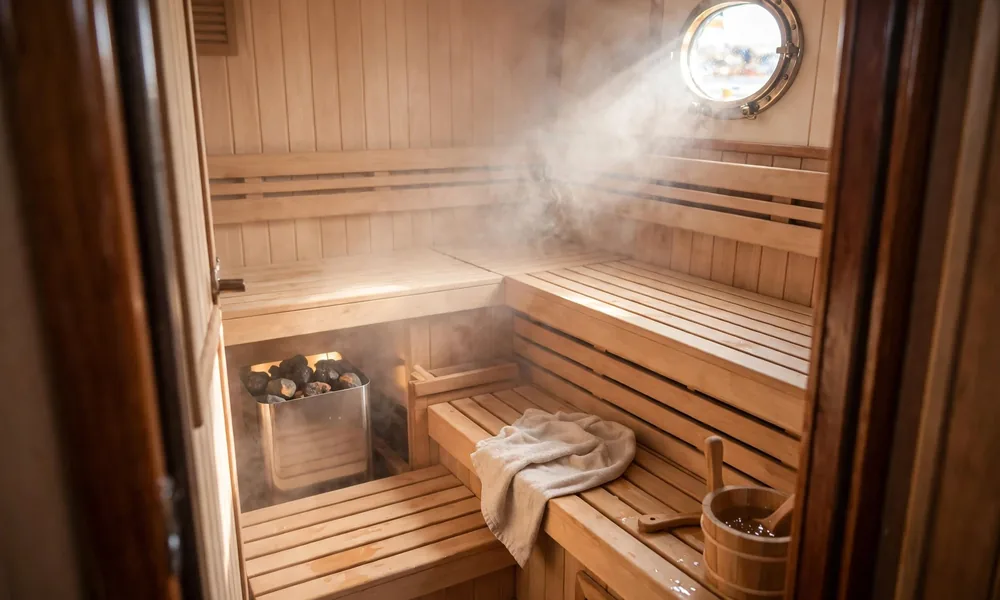
Open the door of a yacht sauna and a wall of warm, dry air rolls out to meet you, scented faintly of cedar. Inside, the benches are warm to the touch, the stones on the heater glow softly, and a small round window shows the sea sliding past. It is a strange luxury to find on a boat, a room built to be heated to the temperature of a hot oven, fitted into a vessel that is otherwise designed to stay cool and dry, and it is one of the most loved rooms on any large yacht.
The spec sheet for a yacht sauna is short, because the room is small, yet every number on it is a safety figure as much as a comfort figure. A sauna that is too hot, too dry or too poorly ventilated is not relaxing, it is dangerous, and at sea there is no stepping outside into a garden to cool down. Reading the sheet properly means knowing how temperature, humidity and ventilation work together in a wooden box floating on the ocean.

Luxury Yacht Sauna Specs at a Glance
| Spec | Detail |
|---|---|
| Room size | About 4 to 10 square metres, seating four to eight people |
| Temperature range | Usually 70 to 100 degrees Celsius, set by the user |
| Heater power | About 6 to 15 kilowatts, electric with stone-filled heater |
| Heat-up time | Roughly 30 to 60 minutes from cold to full heat |
| Humidity | About 5 to 20 percent, raised briefly by water on the stones |
| Wood lining | Cedar or aspen, 12 to 15 millimetres thick, no knots or resin |
| Ventilation | Fresh air inlet low, outlet high, full change every few minutes |
| Safety cut-off | Automatic shut-off at about 110 degrees Celsius or after one hour |
These are typical figures, not promises. One yard may build a bigger room with a smaller heater, another may trade seating for a larger window, and the numbers only make sense together.
Heat, Power and the Warm-Up Wait
Temperature is the headline number, and a yacht sauna usually runs at 70 to 100 degrees Celsius, which is hot enough to make the air shimmer above the heater. The heater itself is an electric unit of 6 to 15 kilowatts, filled with special stones that store the heat and release it slowly, and the power needed depends on the size of the room and how well it is insulated.
Heat-up time is the number guests actually feel. Thirty to sixty minutes from cold to full heat is normal, and the crew usually switches the sauna on well before guests ask for it, so the room is ready when they are. The luxury yacht spa specs show the same patience in the spa, where the steam room and the plunge pool are prepared hours ahead, and the sauna is that idea in its simplest form, a room that must be planned, not switched on like a light.
Wood, Humidity and the Cedar Choice
The wood lining is the material decision that defines the room. Cedar or aspen, 12 to 15 millimetres thick, is used because it stays cool enough to sit on, does not ooze resin when hot, and smells wonderful as it warms. Pine and other softwoods are cheaper, but they weep sticky resin at sauna temperatures, and a bench with resin on it is unusable. The boards are fitted with hidden fixings, because a nail head in a sauna becomes hot enough to burn skin, and every screw is sunk and plugged with wood.
Humidity is the number that separates a sauna from an oven. At 5 to 20 percent, the air is dry enough to breathe easily, and a ladle of water on the stones raises it briefly, giving a wave of heat that fades as the ventilation clears it. The how the luxury yacht spa is made story shows how the whole spa is built around controlling heat and moisture, and the sauna is the driest, hottest room in that system, a room where the air itself is the product.

Ventilation is the safety figure guests never notice. Fresh air enters low, near the floor, and leaves high, near the ceiling, and the whole volume of air changes every few minutes, so the room never becomes stuffy and the oxygen never runs low. Without that flow, a sauna would feel heavy and hard to breathe in, and at sea, where the air outside is already humid and salty, the ventilation system must also keep the sea air out when the room is not in use.
Size, Safety and the Smallest Room
Size is the constraint that shapes everything. At 4 to 10 square metres, a yacht sauna is one of the smallest rooms on the yacht, seating four to eight people on two tiers of benches, and every centimetre is planned. The upper bench is the hot seat, where the temperature is highest, and the lower bench is cooler, so guests can choose their heat by choosing their bench, and the ceiling is kept low, because heat rises and a high ceiling would waste it.
Safety is built into the spec sheet, not added afterwards. The heater cuts out automatically at about 110 degrees Celsius, or after about an hour of continuous use, and the controls sit outside the room, so the temperature is set before anyone goes in. The superyacht spa specs show the same thinking across the whole spa, where every hot surface is guarded and every control is out of reach of a guest who is already overheated, and the sauna is the room where that caution matters most.
As an estimate, a yacht sauna costs about $40,000 to $150,000 installed, the cedar lining and benches about $15,000 to $50,000 of that, the heater and controls about $10,000 to $30,000 more, and the insulation, ventilation and safety systems about $10,000 to $30,000 on top. These are estimated ranges, not quotes, and the final figure depends on the size of the room, the timber chosen and the yard. What never changes is that the sauna is used quietly, every day, by guests who never talk about it afterwards.
A Rare Fact From the World of Yacht Saunas
Here is a detail few guests ever learn: the sauna on a yacht is often the driest room on the whole vessel, and the crew uses it to dry things. Wet towels, damp swimwear and even the odd pair of shoes are hung in the sauna after it has cooled, because the dry heat and the ventilation dry them in an hour. Some captains joke that the sauna earns its keep as a laundry room as much as a spa, and the cedar smell it leaves on the towels is the reason guests ask for it again the next day.
What the Specs Mean for You
If you are comparing yacht saunas, start with four numbers: heater power, heat-up time, wood type and safety cut-off. A sauna with a heater matched to its room, ready in under an hour, lined in cedar or aspen with hidden fixings, and protected by an automatic cut-off is worth its price, because it will heat evenly, smell wonderful and stay safe. Room size matters less than the brochures suggest, and ventilation matters more than anyone admits, because a sauna with fresh air is the one guests can stay in. The best yacht sauna is the one that feels like a quiet wooden cabin, warm, dry, and smelling faintly of cedar.