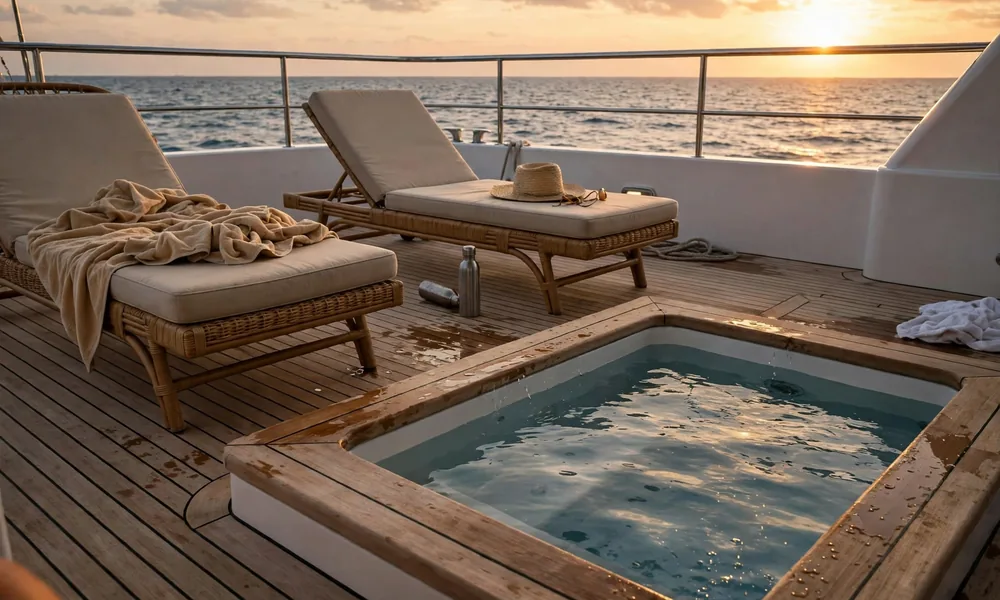
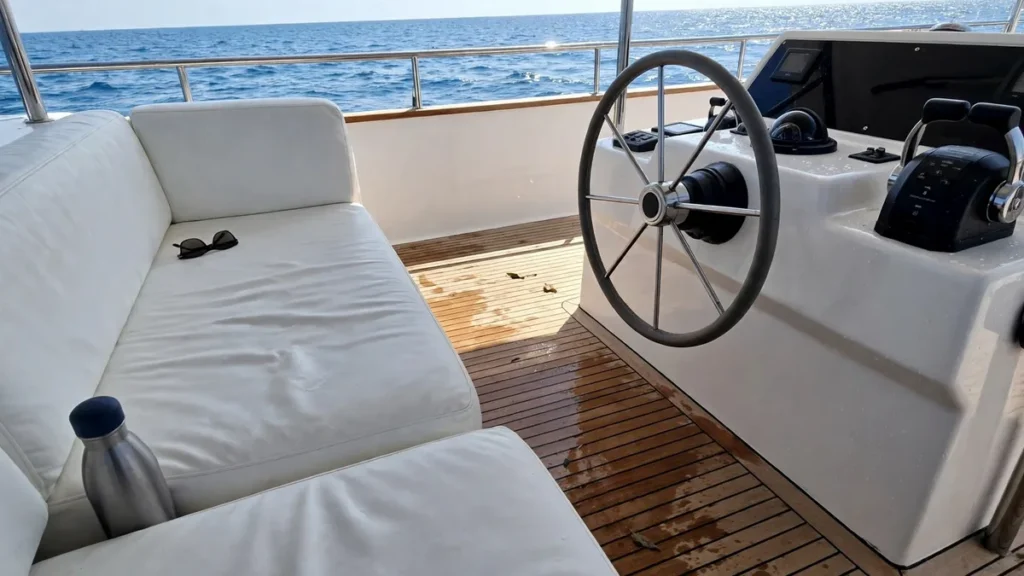
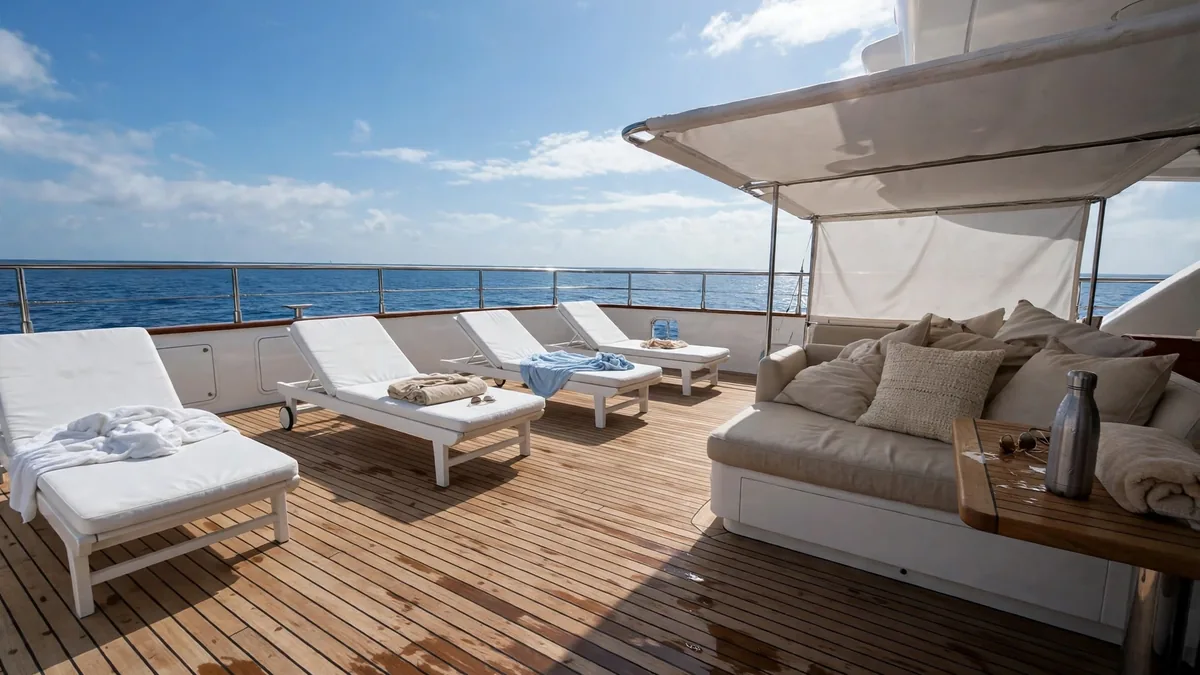
Step onto the sun deck of a luxury yacht and the first thing you feel is space. The deck stretches out in front of you, wide and open, with teak boards underfoot, white loungers lined up along the rails, and nothing above you but sky. It is the highest outdoor floor on the yacht, the place where guests spend most of their daylight hours, and it has to work as a sunbathing terrace, a dining terrace, an open-air cinema and a lookout point, all at once.
The spec sheet for a sun deck looks simple at first glance, because it is mostly about size. Yet every number on it is the result of a trade-off between weight, stability, shade and comfort, and reading it properly means knowing which figures decide how the deck actually feels at sea.
Luxury Yacht Sun Deck Specs at a Glance
| Spec | Detail |
|---|---|
| Deck area | About 80 to 200 square metres on a large superyacht |
| Deck material | Teak planks, usually 8 to 12 millimetres thick, glued and caulked |
| Guest capacity | Roughly 12 to 20 guests seated, more standing for a party |
| Shade cover | About 30 to 50 percent of the deck under a hardtop or awning |
| Lounger count | Six to twelve full-size sun loungers, plus loose cushions |
| Deck load limit | Around 150 to 250 kilograms per square metre, including furniture |
| Wind rating | Furniture secured for winds up to about 60 knots at anchor |
| Drainage | Scuppers and a slight camber clear water in under a minute |
These are typical figures, not promises. One yard may build a bigger deck with less shade, another may trade loungers for a plunge pool, and the numbers only make sense together.
Size, Weight and the Stability Trade-Off
Area is the headline number, and on a large superyacht the sun deck can cover 80 to 200 square metres, an area bigger than many apartments. That sounds generous, yet the naval architect treats every square metre as weight carried high above the waterline, and weight carried high is the enemy of stability. A deck that is too wide or too heavy forces the hull to be wider or the ballast to be heavier, so the size of the deck is always a negotiation between the designer who wants open space and the engineer who wants the yacht to stay upright in a swell.
The load limit tells the quieter part of the story. At roughly 150 to 250 kilograms per square metre, the deck must carry not only the guests but the loungers, the tables, the bar, the spa pool and the tender crane, all at once, and it must do so while the yacht rolls. The best yacht sun decks ranked show how the largest decks are always on the widest hulls, because only a wide hull can carry that much weight up high without rolling like a barrel, and the ranking is really a ranking of hulls as much as of decks.
Teak, Shade and the Heat Problem
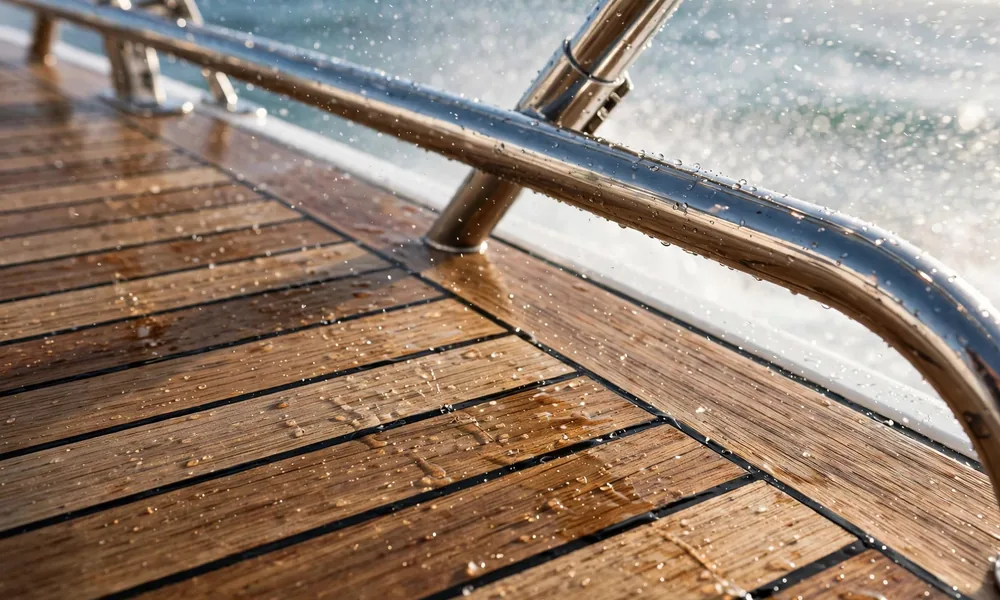
Teak is the traditional deck material for a reason. The planks are usually 8 to 12 millimetres thick, glued to the deck and sealed with black caulking, and the wood stays grippy when wet, cool enough to walk on in the sun, and handsome as it silvers with age. It is also enormously expensive, because genuine marine teak is scarce, and a single large sun deck can use more timber than a small house. Cheaper woods look similar in a photograph, but they get slippery when wet and too hot to stand on by noon.
Shade is the second material decision, and the spec is usually given as a percentage: about 30 to 50 percent of the deck sits under a hardtop or an awning. Too little shade and guests retreat indoors at midday, too much and the deck feels like a room with no sky. The luxury yacht spa specs show the same balancing act in the spa, where heat and comfort are controlled to the degree, and the sun deck is that idea played out across a whole floor of the yacht.
Wind is the force that shapes the furniture. At anchor, the deck must hold its loungers and tables in winds of up to about 60 knots, so every piece is either heavy, fixed to the deck, or stowed away before a blow. The light, elegant furniture guests love is the hardest to keep in place, and designers solve it with hidden sockets and locking pins, so a lounger can be moved in seconds and still stay put in a gale.
Layout, Loungers and Living Outdoors
The layout of a sun deck follows the sun. Loungers face aft, towards the stern, so guests can watch the wake and the sunset, while the shaded seating and the bar sit forward, under the hardtop, where people gather for lunch and drinks. Six to twelve full-size loungers is the usual count, and the space between them matters as much as the number, because a deck where guests can walk between loungers without climbing over each other feels twice as big as one packed tight.
Capacity is measured in two ways, and the spec sheet often gives both. Twelve to twenty guests can sit comfortably for dinner or a film, while a standing party can hold far more, and the difference is the furniture: dining tables and chairs take up room that loungers leave open. The how the luxury yacht pool is made story shows how a plunge pool eats into that same space, and why the biggest decks are the ones that give the pool its own corner instead of putting it in the middle of the loungers.
As an estimate, fitting out a superyacht sun deck costs about $500,000 to $2 million, the teak alone about $100,000 to $300,000, and the furniture and shade systems about $100,000 to $250,000 more. These are estimated ranges, not quotes, and the final figure depends on the size of the yacht, the timber chosen and the builder. What never changes is that the deck is the most used room on the yacht, even though it has no walls at all.
A Rare Fact From the World of Sun Decks
Here is a detail few guests ever learn: the teak on a sun deck is never varnished. Varnish would make it slippery when wet and blisteringly hot in the sun, so the wood is left bare and scrubbed with salt water instead, and the grey-silver colour that results is the sign of a well-kept deck. Some owners insist on keeping the golden colour of new teak, and the crew then oils it every few weeks, a job that takes a full day on a large deck, and the oiled wood is so hot at noon that guests wear shoes to cross it.
What the Specs Mean for You
If you are comparing sun decks, start with four numbers: area, shade percentage, load limit and lounger count. A deck with generous area, shade over about a third of it, a high load limit and room to walk between the loungers is worth its price, because it will be comfortable at noon, safe in a swell and open enough for a party. Teak thickness matters less than the brochures suggest, and drainage matters more than anyone admits, because a deck that clears water in seconds is the one guests actually use. The best sun deck is the one that feels like a beach, not a balcony.