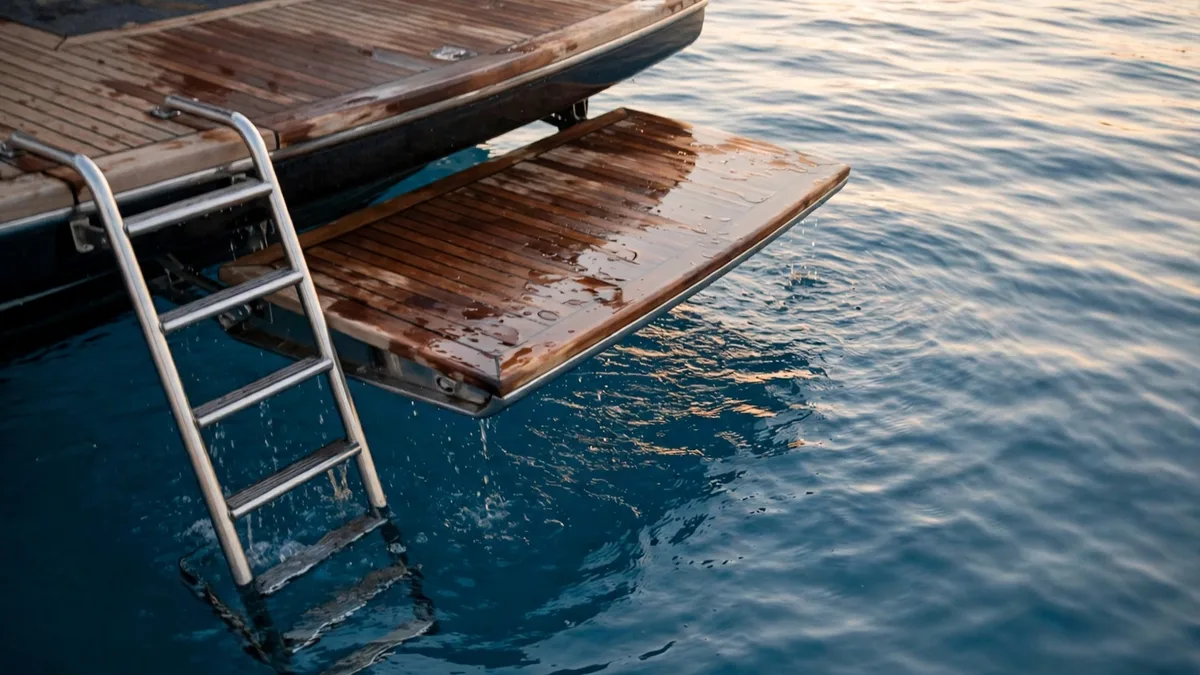
On a warm evening in a Mediterranean marina, a yacht owner watches the crew lower the swim platform into the water, brochure in hand. It promises a load rating of a thousand kilograms, a lift time of forty seconds, and a platform five metres wide. The owner understands almost none of it, because the numbers are written for engineers, not for the person who will swim off the back of the boat.
A luxury yacht swim platform is the flat deck at the stern that lowers to the water so guests can swim, board a tender, or step ashore from a jet ski. It looks like a simple shelf of teak, but the specification sheet behind it covers hydraulics, hinges, weight, and waterproofing. This guide reads it line by line, in plain words.
Luxury Yacht Swim Platform Specs at a Glance
| Specification | Small Yacht | Mid-Size Yacht | Superyacht |
|---|---|---|---|
| Platform width | 2.5–3.5 m | 3.5–4.5 m | 4.5–6 m |
| Platform depth | 0.8–1.0 m | 1.0–1.3 m | 1.3–1.8 m |
| Load rating | 400–600 kg | 600–900 kg | 900–1,500 kg |
| Lift capacity | 500–800 kg | 800–1,200 kg | 1,200–2,000 kg |
| Lowering time | 30–45 seconds | 40–60 seconds | 60–90 seconds |
| Hydraulic rams | 2 rams | 2–4 rams | 4 rams |
| Deck material | Teak on fibreglass | Teak on aluminium | Teak on carbon core |
| Platform weight | 150–250 kg | 250–400 kg | 400–700 kg |
| Submersion depth | 0.3–0.5 m | 0.4–0.6 m | 0.5–0.8 m |
| Control | Deck panel | Panel plus remote | Touchscreen and remote |
1. Platform width and depth: how much deck you get
Width is the measurement across the stern, and depth is how far the platform reaches behind the boat. Small yachts offer two and a half to three and a half metres of width and under a metre of depth, mid-size three and a half to four and a half metres wide, and superyachts four and a half to six metres wide and up to one and eight tenths deep. Width decides how many people can stand on it at once, and depth decides whether there is room to sit and step into a tender without crowding. A platform too deep adds weight at the very back of the boat, where it affects trim.
2. Load rating and lift capacity: two numbers that are not the same
Load rating is the weight the platform can carry when down on the water, while lift capacity is the weight the hydraulics can raise out of it. A small platform is rated for four hundred to six hundred kilograms and lifts five hundred to eight hundred, a mid-size holds six hundred to nine hundred and lifts eight hundred to twelve hundred, and a superyacht holds nine hundred to fifteen hundred and lifts twelve hundred to two thousand. The gap matters because a tender full of fuel weighs far more than the people beside it. The frame and hinges that carry those loads are built first, as described in how a luxury yacht swim platform is made.
3. Lowering time and hydraulic rams: how the platform moves
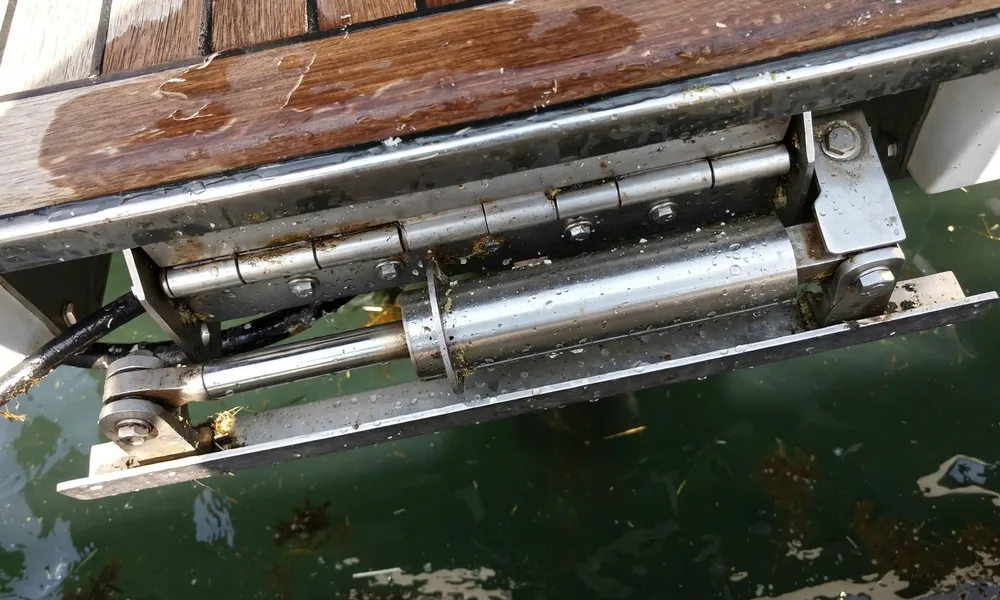
Lowering time is how long the platform takes to travel from its raised position, flush with the transom, down to the water. Small platforms take thirty to forty-five seconds on two rams, mid-size platforms forty to sixty seconds on two to four rams, and superyachts sixty to ninety seconds on four rams. A slower movement is not a weakness: the rams move gently so the platform does not slam into the water, and extra rams spread the load so no single hinge carries it all. How the rams and locks work in daily use is explained in how a luxury yacht swim platform works.
4. Deck material and platform weight: teak over a strong core
The deck is almost always teak, laid over a core of fibreglass, aluminium, or carbon fibre. Fibreglass suits smaller platforms, aluminium mid-size, and carbon the largest, because carbon is stiff for its weight. Platform weight runs from a hundred and fifty to two hundred and fifty kilograms on a small yacht, two hundred and fifty to four hundred on a mid-size, and four hundred to seven hundred on a superyacht. Weight matters twice: a heavy platform needs stronger rams and a stronger transom, and it changes how the yacht sits in the water. The teak is sanded and re-oiled each season.
5. Submersion depth and controls: the platform in the water
Submersion depth is how far below the surface the platform can sit, and it decides how easy it is to climb aboard from the water. Small platforms submerge three to five tenths of a metre, mid-size four to six tenths, and superyachts five to eight tenths. Deeper submersion helps swimmers, but the hinges and seals then spend more time underwater, so the waterproofing must be better. Controls range from a simple deck panel on small yachts to a panel plus remote on mid-size yachts, and a touchscreen with remote on superyachts. The best systems stop the platform at any height and lock it, with a mechanical backup that holds it even if a hose fails.
6. What the numbers mean in practice
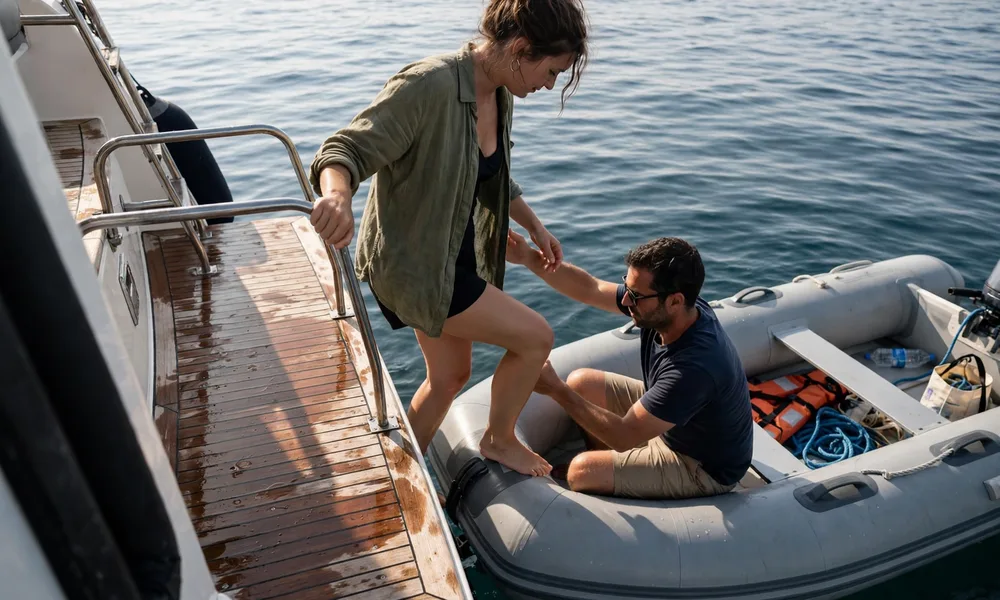
Read as a set, the figures describe the life the platform will lead. A small, light platform suits a family yacht where a few swimmers and a jet ski are the whole job. A mid-size platform suits a charter yacht where guests, luggage, and a tender share the stern all day. A large platform suits a superyacht where the stern becomes a beach club. The test is a real afternoon at anchor: the tender coming aboard, swimmers climbing out, and the platform holding steady while the boat rolls. The price is explained in why a luxury yacht swim platform is so expensive, where the hydraulics alone can cost more than a small car.
What Does a Luxury Yacht Swim Platform Cost?
A luxury yacht swim platform typically costs about $60,000 to $250,000, depending on size, materials, and the hydraulic system behind it. A small platform with two rams and a fibreglass core sits near the lower end, a mid-size with four rams and an aluminium core in the middle, and a superyacht platform with a carbon core and a two-tonne lift at the top. Installation is a large share of the price, because the transom must be strengthened and sealed, and the hydraulic unit fitted in the lazarette.
A Rare Fact
The first swim platforms were not built at all: they were simply the flat top of the rudder or a plank hung over the stern, and swimmers climbed aboard on a rope ladder. The first proper platforms appeared on racing yachts, where crews needed a quick way to get a man overboard back on deck. Modern platforms still carry that rescue role, which is why the best ones lower fast, lock solid, and hold far more weight than the swimmers on them will ever need.
A spec sheet will never tell you how a swim platform feels under bare feet on a hot afternoon. It will tell you whether it is wide enough for your guests, strong enough for your tender, and steady enough to trust in a swell. Those three answers separate a luxury swim platform from a plank at the back of a boat.