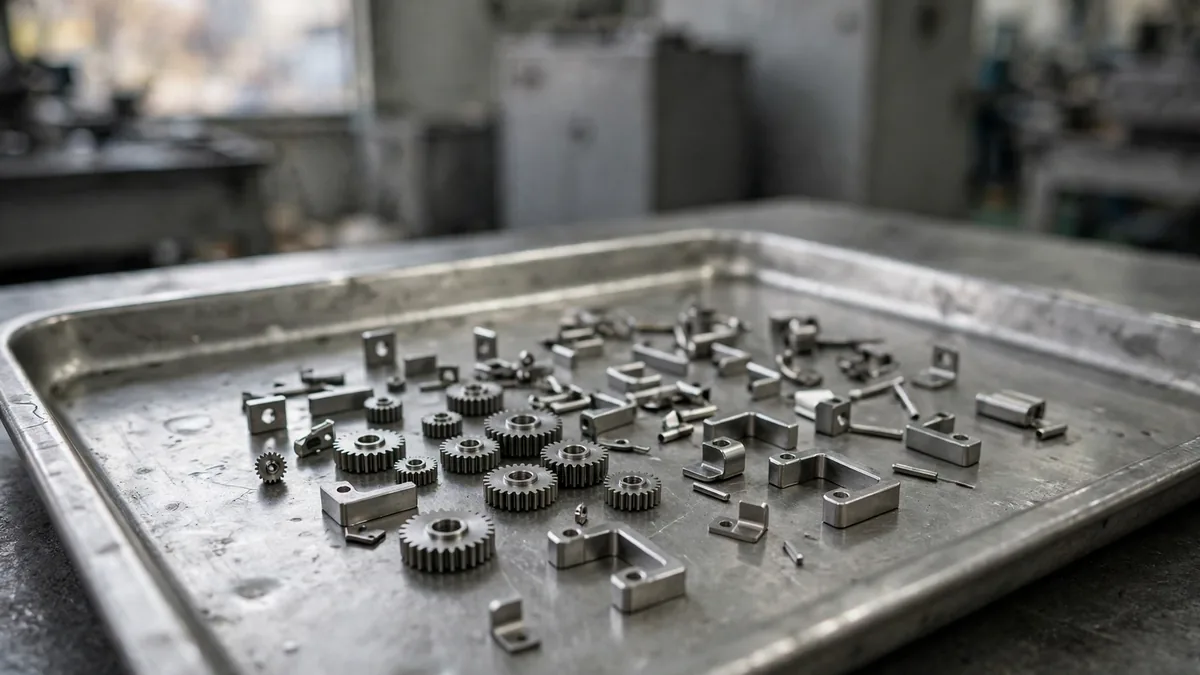
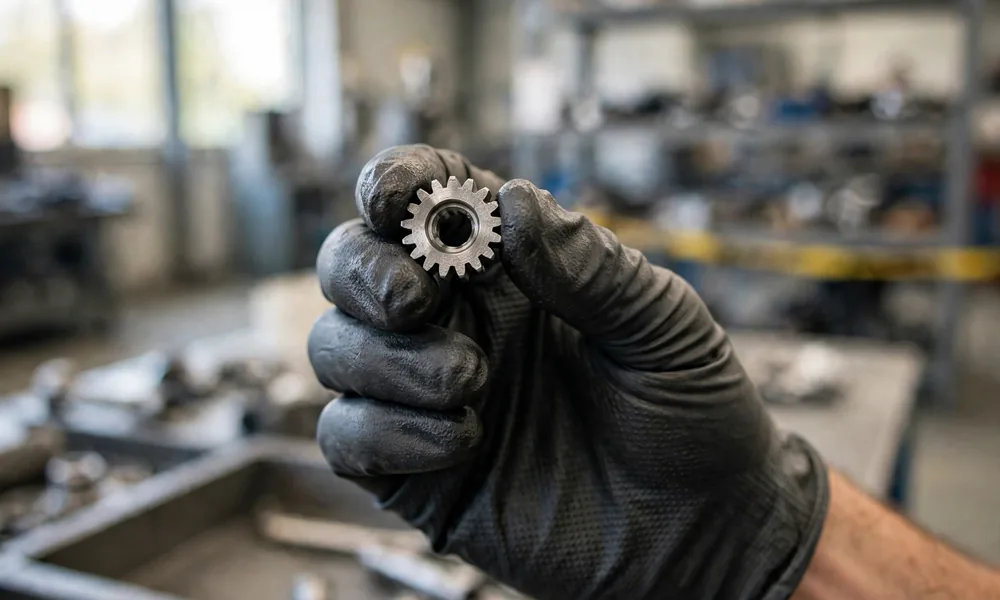
Hold a small steel gear from a watch, a surgical instrument or a firearm, and turn it over in your fingers. It is too small to machine cheaply, too complex to stamp, and too precise to cast in a mould the ordinary way. Yet it exists by the millions, identical to the last, with teeth and holes and curves that look as though they were carved by hand. It was not carved at all. It was injected, like plastic, then baked in a furnace until the plastic vanished and only metal remained. That is metal injection moulding, and it is how the smallest, most intricate metal parts in the world are made.
Metal injection moulding, known as MIM, borrows its core idea from plastic injection moulding, a process perfected over decades for making cheap, complex shapes in huge numbers. The trick is to mix fine metal powder with a plastic binder until the mixture flows like toothpaste, inject it into a mould, and then remove the binder and sinter the metal powder into a solid part.
The Materials Behind the Process
The heart of MIM is the metal powder, and it must be extremely fine, with particles typically between five and twenty microns across, about a fifth of the width of a human hair. Stainless steel is the most common choice, especially the 17-4 PH grade used for surgical tools, firearms and watch parts, but the process also works with low-alloy steels, titanium, nickel alloys and even tungsten for parts that must survive extreme heat. The powder is made by atomising molten metal, spraying it into a gas or water jet that shatters it into tiny droplets that freeze into near-perfect spheres
The binder is the unsung hero of the process. It is a mixture of waxes and polymers, often including polyethylene and paraffin, that holds the metal powder together and lets it flow like plastic when hot. The binder makes up roughly a third of the mixture by volume, and every gram of it must later be removed without disturbing the shape of the part. That removal, called debinding, is the most delicate stage of the whole process, and it is where most failures happen.
Size is the great limit of MIM. The process shines for parts under about a hundred grams, roughly the weight of a small apple, where machining would waste most of the material and take far too long. Larger parts are possible but become harder to debind evenly, and the cost advantage over machining shrinks. That is why MIM dominates the tiny and the intricate: metal 3D printing competes for the same parts in small numbers, but for runs of thousands or millions, MIM is usually the cheaper way to make them.
Step 1: Mixing the feedstock
Metal powder and binder are mixed in a heated kneader, much like dough in a bakery, until the powder is evenly coated and the mixture is uniform. The feedstock that emerges is a grey, putty-like material that is cooled and chopped into pellets, ready for the injection machine. The ratio is critical: too much binder and the part shrinks unevenly in the furnace, too little and the mixture will not flow into the mould. A good feedstock flows smoothly, holds its shape when cool, and contains the same proportion of metal in every pellet.
Step 2: Injecting the green part
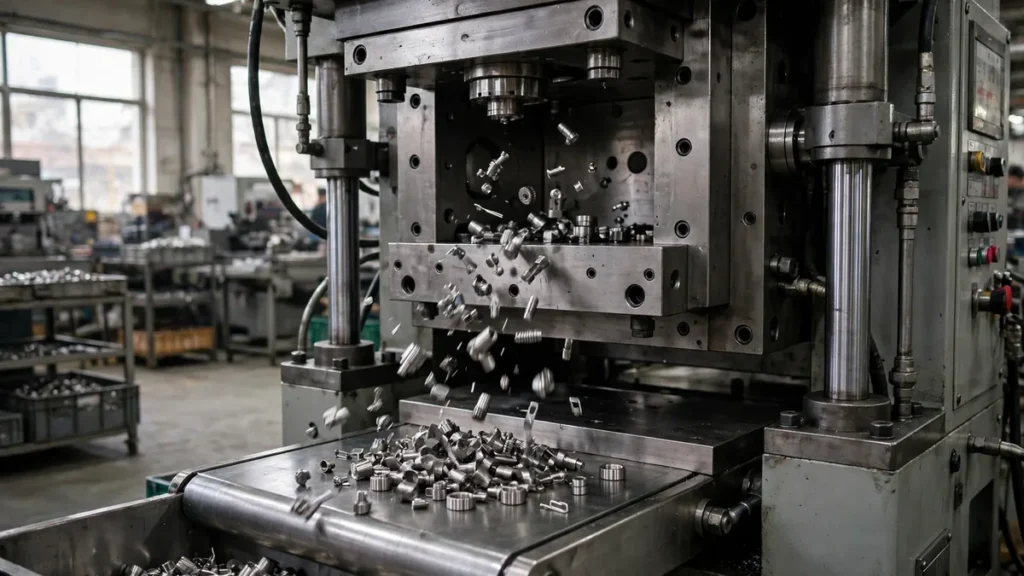
The pellets are heated and injected into a steel mould under high pressure, exactly as plastic parts are made. The mould is a precision tool in its own right, machined to account for the shrinkage that comes later, since the finished part will be fifteen to twenty percent smaller than the moulded one. The part that comes out of the mould is called the green part, and it is fragile, a mixture of metal powder held together by wax, strong enough to handle carefully but weak enough to crumble if dropped.
Step 3: Debinding the binder away
Debinding removes the binder in two stages. First, the green part is soaked in a solvent that dissolves the wax component, leaving a network of open pores through the part. Then it is heated slowly in a furnace, where the remaining polymer binder burns away as vapour through those pores. What remains is the brown part, a fragile skeleton of metal powder held together by the lightest of bonds.

Step 4: Sintering into solid metal
The brown part goes into a sintering furnace, heated to just below the melting point of the metal, typically around 1,300 degrees Celsius for stainless steel, in a protective atmosphere of hydrogen or vacuum. At that temperature, the metal particles fuse together at their contact points, and the part shrinks by fifteen to twenty percent as the empty space between particles closes up.
Step 5: Inspection and testing
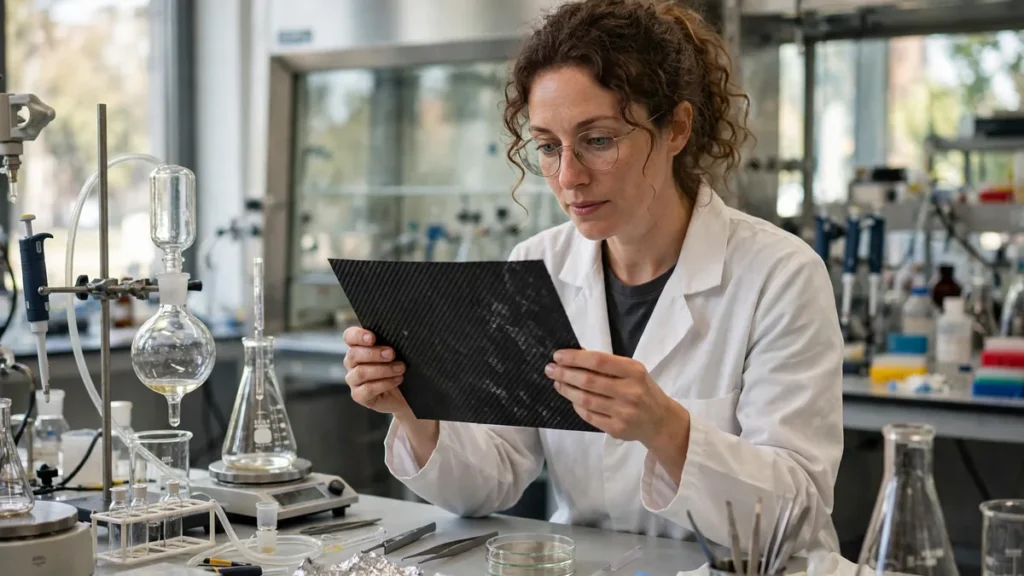
Every batch of MIM parts is inspected for density, dimensions and strength. Samples are weighed and measured, checked under a microscope for porosity, and tested to destruction to confirm they meet the specification. Parts for medical and aerospace use are inspected even more strictly, with X-rays or computed tomography checking for hidden voids inside the metal.
Specifications
| Powder size | Approximately 5 to 20 microns |
| Common metals | Stainless steel, low-alloy steel, titanium, nickel alloys |
| Binder content | Approximately one third of the mixture by volume |
| Part weight range | Typically under 100 grams |
| Shrinkage in sintering | Approximately 15 to 20 percent |
| Sintering temperature | Approximately 1,300 degrees Celsius for stainless steel |
| Final density | Approximately 96 to 99 percent of solid metal |
| Production volume | Thousands to millions of parts per run |
Price
Metal injection moulding is expensive to start and cheap to run. A single mould can cost from around $10,000 to $50,000 (estimate), but once it exists, each part can cost pennies to a few dollars depending on size and metal, far less than machining the same shape from solid bar. That is why the process is chosen for high volumes: the mould pays for itself quickly, and every part after that is nearly pure profit compared with the alternative. For a run of a few hundred parts, precision CNC machining is usually cheaper
Rare Fact
The first metal injection moulded parts were made in the 1970s, but the process only took off when the firearms industry adopted it for triggers, hammers and sights. Today, the tiny metal parts inside a smartphone, a medical implant and a luxury watch may all have been made the same way, injected as a waxy grey putty and baked into solid steel, and most of the people who use them every day have never heard of the process that made them.
The next time you hold a small, intricate metal part and wonder how anyone could have made something so complex so cheaply, remember the journey it took: metal powder finer than dust, mixed with wax, injected into a mould, stripped of its binder and fused in a furnace at 1,300 degrees. It is a process that turns powder into precision, found everywhere from superalloy castings to the smallest gear in a watch.